
By Justin Wiggins
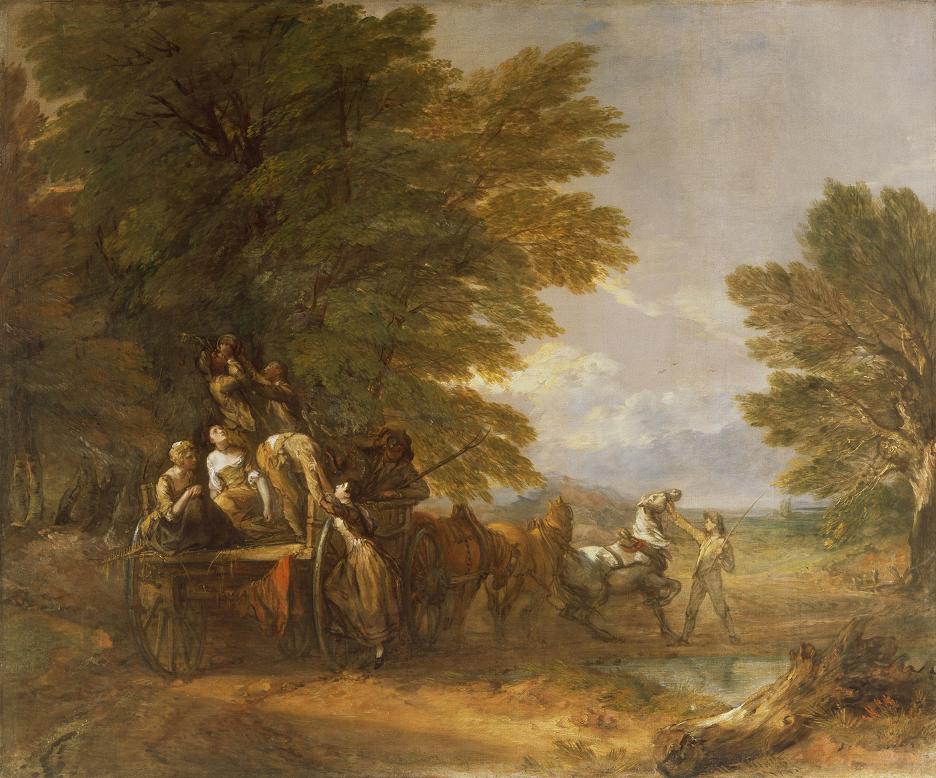
The landscape style in many seventeenth-century Dutch paintings honored the more realistic view of life, which included everyday people going about their everyday jobs. Gainsborough, inspired by his local surroundings, was attracted to this style of Dutch landscape from the previous century. This is noticed in his 1767 painting, The Harvest Wagon, in which a group of peasants travel in a wagon and are led by multiple horses. This scene is very different from the ideal "Italian" landscape. For example, Claude’s Landscape with Apollo and the Muses (1652) portrays a river god lounging on a section of land while the muses joyfully gather at a clifftop. But in The Harvest Wagon, the characters are normal; they don’t have any mystical abilities. They are on their way somewhere, so they aren’t lounging. A young man is seen helping a woman onto the wagon while a younger person handles the horses up front.
This increased craving to relate to art can be paralleled with what other artists created. One of these poets is Wordsworth, who used common language in his works. In the preface to his and S. T. Coleridge's Lyrical Ballads, Wordsworth warns the reader that they will have difficulty appreciating the poems if they are looking for poetic, gaudy language. He aimed to take ordinary people and how they spoke to highlight their way of life.
Between the years 1805 and 1815, the Dutch preference was solidified due to the war that Britain was waging against the French. Their win against the French resulted in them having to depend on their natural resources, which, in turn, meant that the agricultural professions were viewed as more critical. This burst of appreciation for the landscape was then reflected in the art of the time.