
In this exhibit you will see four images illustrating the dark past of children diagnosed with learning disabilities in the 1800s and 1900s. The first public schools in Pennsylvania were opened from 1818 to 1834, but intellectually disabled children were not allowed to attend public school with neurotypical children. Instead, intellectually disabled children were committed to state institutions, sterilized, segregated and sometimes even killed for their harmless differences. It was not until the landmark case of 1972, known as Pennsylvania Association for Retarded Citizens (PARC) v. Commonwealth of Pennsylvania, was it decided that Pennsylvania could not deny an individual's right to equal access to education based on an intellectual or developmental disability status.
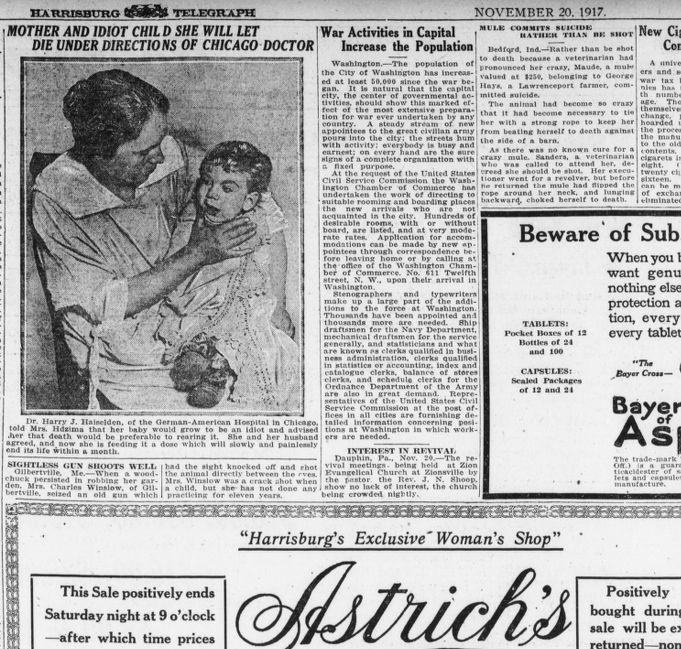
1. Mother and Idiot Child she will let Die - The mother pictured in the Harrisburg newspaper clipping published in 1917 was told by Doctor Harry Halneiden that her son would grow to be an “idiot”. The mother was advised that death would be a more suitable option for the child. Not only was it deemed a necessary approach to kill children with intellectual disabilities in the 1800s and 1900s, but Doctors were encouraged to do so. In America, children diagnosed with an intellectual disability were not only segregated from neurotypical school children but sometimes killed for their differences.
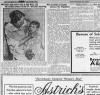
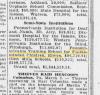
2. The Bill for Sterilization of Idiots - The 1917 Harrisburg newspaper clipping states that Pennsylvania will continue to reintroduce a bill that will allow for the sterilization of “idiots, imbeciles and feeble-minded.” 10 short years later, the United States Supreme Court decided to uphold a state's right to forcibly sterilize a person considered unfit to procreate. This decision allowed for thousands of mentally defective children to be sterilized. Americans believed that intellectually disabled children were uneducable, which is why they were segregated from public schools, and would reproduce an abundance of “idiots, imbeciles and feeble-minded” individuals to increasingly threaten civilization with degeneracy.
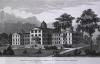
3. The Pennsylvania Training School for Feeble-Minded Children - Founded in 1852, Elwyn was one of the first American schools for children with intellectual disabilities. The Pennsylvania Training School for Idiotic and Feeble-Minded Children was a semi-state institution and received immense funding, as shown in the Harrisburg newspaper clipping from 1919. Despite various barbaric treatment methods performed from 1890 to 1930, such as sterilizing several hundred children, Elwyn is still open to this day and has played a fundamental role in societal acceptance and treatment of those with intellectual disabilities.
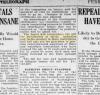
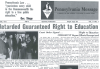
4. Retarded Guaranteed Right to Education - A call for change did not take place until the early 1970s. The Pennsylvania newspaper clipping from 1972 reports the decision made in the landmark case, Pennsylvania Association for Retarded Citizens (PARC) v. Commonwealth of Pennsylvania. It was decided in this case that Pennsylvania could no longer deny an individual's right to equal access to education based on an intellectual or developmental disability status.