
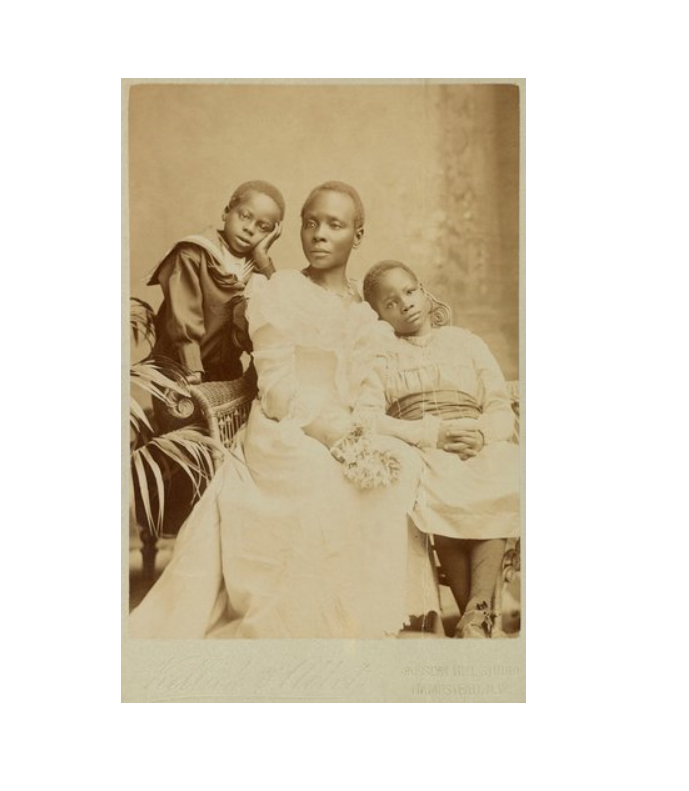
Elsewhere in the collection, a photograph of Sarah Forbes Bonetta speaks to a unique relationship between Queen Victoria and colonization. Bonetta was adopted by the Queen as a goddaughter, and her daughter, Victoria Davies, was subsequently adopted by Queen Victoria as well. The photo above is an image of Victoria in her adulthood and highlights fascinating intersections of colonialism, Victorian ideals of womanhood, and the ways in which class impacted Victorian depictions of Black women.
The photo of Victoria, taken sometime in 1901 (Royal Collection), presents an image of regality as well as motherhood. Her dress is fashionable for the era, featuring a delicate frilled sleeve and feminine fabric, possibly muslin, a popular choice at the turn of the century (Shrimpton 28). The white color of the dress, as well as the small bouquet she holds in her hands, both suggest images of bridal innocence and femininity, an interesting decision given her age at the time the photo was taken. She sits comfortably in a chair, with one of her children leaning on her shoulder and the other resting their head in their hands behind her. One of Victoria’s arms is hidden behind her daughter, perhaps wrapped around her out of frame. Her daughter, Beatrice, wears a white smock dress with a wrap around the waist, a fashionable style for young girls at the turn of the century (Shrimpton 55). Her son’s clothes appear to be modeled after the sailor-style for boys, which was in vogue throughout the last few decades of the nineteenth century (49).
The way Victoria is framed in the photo alludes to the “Black Victoria” trope, a representation of Black womanhood which aligned with Victorian standards of womanhood and intersected with colonialism. With Victoria in the center of the frame and her children leaning toward her on either side, the photograph emphasizes family and motherhood. Her daughter seems to be leaning on her shoulder, her legs crossed comfortably underneath her. The Victorian era placed significant emphasis on women’s roles as mothers, and the cult of domesticity was widely accepted as the natural way of life. Victoria’s framing in the photo emphasizes her status as a mother before anything else, and her white dress signifies a sort of delicate femininity which the Victorians prioritized.
Victoria’s portrait has an interesting tangentiality to colonial photography, as she and her mother were subjects of colonization by the British empire, but the photograph itself speaks to her elevated status as a goddaughter of the Queen. Victoria’s mother was taken from Africa and assimilated into British society by the Queen herself, and portraits of her highlight the extent to which she was brought into upper English society. Similarly, Victoria’s portrait is elegant and does not resemble the fetishistic, sexualized images of African women which were increasingly common during the nineteenth century. Victoria left England in her adulthood and spent much of her life in Lagos, Nigeria. The photograph itself was taken in London in 1901 (Royal Collection Trust), perhaps when Victoria brought her children to visit with the Queen around 1900 (LitCaf Encyclopedia). In that sense, the photo does not have the same voyeuristic qualities which many of the colonial photographs from the period did, since the photographer did not travel to Africa with the sole purpose of ‘studying’ African people. Nevertheless, the contextual colonization which brought the picture into existence cannot be ignored, as Victoria and her mother Sarah Forbes were both women of color whose lives were directly impacted by colonization and forced assimilation into British society.
Certain elements of the portrait, such as her short hair and her facial expression, indicate her life in Nigeria and stand in contrast with British ideals of womanhood. Despite the delicate framing of the photo, Victoria’s facial expression signifies a sort of elegance and power which does not necessarily align with the submissive expectations for women in England. She looks off-camera and to the side, instead of looking directly down the lens, which gives her a regality and casual strength. She also wears her hair very short, while the English style at the time was to wear long hair up in intricate styles on the back of the head. Her hair has significantly more in common with Black women photographed in Africa at the time than with women who lived in Victorian England. Her hair speaks to a kind of visual decolonization, a clear departure from the expectations of the era.
This early twentieth century portrait of Victoria Davies Randle highlights fascinating contradictions and intersections between colonialism, class, and Victorian ideals of womanhood. The framing of the photo in some ways embodies the “Black Victoria” archetype, while her non-Western hairstyle engages with visual decolonization. The portrait both subverts the fetishistic nature of colonial photography by portraying Victoria as simultaneously powerful, regal, and feminine, while also reinforcing imperialist structures of assimilation.
Works Cited:
Carlson, Shirley J. “Black Ideals of Womanhood in the Late Victorian Era.” The Journal of Negro History, vol. 77, no. 2, 1992, pp. 61-73.
“Mrs Victoria Randle with her two children.” Royal Collection Trust, https://www.rct.uk/collection/search#/1/collection/2915313/mrs-victoria-randle-with-her-two-children.
Shrimpton, Jayne. Victorian Fashion. Shire Publications, 2016.
Photo via Royal Collection Trust, London: Killick & Abbot.
“Victoria Davies.” LitCaf Encyclopedia, https://litcaf.com/victoria-davies/.