
The topics of play and childhood rapidly received attention in the Victorian period, with Stevenson’s A Child’s Garden of Verses providing an example of a new way to conceptualize childhood. The ‘garden’ might be understood as the transitional space between childhood and adulthood. Webb discusses the significance of Stevenson’s title:
The garden is an extension of the enclosed domestic space of the house, where there is safety, but also the space for free and imaginative play. It can be a place of adventure, discovery, pondering, and engagement with the outside world. Growth, change and an awareness of the cycles of nature are also part of the life of a garden, and of those who tend and nurture the plants and create the landscape of the garden as an entity. (360)
According to Webb’s interpretation of childhood and play in A Child’s Garden of Verses, when Prince Dolor uses his cloak, he is participating not only in imaginative play but also in the growth and maturity the space of the ‘garden’ provides. Through his godmother’s gifts, the prince learns to exercise his imaginative capabilities, developing empathy and sentimentality through his surveillance of nature and the shepherd boy. He learns the essential qualities needed for kingship, but he also observes the revolution while using his cloak, a critical event that initiates his return to the throne.
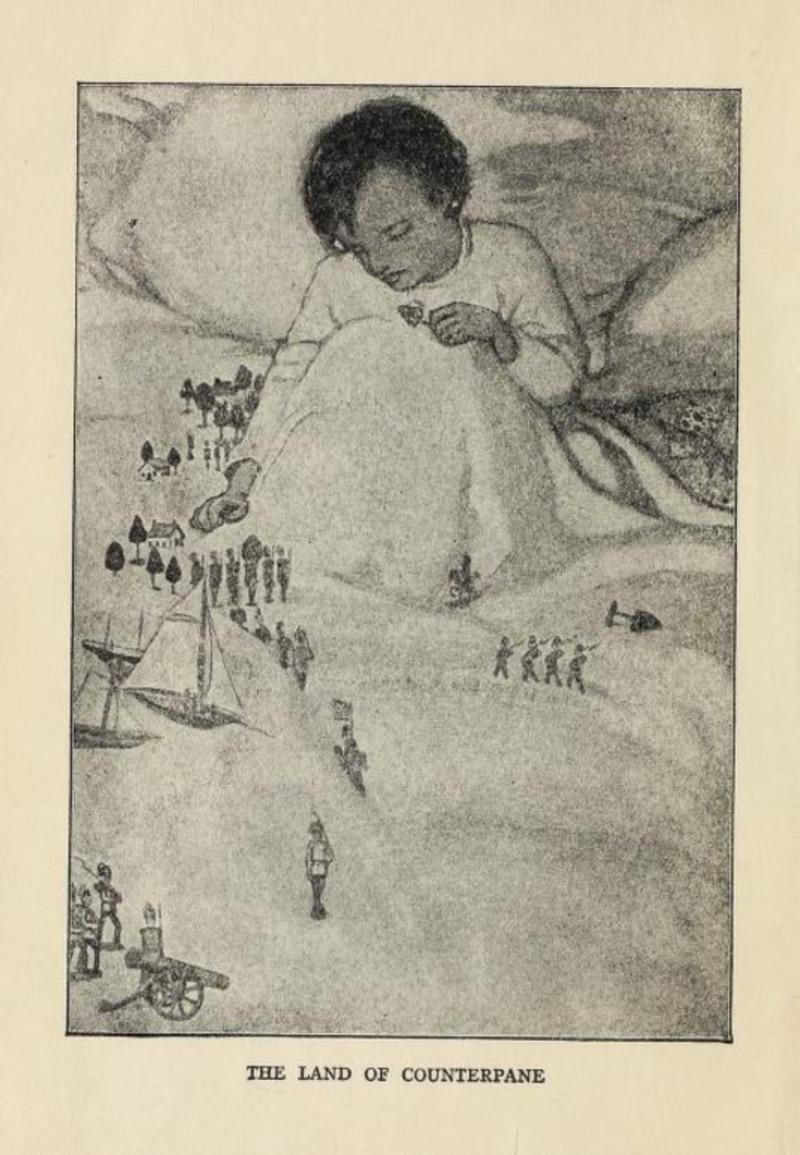
The image is taken specifically from the poem “The Land of Counterpane,” about a young, sick, bedridden speaker engaging in imaginative play. The speaker “watched [his] leaden soldiers go” (line 6), and his bedclothes are described as hills (8), thus participating in imaginative play similar to the prince when he is using his cloak. Through play, the speaker can bring himself joy even in his sickness, much like how the travelling cloak allows Dolor to leave the domestic space of the tower. Craik, however, indicates some limitations to the imagination. The Godmother’s gifts, though enhancing Prince Dolor’s imagination and mobility, do not allow him to overcome his isolation. Though the time spent using the travelling cloak is inarguably conducive to his growth, the prince cannot overcome his isolation until he is faced with five days utterly alone in his tower. Thus, while it seems Dolor is participating in Webb’s conception of childhood maturity through the ‘garden,’ he cannot fully do so because he lacks an environment conducive to growth, having to look beyond the imagination for a means to maturity.
sources:
Stevenson, Robert Louis. A Child's Garden of Verses. Copp Clark, 1918. Internet Archive, https://archive.org/details/childsgardenofve00stev_5/mode/2up.
Webb, Jean. "Conceptualising Childhood: Robert Louis Stevenson's A Child's Garden of Verses." Cambridge Journal of Education, vol. 32, no. 3, pp. 359-365, 10.1080/0305764022000024203.