
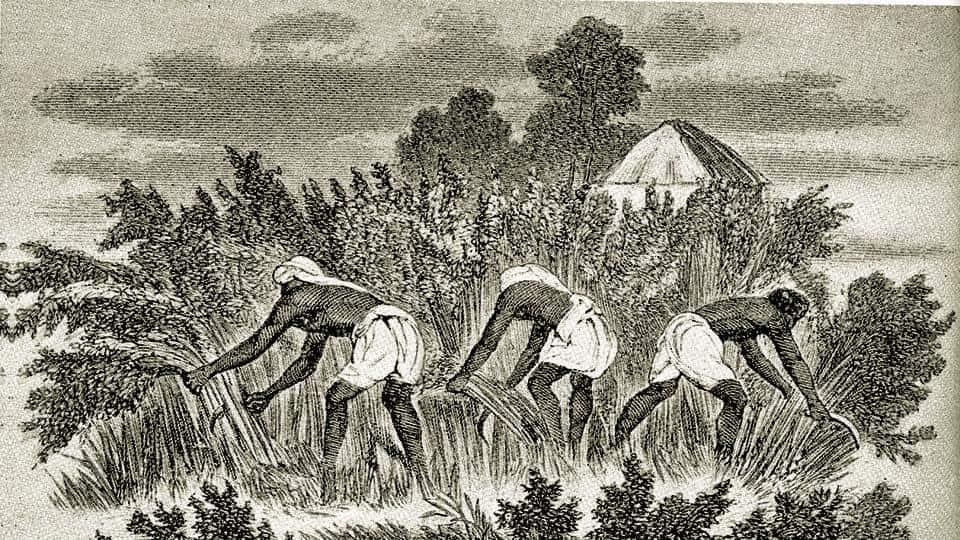
Indigo is a dye produced and used in the largest amounts in the world. Indigo (a plant) was cultivated and used for dying during the Indus Valley Civilization, which is about 5300-2500 years ago. The Portuguese and Greeks were the first to transport this dye from India to Europe and they had the monopoly in its trade until the British got interested in this commodity; it also fitted well with British cotton industry and trade. In the 19th century, the number of British indigo planters gradually increased. They mercilessly pursued the peasants to plant indigo instead of food crops. They provided loans called dadon at a very high interest rate. Such loans could keep a farmer in debt for a whole life; and if he remained insolvent, the loans were passed to his children. In 1857, the slavery and forced cultivation of indigo led to the "Indigo revolt", a peasant movement and subsequent uprising of indigo farmers against the indigo planters that arose in large parts of the districts of Burdwan, Bankura, Birbhum, and Bengal.
The history of indigo reminds us of the presence of the British Empire in Because I am a Woman. In particular, it suggests that British colonization had a dual effect on Indian society. While some may argue that the colonial government "helped" to destabilize controversial traditions such as sati and imported modern ideas of female education (both of which had a material impact on Sen's fate), we should not neglect the dark side of the story. The motive of colonizers was essentially a pursuit of self-interest. They brought in forced labor, usury, and economic distress (due to widespread poverty and trade deficit). The presence of British colonization had an ironic impact on Sen's life story. One the one hand, her life was probably saved from sati by the Sati Regulation Act and her first full-time employer was funded by the government. On the other hand, it was possible that her unfortunate marriage was in part an indirect result of colonization--the famine that increased her family's burden was perhaps caused by the reduction of food crop production. From this perspective, we appreciate the fact that one's life story is not a stand-alone effect, but bears an indelible mark of certain historical context.
Sources:
Prasad, Rajendra. "Indigo — The Crop that Created History and then Itself Became History". Indian Journal of History of Science, vol. 53, no. 3, 2018. https://pdfs.semanticscholar.org/c1ff/8c89895043e63941e93d16bcceb005ad9…. Accessed 21 Feb. 2021.
https://www.hindustantimes.com/india-news/remembering-the-first-satyagr…. Accessed 21 Feb. 2021.