
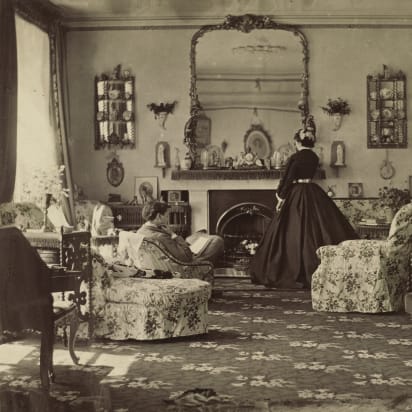
A significant technological advancement in the early 1830s was the invention of photography. Fox Talbot, a British inventor, was the first to create a photographic image that did not instantly fade in 1834. These portraits were initially reserved for the very wealthy, and many people who appear in early photographs seem stoic or angry. At the time, a photograph was viewed as a professional event meant to capture your natural appearance so that your descendants would remember what you looked like, since they were so costly to produce. Likely, the Brooke family would have been early to this trend of photographed self portraits. The Brooke sisters would have been from the first generation of wealthy people that had themselves captured in true form, rather than artistic rendering. In addition, the invention of photography would have represented another industrial creation that would have deepened the gap between wealthy and poor, and the quality of life attainable by the different social classes in Victorian times.
Invention of photography. (n.d.). Retrieved September 15, 2020, from https://www.bl.uk/learning/timeline/item106980.html