
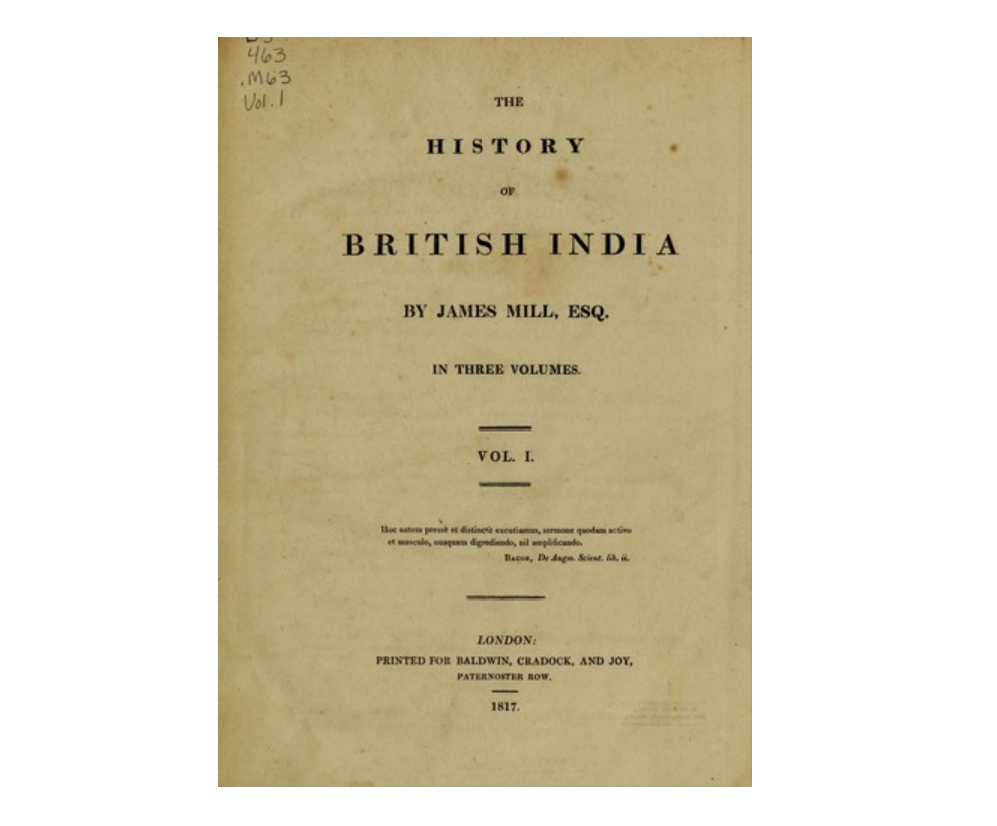
The History of British India was published in 1817 and aimed at being an historical and political philosophy study. James Mill introduces his work, in its preface, as a “critical history”. Indeed, he analyses and criticizes for instance the Sati, the Hindu tradition in which the widow immolating herself if her husband dies, that is banned by the way in 1829. It seems like Mill follows Francis Jeffrey’s concept of semi-barbarism. Actually, this way to judge the culture he studies have been denounced later. Mill uses political theory to depict the civilizations of India, his purpose is to drive his reader to draw more general lessons about men, reason, etc. It is to some extent a work of philosophical history. Moreover, James Mill puts forward some potential political reforms or guidelines in its book: beginning in India with an improving of agriculture and securing social freedom. In addition, he was against the idea of the British government at the time to rule India as a commercial society. With Bentham’s ideas in mind, he considered that Indian society should not be reformed as European countries were, and could follow a new road.
This book is cited in J. S. Mill’s Autobiography, in passages concerning his father and his education. J. S. Mill had obviously read The History of British India and made its own comment on the book in the Autobiography. Moreover, it is useful to have in mind that he was himself a colonial administrator at the East India Company, between 1823 and 1858, thus he had later its own history with India and its colonization.
Sources:
The text is in the public domain: The History of British India in 6 vols. (3rd edition) (London: Baldwin, Cradock, and Joy, 1826). https://oll.libertyfund.org/title/mill-the-history-of-british-india-6-v…
Naik, J. V. “INSTANT INDIAN NATIONALIST REACTION TO JAMES MILL'S ‘THE HISTORY OF BRITISH INDIA.’” Proceedings of the Indian History Congress, vol. 63, 2002, pp. 587–595., www.jstor.org/stable/44158125. Accessed 21 Feb. 2021.
JAMES MILL'S HISTORY OF BRITISH INDIA IN ITS INTELLECTUAL CONTEXT By Jeng-Guo Chen A Thesis Submitted for the PhD Degree The University of Edinburgh 2000.