
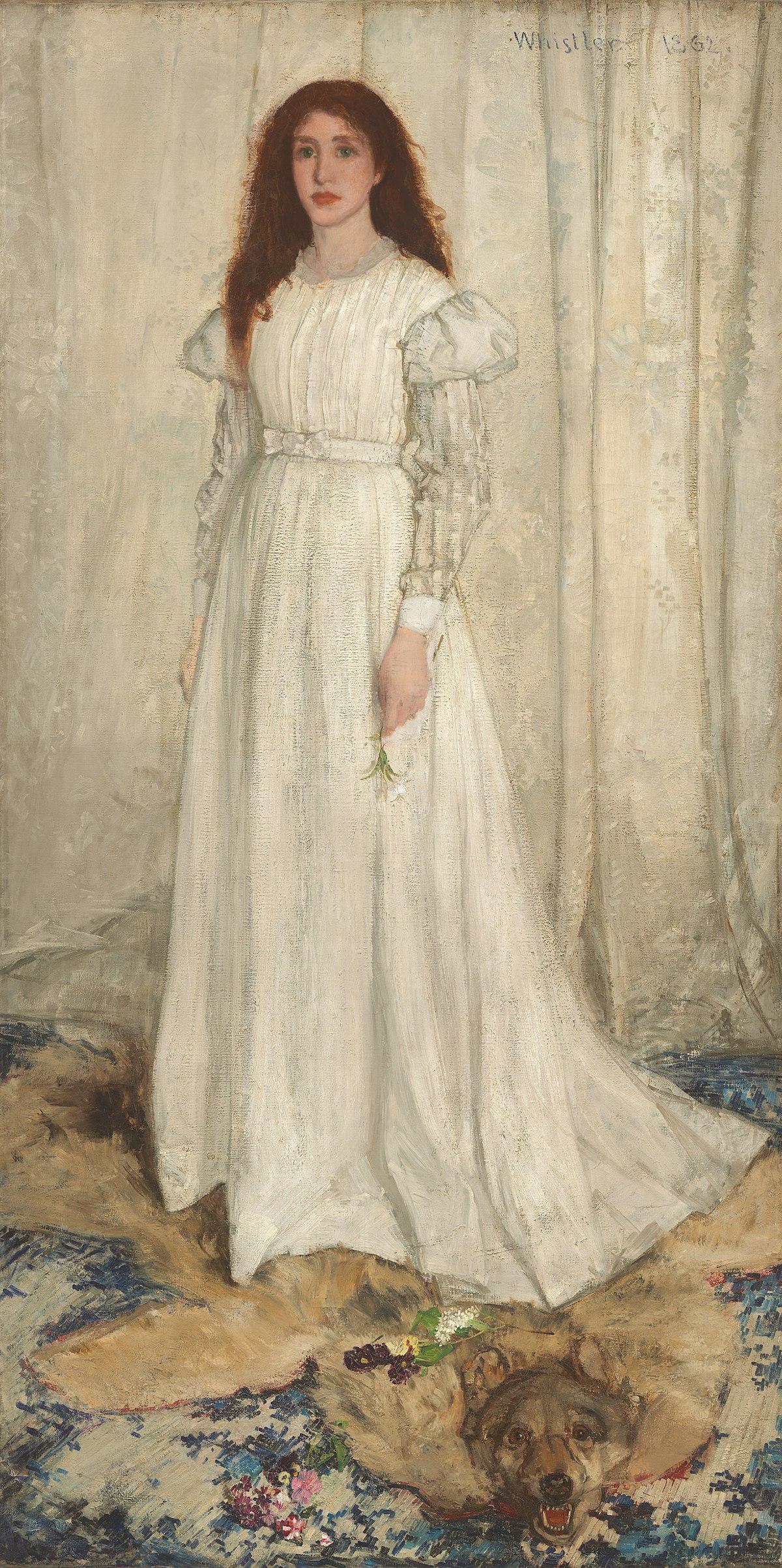

I absolutely adore this woman’s attire. I am tired of constantly wearing corsets and tight clothing, restricting me from doing practical tasks. This woman’s dress flows without any stiffness, allowing for more movement unlike the typical dress that we women are forced to wear each day to look “put together” and “elegant” for the men in our society. Why must we struggle in discomfort to impress these men when they do not have to do the same for us? The tightness of the dresses we wear to display our figure forbid us from doing many activities, restraining each of our movements. A dress like the one in James Whistler’s piece is much more reasonable. I think it is time for more women to dress in whichever way they feel is most comfortable. There is no reason we should be wearing these dresses that continuously restrict us. There is currently a movement started by artists and writers against the traditional corsets and rigid clothing. The clothing that they are encouraging our society to wear reminds me of the medieval times when women were not limited to the duties of the household. They were involved with their family’s business, and as a result, they wore less restrictive clothing to allow for performing more tasks. As more of us are leaving the household and moving toward an independent life to provide for ourselves, it is only efficient for us to wear more practical clothing for additional freedom. We have no one to impress except ourselves, so why should we wear those tight dresses with such intricate designs? The simpler option is the more practical. This is the perfect addition to my Commonplace Book as I look for more attire to add to my wardrobe!
Editorial Commentary: This art piece by James Whistler demonstrates the change in fashion for women during the Victorian Era, especially towards the end. During the Victorian Era, most women wore corsets and very tight dresses to emphasize their figure and appear more dignified and feminine to society. However, the dresses that they had to wear were very uncomfortable and more for show rather than practicality. In the late 19th century, the Aesthetic Movement emerged, which changed fashion. The inspiration for the clothing came from the medieval times when women wore clothes that were more loose and simple in order to allow them to perform everyday activities (Monet). Due to this woman's commentary on the new fashion, I would consider her a New Woman. The New Woman would be in support of this change in fashion because women are able to wear clothing that is most functional for them instead of wearing the normal attire that is expected from them by society. It gives them a sense of freedom, not just physically due to the absence of the corset, but it also gives them freedom in that they are breaking away from the standard attire. In addition, the changes in gender roles during the late Victorian Era as the New Woman was introduced allowed more women to express themselves in the way they dressed. Although society wants women to dress conservatively and gracefully, New Women, like the one commenting on the dress, advocates for all women to break from this expectation and wear whatever is most feasible and desirable to them.
Citation:
Monet, Dolores. “Fashions of the Aesthetic Movement: A Cult of Beauty and Victorian Counterculture.” Bellatory, 13 January 2020, https://bellatory.com/fashion-industry/FashionsofTheAestheticMovementAC…. Accessed 16 November 2020.
Whistler, James. Symphony in White, No. 1: The White Girl. 1862. National Gallery of Art, https://www.nga.gov/collection/art-object-page.12198.html.