
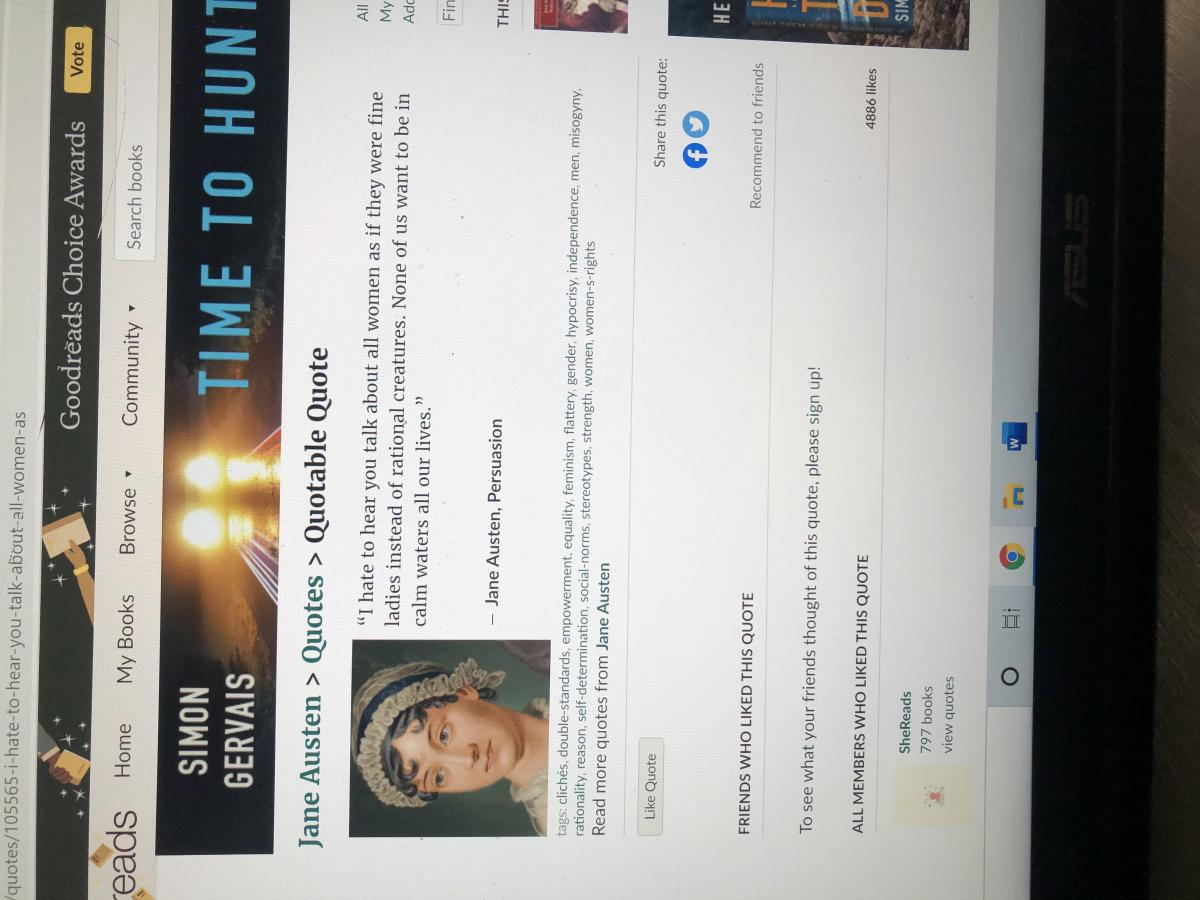

The New Woman: What a powerful, inspiring thing Ms. Jane Austen has said. I emphasize “Ms.”, as she turned down a chance at marriage a multitude of times. I feel as though that is an avenue not taken nearly enough in this day and age. For centuries, women have grown and matured with one societal goal in place: marriage. From birth, we know what our future holds. Some of us attend school. Some of us stay home and help around the house. Which path we take does not matter, for all of us end up as property the day we marry. Now, marriage is not an issue. Finding a lifelong partner is part of life, and I do not believe it should be eliminated or even looked down upon. The problem is the way men, and some women, look upon our sex as helpless, as pitiful, as inferior. These sexist assumptions could not be further from reality. While it is true that in most cases men are physically stronger than women, this has no correlation to our mental strength. Women are tired of being looked upon as too weak to handle life outside the confines of our homes. We wish to make mistakes. We yearn to explore the unknown. This quote embodies the feelings of entrapment women have. The feeling that there is no future to look forward to, no change in our lives. No longer will we sit tight-lipped. As Ms. Austen said, we no longer want the comfort and calm parts of life. We can handle the roughest, choppiest waters life has to offer because we are women.
Editorial Commentary: Jane Austen was ahead of her time. As a writer around the turn of the 19th century, Austen was speaking out for the large-scale change of women’s rights and roles before the Feminist Movement had begun. She was a pioneer. She never married, even though she was approached for a long-term commitment six times. She embodied her writing. The above quote comes from her book Persuasion. The first thing that catches my eye is Austen’s word choice of “hate”. She could have used other phrases to describe her distaste. However, her use of hate is intentional. To hate is to completely despise someone or something and everything it stands for, and Austen certainly feels this way towards the views and expectations of women. Women are treated as “fine ladies instead of rational creatures”. To describe any woman as a “fine lady” would seem like a compliment. Austen, however, views it as placing a limitation upon her sex. To Austen, a fine lady is mindless. She has no emotion, no opinion. She simply goes through the motions expected of her. Austen instead wants women to be viewed as rational creatures, as humans capable to make their own decisions. Women weren’t given this opportunity at all. Men placed women in a protective bubble, believing they were doing women good by this. In order to be treated as rational creatures, they must be allowed to be uncomfortable and make mistakes. Men have been allowed to discover, experiment, and learn since the dawn of time. Austen believes women deserve this same choice to choose their own destiny. This ideology embodied Austen, a New Woman before the New Woman existed. The New Woman relates to this quote. Victoria Era ideals for women included them playing the role as the mindless spouse, following her husband’s orders. Women were not expected to think for themselves; that was a man’s job. The New Woman knows she is equal to her male counterparts. The New Woman cares not to be a fine lady. The New Woman is a rational creature.
Austen, Jane. Persuasion. Open Road Media Integrated Media, 2015. EBSCOhost, search.ebscohost.com/login.aspx?direct=true&db=cat06564a&AN=uga.9915803074302931&site+eds-live.