
Introduction
Robert Louis Stevenson’s 1886 novella Strange Case of Dr. Jekyll and Mr. Hyde presents a story about a man, Dr. Jekyll, whose personality is split between two different extremes of the human condition. On one end lies the amiable and well-composed Dr. Henry Jekyll, while on the other is the deformed and savage Mr. Edward Hyde. Since its inception, this novella has inspired many direct and indirect adaptations that play off the duality of the human psyche. As a result, the characters of Jekyll and Hyde exist in modern tales, outside of Stevenson’s original novella.
In Andreas Reichstein’s 1998 article titled “Batman — An American Mr. Hyde?” Reichstein argues that the popular crime-fighting comic book superhero Batman is similar to the story of Dr. Jekyll in more than just a surface-level comparison. He states that “Besides all these formal similarities between Wayne and Jekyll, the essential link between these characters lies in their basic trait; their double identity, their double personality” (Reichstein, 343). By day, Bruce Wayne and Dr. Jekyll are benevolent men with a high stature in society. By night, their alter egos Batman and Mr. Hyde are dark figures who transcend the reaches of the law and natural order of society to carry out their darker tasks. Though both characters have very different backstories and motivators, Reichstein argues, they are more alike than we might think because of the split between different personalities.
This gallery is meant to explore the adaptations and lasting impact of Strange Case of Dr. Jekyll and Mr. Hyde through modern works, specifically in the comic format. Robert Louis Stevenson’s novella has seemingly influenced many modern characters, such as Batman, in its exploration of the duality of the mind. Direct adaptations of the work have showcased this division across different and reimagined characters, exemplifying how Jekyll and Hyde are portrayed outside of their source material.
Works Cited
Reichstein, Andreas. “Batman — An American Mr. Hyde?” Amerikastudien / American Studies, vol. 43, no. 2, Universitätsverlag WINTER Gmbh, 1998, pp. 329–50, http://www.jstor.org/stable/41157373.
Images in the Series
Fig. 1. Bowen, Carl, et al. The Strange Case of Dr. Jekyll and Mr. Hyde. Stone Arch Books, 2009.
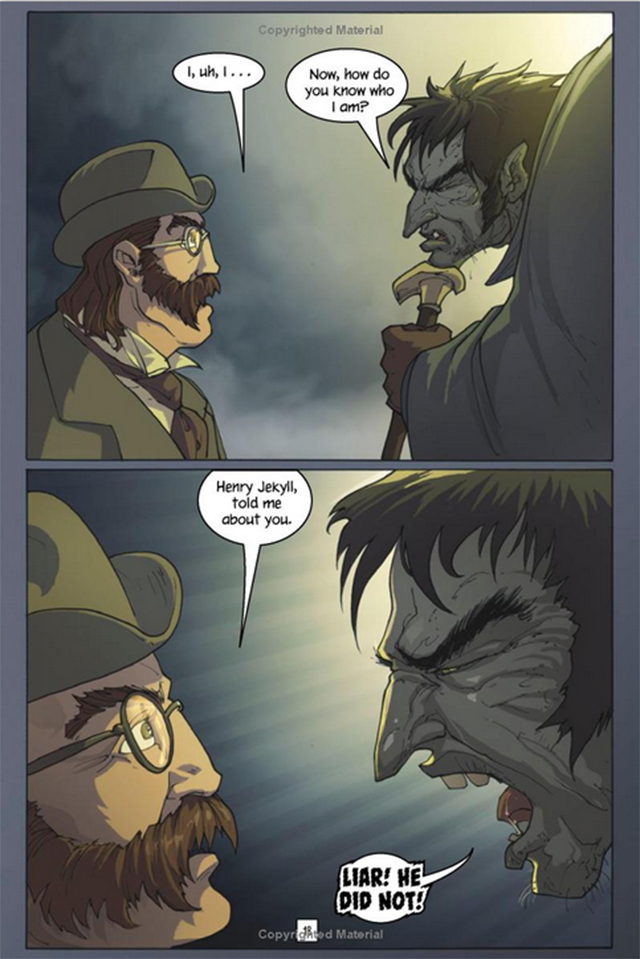
This image is from a comic book adaptation of Strange Case of Dr. Jekyll and Mr. Hyde, adapted by Carl Bowen and Martin Powell. It shows the confrontation between Utterson and Hyde early on in the story, where Utterson confronts Hyde near the door, and Hyde reveals his true self. This version of Hyde probably takes the most inspiration from the source material, which makes sense. Although Hyde isn’t pale, he does give off the “haunting sense of unexpressed deformity with which the fugitive impressed his beholders” (Stevenson). We see here that Utterson is speechless at the sight of Hyde; in the first panel he stutters, only saying “I, uh, I …” (Bowen) and exemplifying the “haunting sense” that Hyde impresses upon him. The illustrator, Daniel Ferran, leans into Hyde’s “deformity” through his long, pointed nose and pointed ears, suggesting that Hyde is other than human. Furthermore, his unkempt hair, the scattered stubble on his chin, and pale, olive-grey skin tone only furthers this idea of Hyde appearing almost “troglodytic” (Stevenson).
Fig. 2. Sable, Mark, et al. Two-Face: Year One, DC Comics, New York, NY, 2008, p. 39.
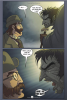
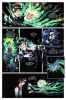
This image is taken from the second issue of Two-Face: Year One, a DC Comics miniseries about the Batman supervillain named Two-Face. Harvey Dent was District Attorney of the fictional city of Gotham before a criminal threw acid in his face, leaving him horribly scarred and driving him insane; thus Two-Face was born. Two-Face clearly takes heavy inspiration from both Dr. Jekyll and Mr. Hyde. Aside from being obsessed with duality, Harvey Dent is the more composed and “dapper” of the two personalities, capable of showing restraint and class like Dr. Jekyll, meanwhile Two-Face is much more irrational and violent like Mr. Hyde. This image shows the different sides of Two-Face and how he is portrayed in the comics form. Stevenson wrote that Mr. Hyde “spoke with a husky, whispering and somewhat broken voice” (Stevenson) which is visually shown here when Two-Face’s left half, the more sinister half, speaks. The green text against the frayed speech bubble visually communicates to the reader that this half of Two-Face is more deranged and more like Mr. Hyde. This contrasts the more common black-on-white speech bubbles of Two-Face’s right half, which resemble a Jekyll-like personality.
Fig. 3. Moore, Alan, et al. League of Extraordinary Gentlemen. Graphitti Designs, 2015, p. 31.
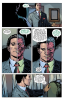
This image is from a page of Alan Moore’s League of Extraordinary Gentlemen, a comic book series that takes characters from famous fiction novels of the 19th century and puts them all into an adventure together. On this page, we see an ape-like Mr. Hyde emerged from the darkness of a doorway, saying “Huhuh, Henry isn’t home. I’m Edward” (Moore, 31). This depiction of Mr. Hyde departs from Stevenson’s original description of Hyde, which describes him as “pale and dwarfish.” Instead, Moore focuses on making Hyde appear more like a monster. However, it’s clear that Moore still took inspiration from the source material, focusing instead on some of the smaller details and emphasizing them in his own work. He takes Hyde’s “ape-like fury” and quite literally transforms him into an ape-like monster. Moore also shows his version of Hyde brandishing the “heavy cane” as his weapon, the same cane that was used to kill Sir Danvers Carew, as mentioned in the chapter titled “THE CAREW MURDER CASE” in Stevenson’s original novella.
Fig. 4. Cotugno, Sabrina. The Glass Scientists, 2016, https://www.theglassscientists.com/comic/page-37.
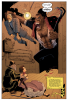
This is an excerpt from a webcomic called The Glass Scientists. This webcomic takes the iconic characters of Dr. Jekyll and Mr. Hyde and creates a reinterpretation of Stevenson’s original novella, but also includes other characters and references from gothic and classic literature. This interpretation of Edward Hyde sees him appear more human than in any other adaptation we’ve examined thus far. He appears pale, as Stevenson originally described him, but he lacks any kind of deformity or features that would normally make him appear more monstrous. In fact, this Hyde is more like a visual variant of Jekyll, with very similar facial features and few differences, like jagged teeth and blonde, unkempt hair. Aside from visual differences in the two characters, we see the Hyde's dialogue and speech bubbles are different from the usual comic-standard speech bubbles, which are normally a white bubble with black lettering and a black outline. For Hyde's dialogue, we see that his speech bubbles are portrayed through white text against a black, shadowy background. This departure of speech bubbles shows the reader how Hyde is more sinister than Jekyll through the color association of his speech bubbles being black, rather than white. Also, since Hyde's speech bubbles lack any clear outline to them, it also symbolizes an internal dialogue taking place within Jekyll's head, furthering this issue of an ongoing mental battle between Jekyll's two personalities. In Stevenson's novella in the chapter titled “HENRY JEKYLL’S FULL STATEMENT OF THE CASE,” Jekyll writes, “It was on this side that my new power tempted me until I fell in slavery” (Stevenson). This quote is exemplified among these panels as Hyde continues to tempt Jekyll into allowing him to take over the body. Literally, we see Jekyll slowly becoming ensnared and suffocated by Hyde’s influence until the very last panel where, free of all bonds, he appears exhausted to the point of giving in to Hyde’s demands and falling to “slavery” of Hyde’s will.