
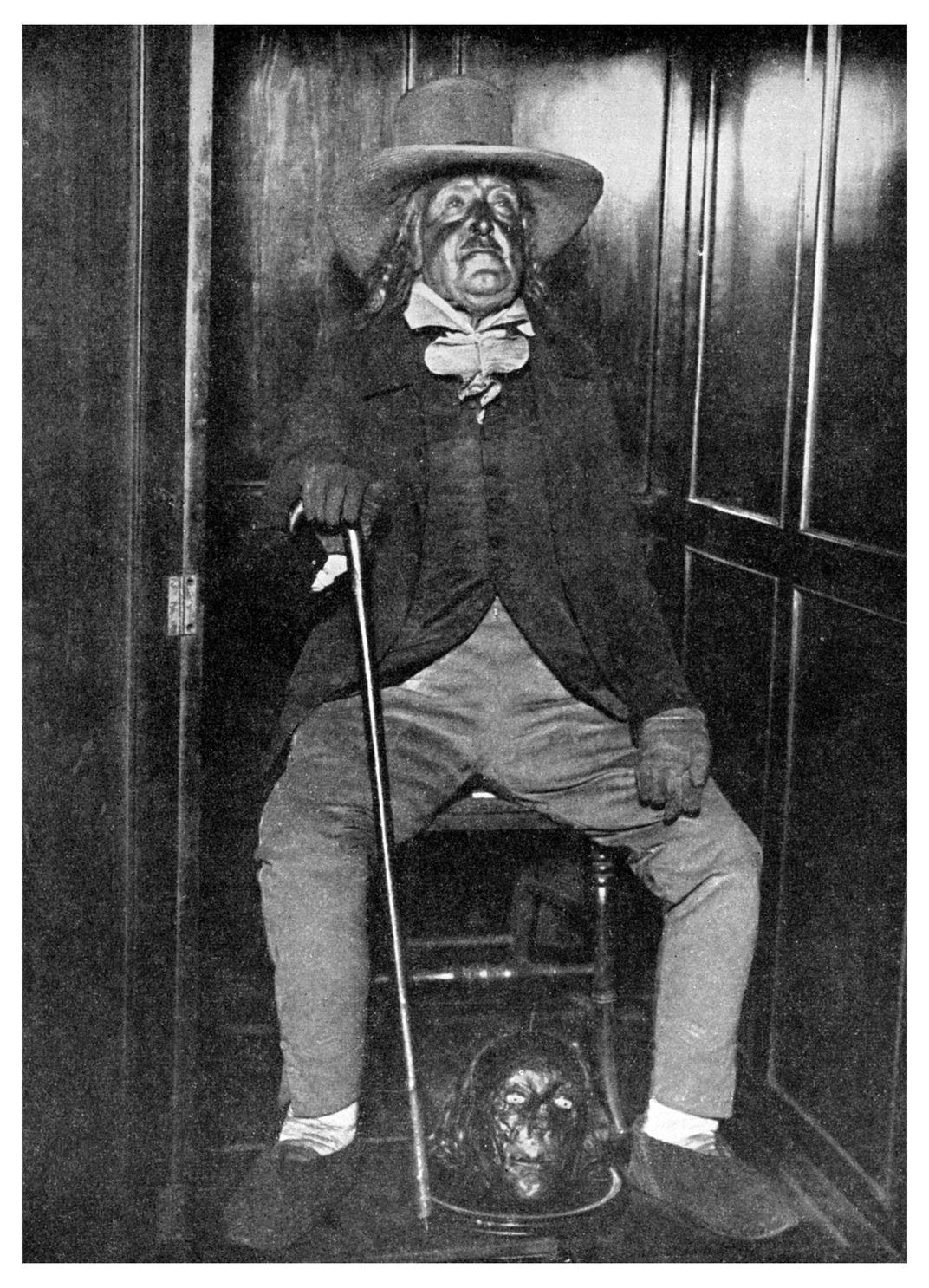
Jeremy Bentham, the father of modern utilitarianism, died in 1832 at the age of 84. In his will, he bequeathed his body to his friend to dissect for the benefit of medical science. He also specified that, after dissection, an auto-icon should be created and displayed in an appropriate case for viewing. This auto-icon consisted of his skeleton and mummified head dressed in his clothes and hat, which would “be seated in a chair usually occupied by me when living, in the attitude in which I am sitting when engaged in thought in the course of time employed by writing.” (Thulin).
A year before his death, Bentham wrote a pamphlet on the auto-icon and its utility. He claimed that an auto-icon would be of use in multiple ways: the dissection of one’s body would help to advance science, the icon itself would decrease the need for monuments, paintings, and other remembrances, and this practice would prevent the piling up of corpses. His plans went somewhat awry in a few ways. His auto-icon is the only auto-icon in existence; it never became popularized. Additionally, this mummification of his head was done incorrectly, causing the skin to tighten and become waxy. Because of this, another head, made of wax, was commissioned. In 1850, his auto-icon and head were donated to the University College London where they remain today.
Bentham’s remains and auto-icon epitomize Utilitarianism. Even in death, he wanted to continue to be useful, advancing medical science and destigmatizing anatomical dissection. While John Stuart Mill did not mention any thoughts about his body post mortem, he discussed both Utilitarianism and Jeremy Bentham at length. Mill subscribed to Utilitarianism but struggled with Bentham’s version of the philosophy throughout his life. Mill’s understanding of Utilitarianism focused less on the quantitative nature of the philosophy and instead defined utility as the consequence of good action. According to this definition, Bentham’s auto-icon has utility.
SOURCES
https://www.britannica.com/story/what-is-jeremy-benthams-auto-icon
https://www.ucl.ac.uk/culture/auto-icon/auto-icon
https://www.ucl.ac.uk/bentham-project/who-was-jeremy-bentham/auto-icon
https://medicalhealthhumanities.com/2019/09/07/benthams-auto-icon/
https://www.tandfonline.com/doi/abs/10.1080/01440350008586718?journalCode=fprs20