
John Everett Millais was born on June 8th, 1829 to a rising middle class family from Southampton (Rosenfeld 13). As Millais was home-schooled by his mother, she had the greatest influence on Millais and would continue to be a strong presence in his life (Rosenfeld 14). Through his father, Millais grew to admire observing flora and fauna (Rosenfeld 14). In Millais’ early years, he and his family moved to various locations due to his mother’s health (Rosenfeld 15). However, while in France and Jersey, Millais created impressive drawings of the militiamen which prompted his parents to move the family to London so that Millais could have a chance at becoming an artist (Rosenfeld 15). Millais’ father did not have a job and relied on a “private income” that stemmed from his wife’s family’s trade business in the port city of Southampton (Rosenfeld 15). Given his family’s unique financial situation, it was hoped that John would succeed in his artistic career.
Millais did not disappoint as he would win multiple awards, the first being at Henry Sass’s drawing school where he won “a silver ‘Isis’ award” from the Society of Arts at around ten years old. The prizes that he won because of this prestigious award helped his family financially (Rosenfeld 16). These prizes foreshadow the great impact capitalism had on Millais’ artistic career. One year later, he became the youngest student to be admitted to the Royal Academy of the Arts (Rosenfeld 15). Millais gained incredible skills from the exclusive access the students had to private collections of “fine pictures,” exposure to Greek and Roman art, and to “academicians” who taught subjects from literature and the arts to science and engineering (Rosenfeld 16). However, it is important to note that Millais did not attend the Painting School like his fellow students (Rosenfeld 16). This had significant impacts on Millais’ artistic abilities in that Millais was inspired by unorthodox styles, further developing his own sense of style.
Millais’ confidence in his work, individual style and his ambition was tested when he received immense criticism from the public, most notably Charles Dickens, in his painting Christ in the House of His Parents (The Carpenter’s Shop), painted in 1849-1850. At this time, Millais was part of the Pre-Raphaelite Brotherhood (PRB) who were known for their realist paintings that challenged traditional Victorian society. Despite the PRB’s ambition to break the status quo, they did not accept criticism well and in fact disliked criticism so much they wrote anonymous reviews to combat the critiques. The Art Journal and Punch were news outlets that reflected Victorian society pious aspects as they negatively commented on how, for example, Joseph looked too human (Rosenfeld 45). In other words, these news outlets felt that this painting stripped this religious scene of its divinity as the religious figures in this painting resembled too closely of imperfect human beings.
Dickens criticized Millais’ painting as he compared Millais’ painting to traditional paintings in Household Words. Household Words was Dickens’ hugely popular magazine that discussed the social issues of the time. Like The Art Journal and Punch, Dickens addressed how Millais’ painting did not exhibit the perfectionism divine figures should have. Also, given the disheveled appearances of Christ and his family, Dickens lamented that this painting would cater to the lower-class (Rosenfeld 47). Despite these harsh critiques and Millais’ determination to never hurt his reputation again, Millais further developed the unorthodox styles of the PRB that brought meaning and truth to their artwork (Alexander Street).
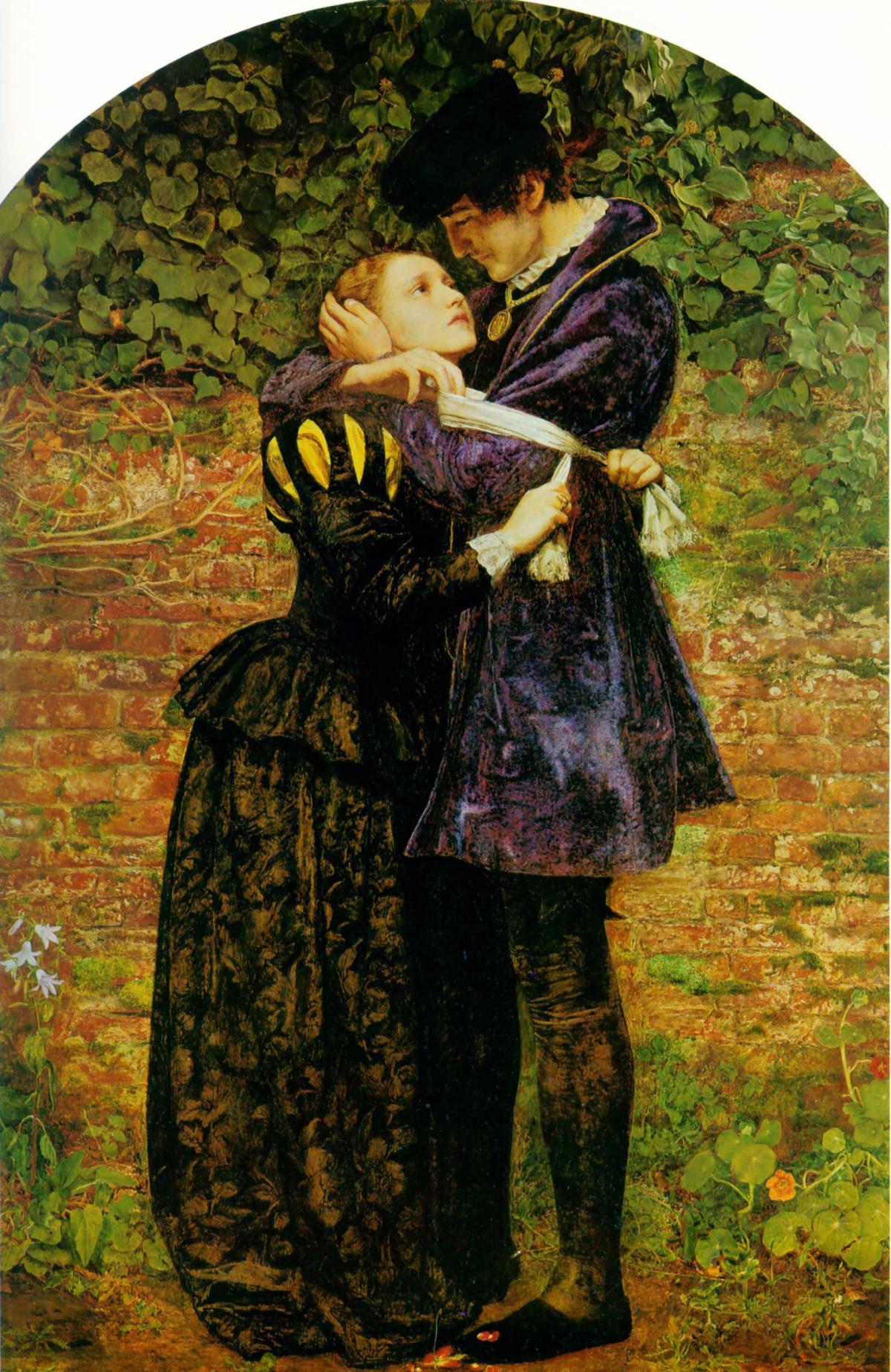
Millais improved his reputation with his painting A Huguenot, on St. Bartholomew’s Day, Refusing to Shield Himself from Danger by Wearing the Roman Catholic Badge (1851-2) (Barlow). The intimate couple portrayed in this painting caught the eyes of Victorian society as the couple deeply loved one another and the woman was trying to save her lover’s soul (Barlow). The white band symbolizes Roman Catholicism and as the woman attempts to tie this band around her lover’s arm, her lover stands true to his Protestant beliefs and carefully refuses her by pulling away the band (Rosenfeld, 68). This painting reflects Millais’ use of popular PRB techniques of dramatic facial expressions, symbolism, and hints of nature references with pigmented flowers at the feet of the two lovers. Millais also captured Victorian society’s hearts with an innocent, adorable young boy observing the bubbles he created in Bubbles (1886). Although this painting did face a bit of scrutiny as it was commercialized by its appearance in an advertisement, it was not created specifically for the advertisement. Interestingly, this painting exhibits the PRB coloring as the bubble has its proper reflective and shiny appearance. To have achieved this realistic look, Millais needed to add pigmented colors to “a white background that was still wet” (Alexander Street). Also, facial expressions were key in PRB paintings and the little boy’s facial expression clearly expresses his interest and analyzation of the bubble above him.
Millais and his contributions to the PRB challenged society’s ideals regarding artwork and offered new perspectives on how art should be expressed. Despite critics questioning Millais’ identity as a Pre-Raphaelite, there is a more contemporary debate regarding the use of Millais’ artwork to better understand the complexities within Pre-Raphaelitism (Barlow). Nevertheless, Millais was a pioneer of maintaining the complexity of his artwork through realism, symbolism, and nature aspects while commercializing his work.
Works Cited
Barlow, Paul. “John Everett Millais.” The Cambridge Companion to the Pre-Raphaelites, Cambridge. Edited by Elizabeth Prettejohn. Cambridge University Press, Cambridge, 2012. ProQuest, http://ezproxy.depaul.edu/login?url=https://www.proquest.com/doc view/21379 98858?accountid=10477, doi:htt p://dx.doi. org/10.1017/CCOL9780521 895156.011. Accessed 25 Oct. 2020.
Millais, John Everett. A Hugenot on St. Bartholomew’s Day, Refusing to Shield Himself from Danger by Wearing the Roman Catholic Badge. 1852. Private Collection. https://en.wikipedia.org/wiki/A_Huguenot. Accessed 25 Oct. 2020.
Millais, John Everett. Bubbles.1886. Lady Lever Art Gallery, Port Sunlight. https://www.bimago.co.uk/reproductions/john-everett-millais/bubbles-109…. Accessed 25 Oct. 2020.
Moritz, Reiner. “John Everett Millais – Ophelia.” Alexander Street, produced by ArtHaus Musik, 2012. https://video-alexanderstreet-com.ezproxy.depaul.edu/watch/john-everett….
Rosenfeld, Jason. John Everett Millais. London, Phaidon Press, 2012.