
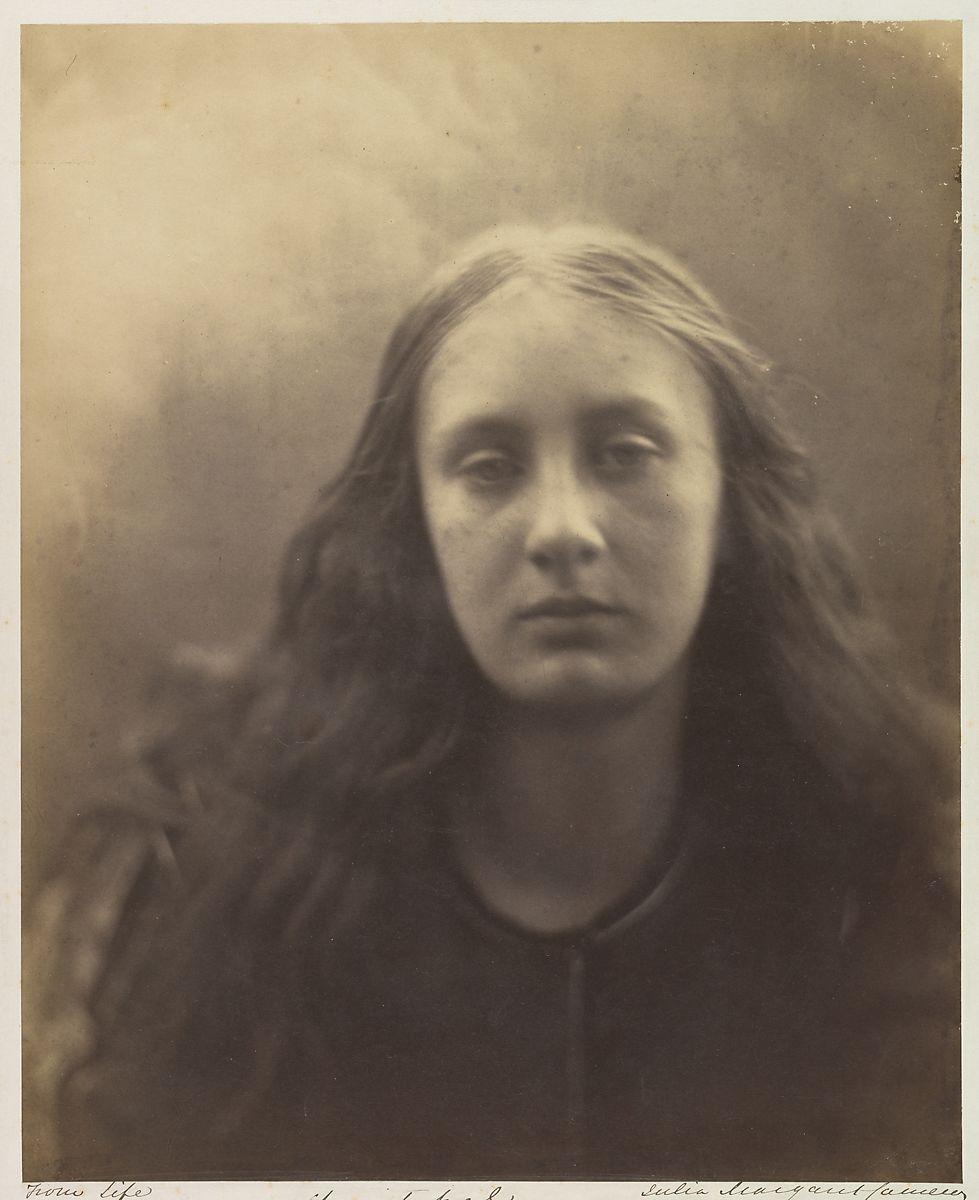
Julia Margaret Cameron is able to portray so much into her photos without the use of a lot of different advanced techniques. In some cases, it is said that she lacks a certain set of professional techniques that many photographers used at the time. However, after looking past this fact many were able to see her photos for what they truly were.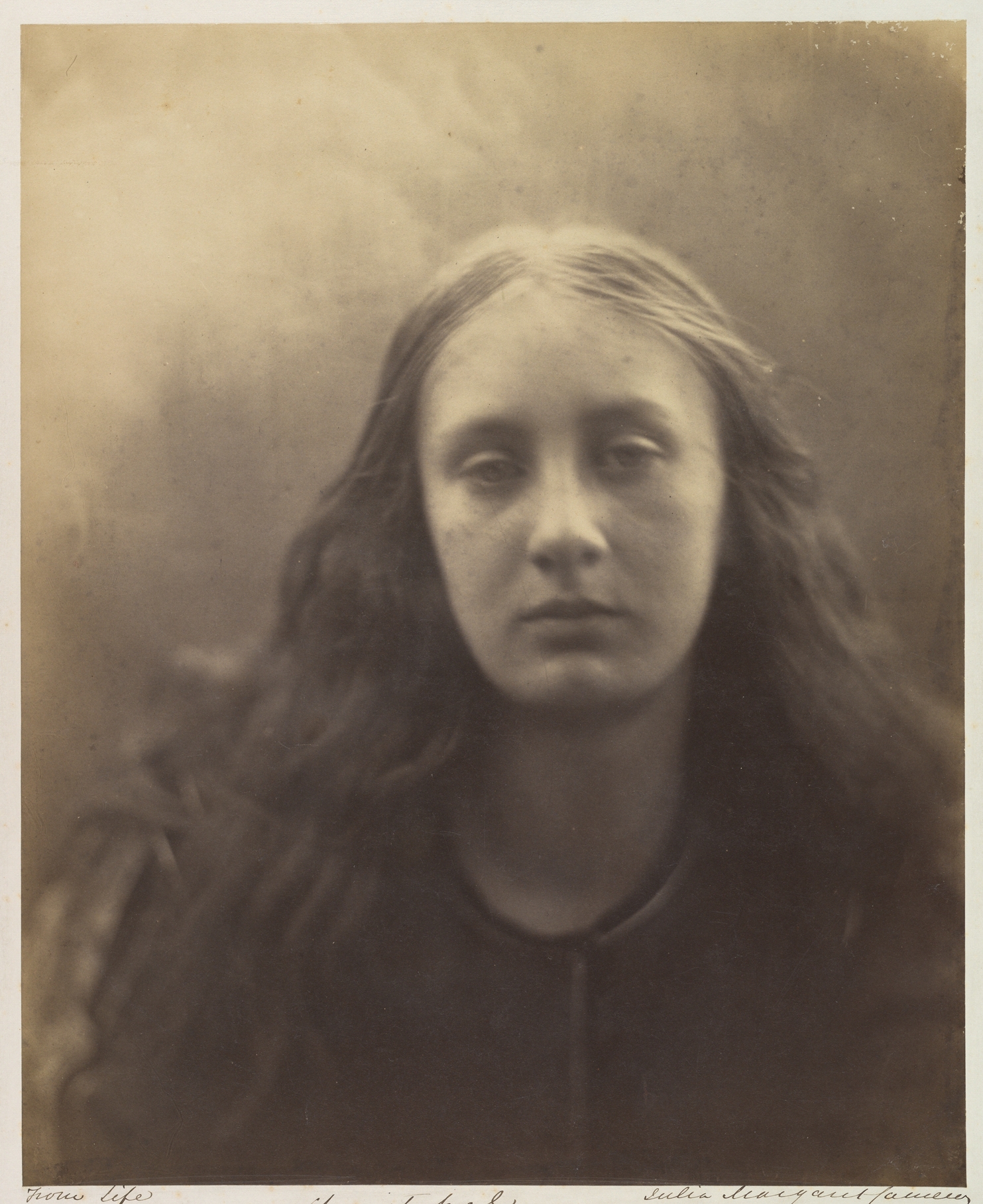
The way in which she took pictures is important to initially bring up since this was an issue for many that had critiqued her professionalism. Her photo taking was explained with, “Mrs. Cameron was so obsessed by the spiritual quality of her pictures that she paid too little attention to whether the image was sharp or not, whether the sitter had moved, or whether the plate was covered in blemishes” (Bear 87). She was more focused on having her intentions come through in the image as a whole. This caused her method of capturing the moment in a photo to leave out many of the basic strategies in photo-taking such as the actual camera focus and having the models for the image stay still. Having little focus on the small aspects of the photo caused some to write Cameron off as not much as a photographer, but those that gave her a chance saw the whole story.
Cameron was able to prove herself through her own work as a photographer. Her ideas as a photographer are exemplified with, “Ultimately she could not be beholden to anything other than her own visions of what her photographic art should be '' (Green-Lewis 616). The quote is going to show how she did feel as though her idea and then execution of that idea was a one to one comparison for her. Cameron’s target for taking photos is seen in that she would have a vision of what she wanted to portray and make it happen. This was a technique used by Cameron in order to set her apart from others since this allowed for her photos and portraits to feel natural. Having her idea of what the image should be was an important aspect of how she worked. 
Knowing her views on how Cameron was able to accomplish her task of making her vision come through in a photo is just as important. The way in which Cameron had seen her works is presented with, “Cameron called her allegorical works fancy subjects for pictorial effect after ‘fancy pictures’, a term which, by the 1850s, referred to artworks that caught sitters in static moments of reflection, be it religious, erotic, or sentimental” (Parhar 242). Being able to present all of these different ideas such as religion allowed her to show a plentiful amount of works that would show the models in a natural setting and as she originally imagined. Many had described her works as having a spiritual undertone to them. This was the case since there was so much time put into the photo bringing to life her original plans. Cameron’s persistence in trying to stage the different photos to fit her objective in a photo allowed for her to solicit a stronger emotion to the photo without having to worry about any small blurs or issues.
Cameron had additionally had thought about the idea of the photograph being a still image of an event in order to portray a whole narrative within. She had described her own personal works by explaining, “Her general technique produces photographs that “are, as Cameron herself vigorously argued, self-consciously poetic in their slowing down of time and fascination with duration” (Witcher 208). Capturing a moment in time in order to preserve an event was the main idea of what she was trying to accomplish. Having this in her head as she worked as one of her main techniques because this would allow her to think in many different ways in order to tell a story with only one photo. Then on top of this make it reasonable to photograph since not all ideas could be followed through at the time due to only relying on the ability of the camera.
Julia Cameron used the technique of bringing quality ideas first before any other aspects of any other photos. She was less concerned with making her own photos have all the essentials that other photographers would most definitely have. Being able to get the message of a photograph was her primary goal and everything was secondary. This allowed for many of her works to stand out for being able to portray the models in the photos in nice and unique ways.
Work Cited
Bear, Jordan. “The Silent Partner: Agency and Absence in Julia Margaret Cameron's Collaborations.” Grey Room, vol. 48, 2012, pp. 78–101., doi:10.1162/grey_a_00081.
Douglas-Fairhurst, Robert, and Name *. “The Eccentric and Enduring Visions of Julia Margaret Cameron.” Apollo Magazine, 27 Feb. 2016, www.apollo-magazine.com/the-eccentric-and-enduring-visions-of-julia-mar…
Green-Lewis, Jennifer. “From Life: The Story of Julia Margaret Cameron and Victorian Photography (Review).” Biography, vol. 27, no. 3, 2004, pp. 613–617., doi:10.1353/bio.2004.0065.
Metmuseum.org, www.metmuseum.org/art/collection/search/268709.
Parhar, Katherine. “Julia Margaret Cameron’s ‘Fancy Subjects’ – Photographic Allegories of Victorian Identity and Empire , by Jeff Rosen.” Visual Culture in Britain, vol. 17, no. 2, July 2016, pp. 242–244., doi:10.1080/14714787.2016.1186380.
Witcher, Heather. “‘Art of the Future’: Julia Margaret Cameron's Poetry, Photography, and Pre-Raphaelitism.” Victorian Studies, vol. 61, no. 2, 2019, p. 204., doi:10.2979/victorianstudies.61.2.04.