
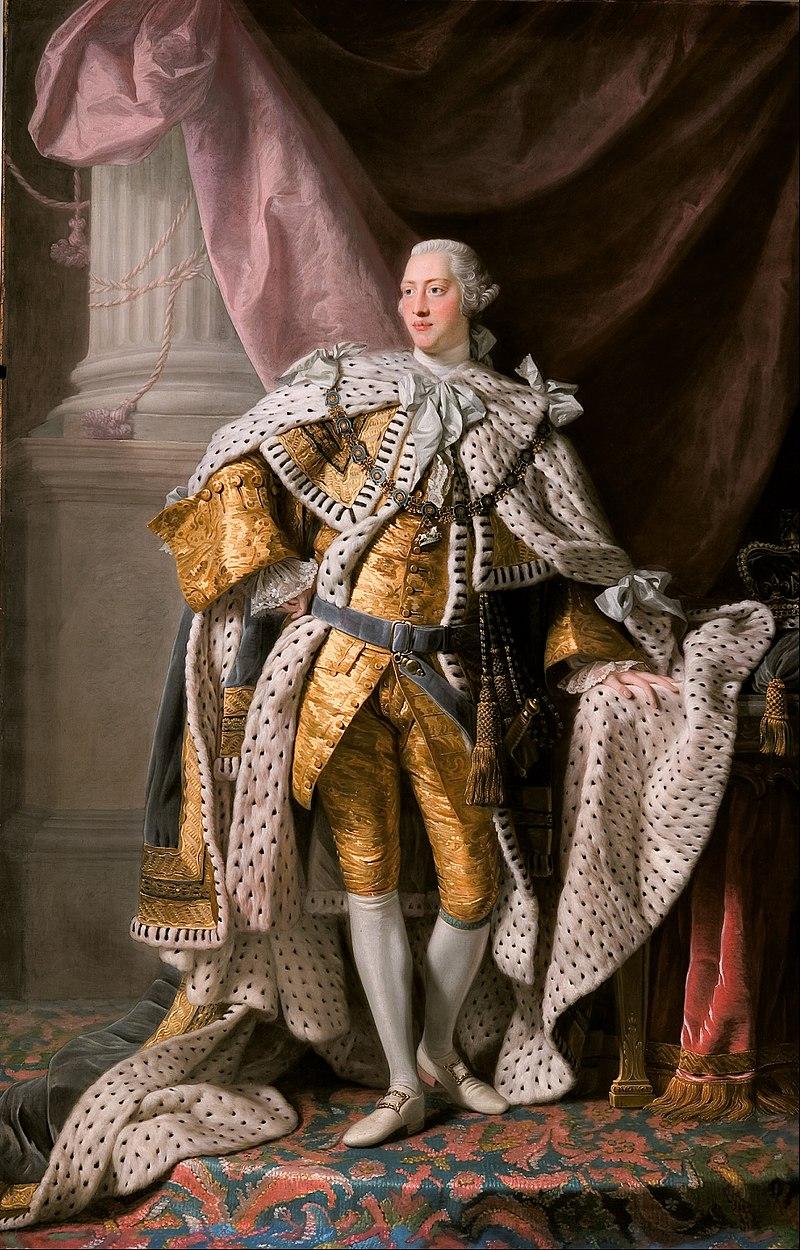

George III (George William Frederick; 4 June 1738[c] – 29 January 1820) was King of Great Britain and Ireland from 25 October 1760 until the union of the two kingdoms on 1 January 1801, after which he was King of the United Kingdom of Great Britain and Ireland until his death in 1820. He was concurrently Duke and Prince-elector of Brunswick-Lüneburg ("Hanover") in the Holy Roman Empire before becoming King of Hanover on 12 October 1814. He was a monarch of the House of Hanover but, unlike his two predecessors, he was born in Great Britain, spoke English as his first language[1] and never visited Hanover.[2]
George's life and reign, which were longer than those of any of his predecessors, were marked by a series of military conflicts involving his kingdoms, much of the rest of Europe, and places farther afield in Africa, the Americas and Asia. Early in his reign, Great Britain defeated France in the Seven Years' War, becoming the dominant European power in North America and India. However, many of Britain's American colonies were soon lost in the American War of Independence. Further wars against revolutionary and Napoleonic France from 1793 concluded in the defeat of Napoleon at the Battle of Waterloo in 1815. In 1807, the transatlantic slave trade was banned from the British Empire.
In the later part of his life, George had recurrent, and eventually permanent, mental illness. Although it has since been suggested that he had bipolar disorder or the blood disease porphyria, the cause of his illness remains unknown. George suffered a final relapse in 1810, and his eldest son, the Prince of Wales, became Prince Regent the following year. When George III died in 1820, the Regent succeeded him as King George IV. Historical analysis of George III's life has gone through a "kaleidoscope of changing views" that have depended heavily on the prejudices of his biographers and the sources available to them.[3]