
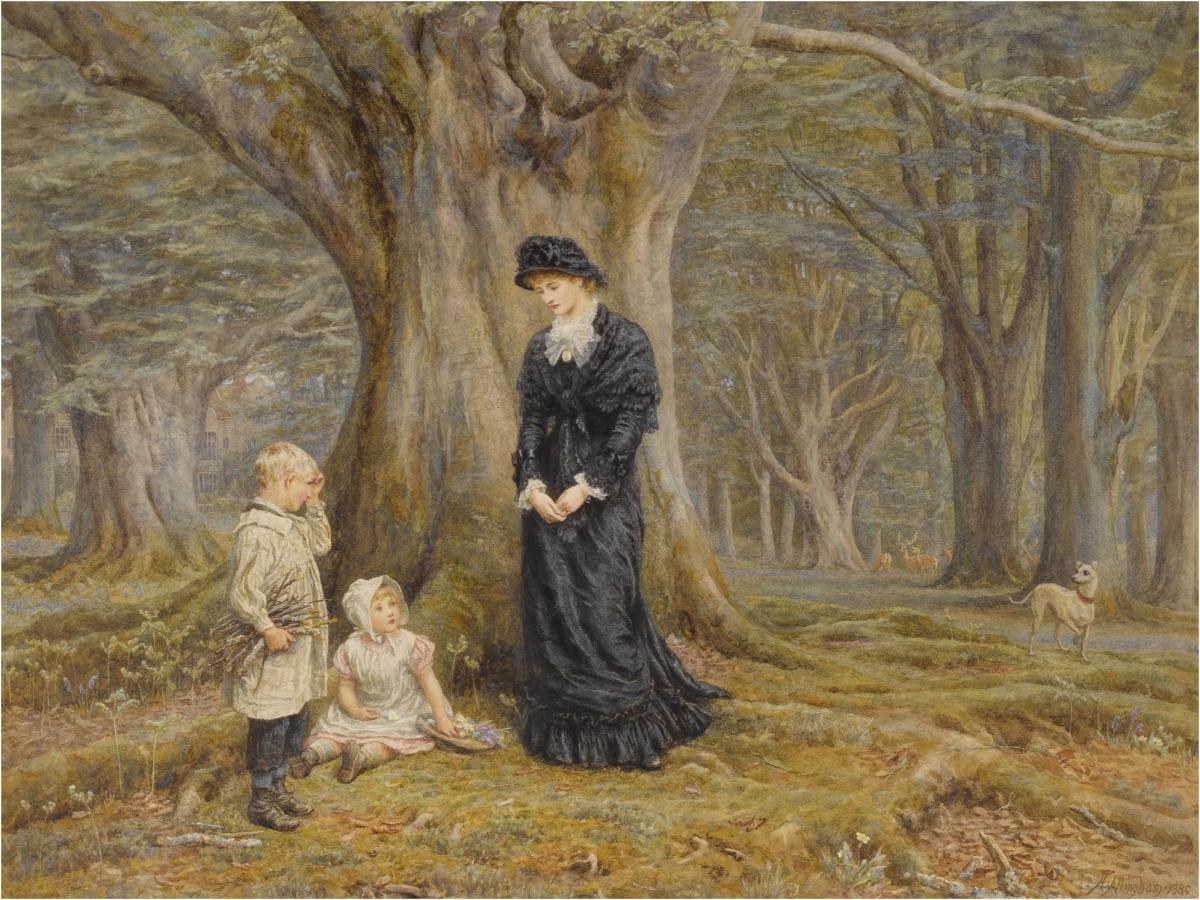
In 1880, British watercolorist Helen Allingham created an artwork titled “The Lady of the Manor” using watercolors. This painting features an unnamed lady in the center of the image in front of a large tree, looking down at two children who appear to be collecting sticks and flowers in a hat. In the background, there is a dense forest, a dog, some deer, and a manor. From the title and eye-catching details of the painting, the viewer connects that the lady is the focal point of the painting and the manor is her home. The woman is further emphasized with the black dress she wears in the vibrant environment, drawing the spectator’s eye to her and her interaction with the children.
The outfit the lady dons is particularly interesting to look at and dissect because of how contrasting it is to the environment around her. From a historical standpoint, the outfit fits in with the time period with its clear influences from the late 1870s and early 1880s fashion trends. These influences can be seen with how her hair is neatly tucked up in a jaunty hat that tilts over the forehead, as was typical in the 1870s for women (Shrimpton 19). The dress she wears is also in alignment with the time period with the narrowed front and sides of the skirt and drapery in the back to form a slight train (which can be seen hanging over a tree root). There is also the influence of the early 1880s fashion, as seen with the pleating around the bottom of the skirt (Shrimpton 21). Overall, since this artwork was made at the cusp of a shift in female fashion trends, the dress the lady wears is representative of the ongoing changes.
The characteristics of the outfit aside, the color of the dress and the accessories the lady of the manor wears also add an element of intrigue to this painting. Black was the typical color of mourning worn by those who had lost someone in the Victorian era. Almost every article of clothing the lady wears is colored black, giving the viewer the impression that she is in mourning over someone, perhaps a husband, family member, or child. Additionally, this mourning narrative is further emphasized by the jewelry the lady wears and the touches of white on her dress. There is a ring on her left ring finger, implying that she is married (or was, depending on who she is mourning). She also wears bracelets, most likely personal accessories, on her left wrist which appear to be dulled and minimal since no flashy jewelry would be seen from a woman in mourning. As for her dress, there are hints of white in the cuffs of her sleeves and the wrap around her neck, informing the viewer that she could be experiencing the later period of mourning since it was typical to add hints of white during this period (Shrimpton 92). When women lost their husbands, they were in mourning for at least two and a half years, so it is possible she has been mourning for a while and is now entering the later stages.
Another point of interest in this painting is the interaction happening between the lady and the two children. The little boy, with a bunch of sticks in one hand, appears to be embarrassed, as seen with the gentle pink flush on his cheeks, the downward tip of his head, and the awkward hand by his eyes. The little girl is less flustered than he, but she too has a pink flush, showing that she too feels some embarrassment. From this, the viewer brings their eyes back to the lady of the manor who looks down at them in an unthreatening manner. Her hands are clasped in front of her sympathetically and she looks at the children with a look of intrigue as she listens to what the young children are saying in amusement or understanding. These poses and detailing give the impression that the children were playing on the lady of the manor’s property and were caught in the act, though the lady does not appear to be upset by this.
The narrative that the painting tells aligns with the common themes and meanings Allingham put into her watercolor paintings. In her watercolors, Allingham drew picturesque sceneries such as cottages and small fields which typically featured women or young children (Devereux 113). And in these picturesque and domestic scenes, Allingham portrayed a nostalgia for a lost, golden age of England, infusing a feeling of refuge and comfort in her works that draws the viewer in (Devereux 114). This is seen in “The Lady of the Manor” (1880) with the scene she drew. The viewer is looking at a frozen moment in time of children playing in the gorgeous, blossoming country landscape with a gentle woman interacting with them. The many deer in the background support a feeling of comfort as they quietly graze, undisturbed by their environment. Also, the scenery is filled with a multitude of soft yellows, greens, browns, and blues that are muted and dulled enough that they are not harshly vibrant, instead softening the environment and giving it an ethereal feel. All of these factors combine to make this landscape the perfect place of refuge and comfort.
Overall, this watercolor image by Helen Allingham aligns itself with the thematic idea of her works and proves itself to be a dynamic, interesting, and vibrant painting. The painting “The Lady of the Manor” invokes a sense of nostalgia for simpler times playing in the countryside as children as opposed to the harsh realities of the real world. The viewer takes refuge in this quiet moment of the painting and transports themselves to this simpler time.
Works Cited
Devereux, Jo. The Making of Women Artists in Victorian England: The Education and Careers of Six Professionals. McFarland, Publishers, 2016.
Shrimpton, Jayne. Victorian Fashion. Shire Publications, 2016.
Image Attributions
"The Lady of the Manor" by Helen Allingham (1880), via Wikipedia