
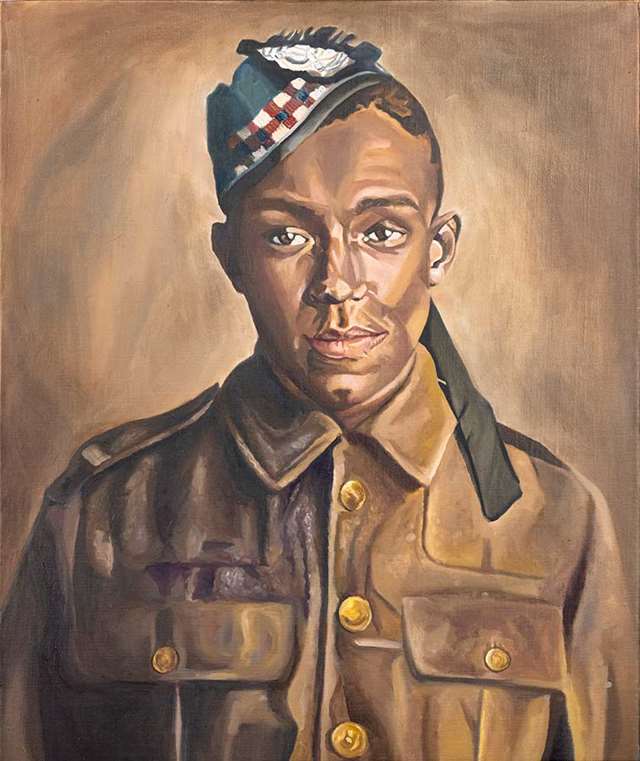
Arthur William David Roberts was a Black soldier who served in WWI. In 2004, his war diaries were discovered, uncovering the truth about his experiences during the war. In one of his diary entries, he talks about coming across a dead soldier. Arthur Roberts wrote, “At that sight, it was as if my ruminations had been cast from their exalted altitude of self-contentedness to an abyss of nauseating realities…the poor corpse lay like a rag doll with all the stuffing knocked out of it, and just flung down as if in anger or haste” (English Heritage). Now image witnessing this and so much more, only for your service to be completely erased and forgotten. That is exactly what happened to Arthur Roberts. “There were no black troops included in the Peace March of July 1919, a victory parade held in London to mark the end of the war” (The Guardian). Additionally, Jackie Kay wrote “The Looks of Loss” about Arthur’s loss and feelings upon returning from WWI. In one of the lines she writes, “Loss like the loss when you’re wiped out of the picture” which is exactly what happened to Arthur Roberts after returning from WWI. Furthermore, Arthur wasn’t the only black soldier during WWI to experience racial injustices, in fact, he was one of many. Melissa N. Shaw writes that “The hardships they faced when trying to enlist in World War I marked a decisive turning point for Black Canadian activism in Ontario” (Shaw). Even trying to enlist in the war was difficult for many as they were facing racial discrimination and were told they could not serve. Shaw also writes that, “Even though Black Canadians adamantly demanded their right to fight in the war, their ambitions for racial equality were thwarted.” Black soldiers were discriminated from the moment they tried to enlist, to the moment that they returned from the war. Whether this meant that they couldn’t serve in the war or their service wasn’t acknowledged, black soldiers were treated very unfairly. In thinking about recent events, like Will Smith at the Oscars, one must remember the history and what lead to this point. For the longest time, black people have been discriminated against. Even when they aren’t, from the moment that they make a mistake, they are completely hated and/or forgotten by others. Their mistakes are used against them to reinforce stereotypes and justify racism. People of color basically have to walk on eggshells because any small mistake that they make could be used against them, whereas a white person is forgiven for the unforgiveable. On the other hand, many black people are not given the recognition that they deserve for all of their hard work. They are often times more forgotten than a white person. They both could have accomplished the same thing and yet the white person will likely get more praise for it, which is what happened with Arthur Roberts when he returned from the war.
“Arthur Roberts.” English Heritage, https://www.english-heritage.org.uk/learn/histories/black-history/arthur-roberts/.
“Jackie Kay on Arthur Roberts: The Black Scottish First World War Soldier Who Felt Forgotten.” The Guardian, Guardian News and Media, 11 Nov. 2018, https://www.theguardian.com/books/2018/nov/11/jackie-kay-makar-poem-black-scottish-first-world-war-soldier-arthur-roberts.
Shaw, Melissa N. "“Most Anxious to Serve their King and Country”: Black Canadians’ Fight to Enlist in WWI and Emerging Race Consciousness in Ontario, 1914-1919." Histoire sociale / Social History, vol. 49 no. 100, 2016, p. 543-580. Project MUSE, doi:10.1353/his.2016.0040.
Related Links: