
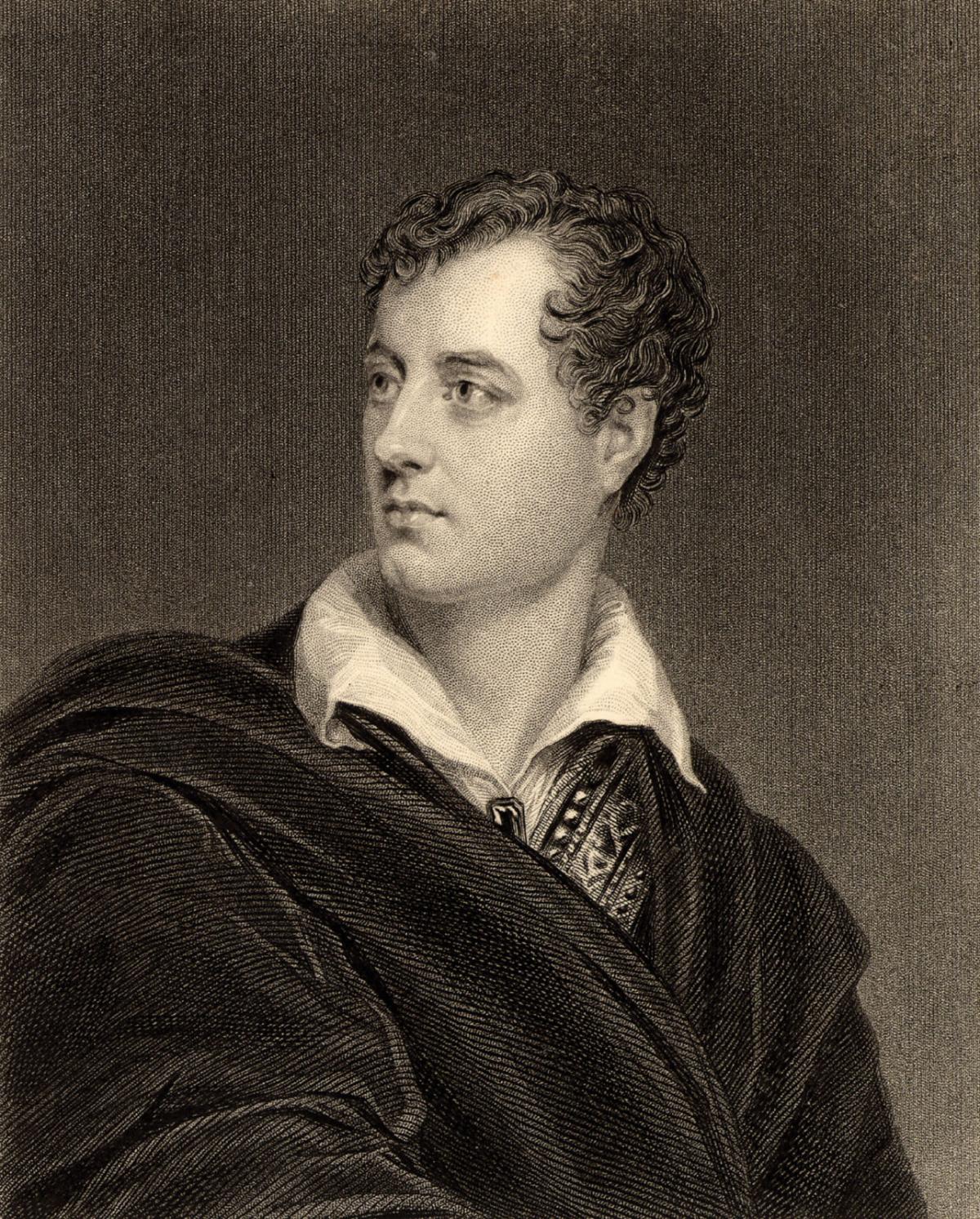
Lord Byron (1788-1824) was an English poet and central to the Romantic movement in poetry. Born in England, with a clubfoot, he was mainly raised by his mother after his father squandered away all their fortune. However, when Byron was ten-years-old, his great-uncle died, leaving Byron with his title and estates. Byron went on to school at Trinity College where his pursuit of sexual escapades began and would carry on throughout his life. After college, Byron traveled greatly and many of his poems were inspired by his wanderings.
During John Stuart Mill’s nervous breakdown in 1826, among other authors, Mill turned to Byron for relief. However, Mill notes that Byron’s poetry was not helpful to him since Byron’s poetry consisted of the “the lament of a man who had worn out all pleasures, and who seemed to think that life, to all who possess the good things of it, must necessarily be the vapid, uninteresting thing which I found it” (120). Furthermore, Mill notes that Byron’s “Harold and Manfred had the same burden on them which I had” (120).
It is no wonder that Harold and Manfred would not be of comfort to Mill during his despair. Both poems are considered semi-autobiographical works of Byron and are both rife with themes of guilt, disillusion, and melancholy, many of which arose due to his sexual affairs and pursuit of distractions in foreign lands. These two poems gave him the reputation as the “gloomy egoist.” Though it would ultimately be Wordsworth to provide Mill with comfort, it is logical that Mill consider Byron, a Romantic poet who emphasized states of feeling.
Sources:
“Lord Byron -- Britannica Academic.” Accessed February 13, 2021. https://academic-eb-com.proxy.uchicago.edu/levels/collegiate/article/Lord-Byron/18402.
“Childe Harold’s Pilgrimage -- Britannica Academic.” Accessed February 23, 2021. https://academic-eb-com.proxy.uchicago.edu/levels/collegiate/article/Childe-Harolds-Pilgrimage/484264.
Mill, John. Autobiography. Edited by John M. Robson. London: Penguin Books, 1989.