

Gertrude’s Commentary:
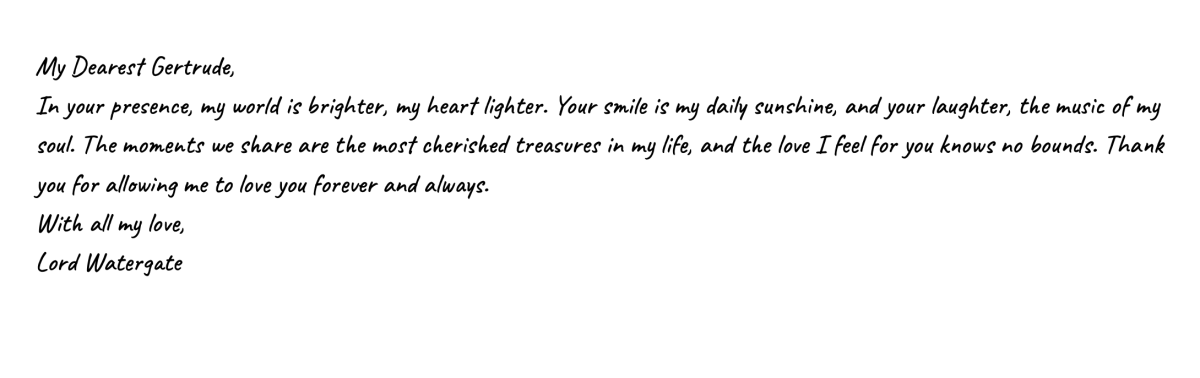
Upon receiving Lord Watergate's heartfelt letter, I was overwhelmed with a mix of feelings. It was a short yet deeply touching declaration of his love for me. As I read his words, I couldn't help but feel a warm happiness spreading through me. The letter began with "My Dearest Gertrude," and those three words alone made my heart race. It was a greeting that spoke of deep affection, a feeling that was certainly mutual. Lord Watergate went on to express how my presence brightened his life and how my smile and laughter meant the most to him. His words were beautifully written, and they resonated with me in a way that made my heart swell with love. But what touched me even more was the unsaid message in his letter - the silent recognition of how he had returned, giving our love another chance to grow. It was proof of the strength of our connection, and I couldn't help but feel a deep sense of gratitude that he had come back into my life. Reading this letter made me feel cherished and valued. It was a reminder of the second opportunity fate had given us, and it left me eager to express my affection in return. Lord Watergate's love was a precious gift, and I was determined to make the most of this chance to create a love story that would be cherished for a lifetime. His letter had ignited a flame of love within me that burned brighter than ever, and I couldn't wait to tell him just how deeply I felt for him in return.
Researcher’s Commentary:
As a researcher deeply immersed in historical documents, stumbling upon Lord Watergate's affectionate letter to Gertrude Lorimer was a remarkable discovery. The letter, while concise, radiated profound sentiments. Beginning with the endearing "My Dearest Gertrude," it hinted at an intimate connection between them. Lord Watergate's words, elegantly simple, conveyed deep emotions, emphasizing Gertrude's role in brightening his life. This eloquent simplicity evoked a sense of sincerity and authenticity, a testament to the power of love in its purest form. “During the Victorian era, men and women searched for an ideal relationship based on the expectations of a demanding society. If a man or woman did not possess the qualities desired by the Victorian society, the opposite sex may have dismissed the person as an unsuitable mate” (“Victorian Ideals.”). Their story of discovering love within one another showed that society’s expectations did not have a negative impact on all relationships during the Victorian Era, and true love could still be fostered. What intrigued me most was the unspoken subtext: a silent recognition of a second chance at love. It is important to note that women of this time could also be the reason for a lack of authenticity in marriage. “A worse prostitution than that of the streets, i. e., that of loveless marriages of convenience, are brought about by women, not by men. In such unions the man always gives much more than he gains, and the woman in almost every instance is persuaded or driven into it by women—her mother, her sisters, her acquaintances” (Ouida). The love that Gertrude seemed to finally give to Lord Watergate is of the utmost authenticity surrounding love. This subtext hinted at a backstory, a past perhaps marred by separation or misunderstanding, and a subsequent reunion that breathed new life into their romance. This subtext was a narrative thread waiting to be explored. Reading the letter, I was amazed at how history preserved the human experience. Lord Watergate's words transcended time, allowing me to glimpse into a love story that had endured, evolved, and ultimately found its way back to one another. It kindled my curiosity, motivating me to uncover the full tale of Lord Watergate and Gertrude Lorimer.
Ouida. “The New Woman”. 1894. COVE, 2023.
“Victorian Ideals.” McKendree University, https://www.mckendree.edu/academics/scholars/issue18/appell.htm. Accessed 12 October 2023.