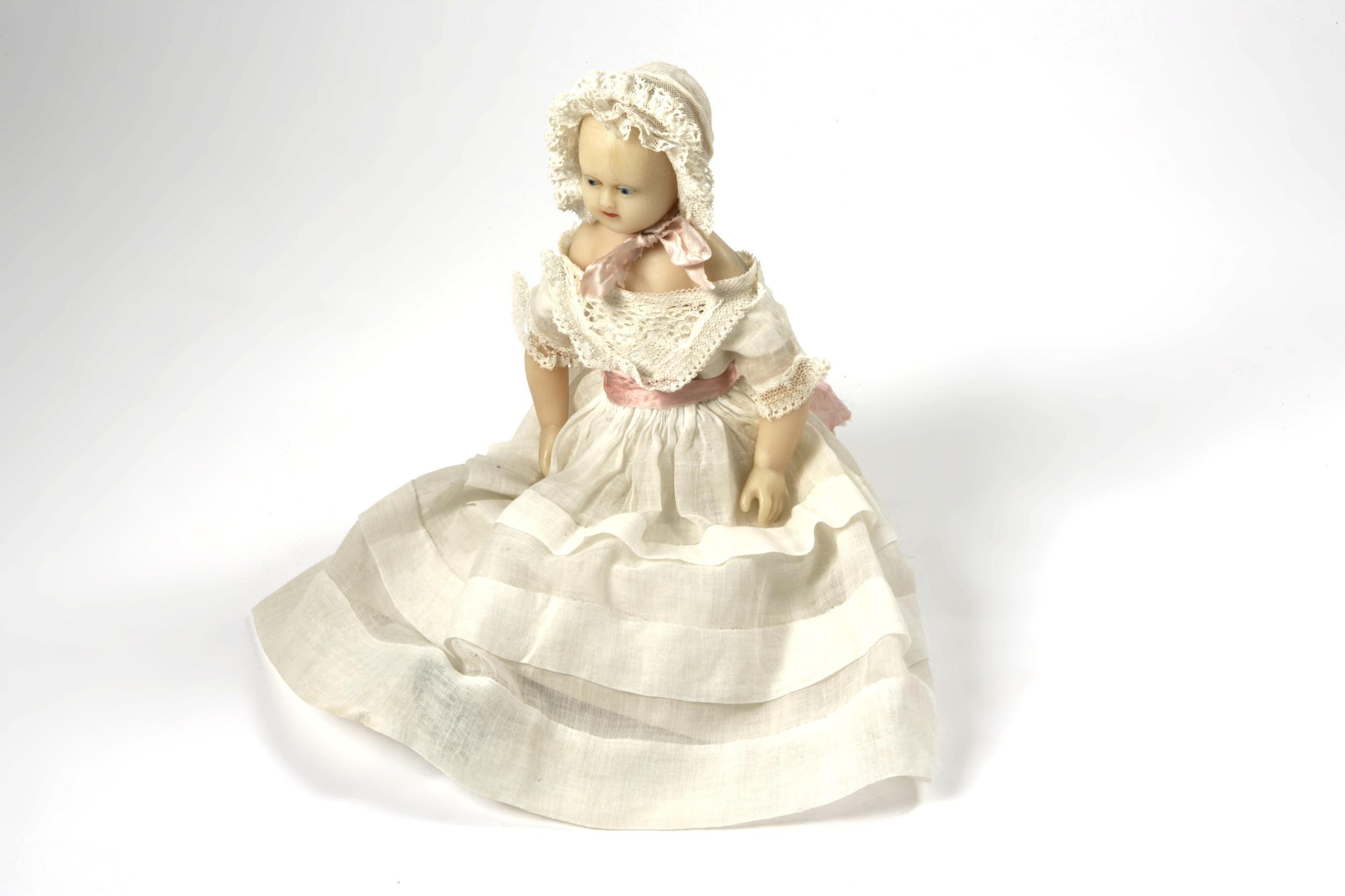
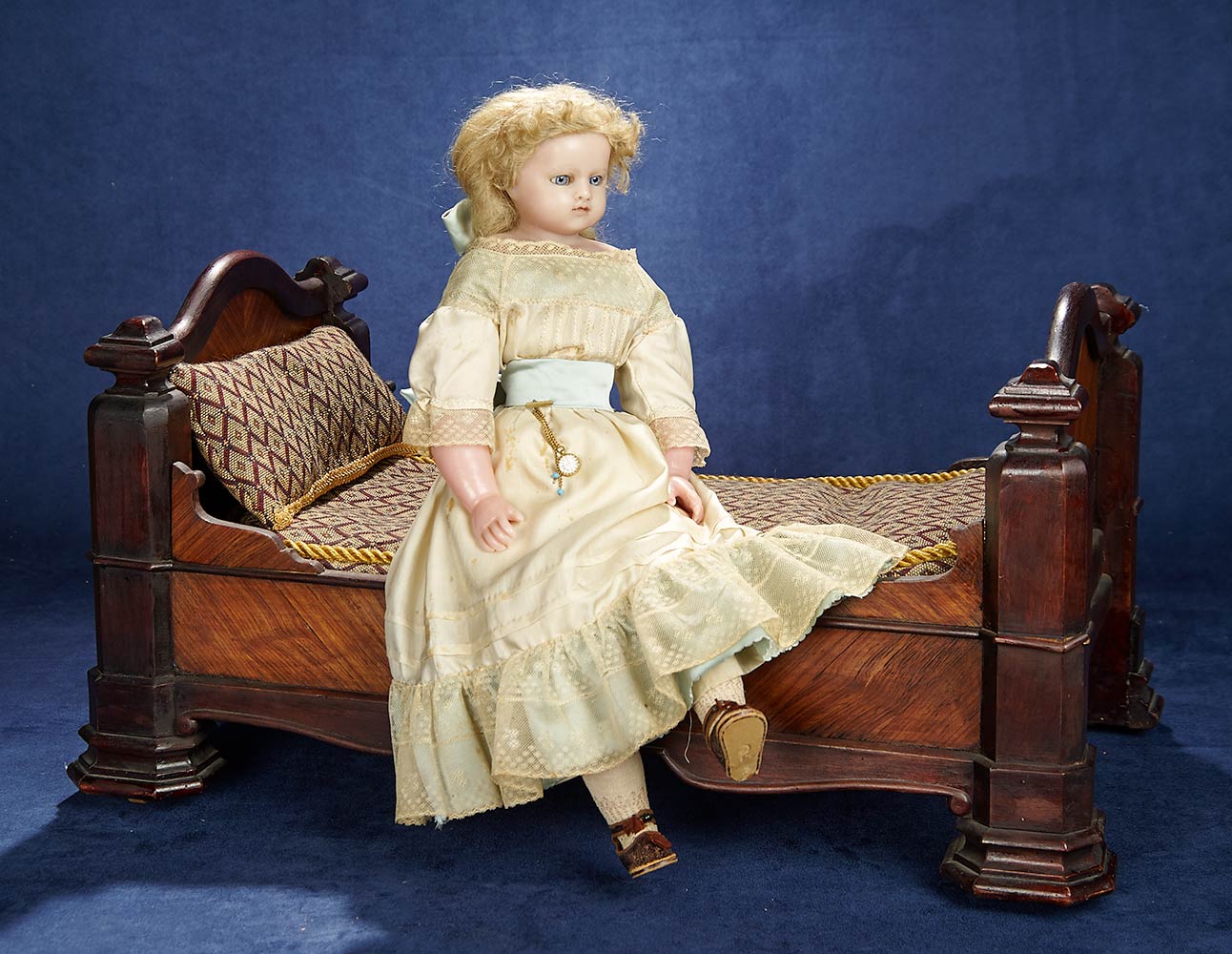
Wax dolls were one of the most famous and expensive luxury dolls in Victorian-era England. A testament to their price and extravagance, the process of manufacturing wax dolls was a complex multi-step process. Their heads were first constructed of wax shells, which were then put together and reinforced with a hard paste. They were then dusted with powders such as potato meal and alabaster, which gave it a fleshlike appearance. Facial features such as eyes, eyelashes, and hair were then added by separate workmen. The sum of these efforts created dolls that were considered the most realistic compared to dolls made of other materials such as porcelain, papier-mache, and wood. In their completed form, wax dolls often resembled young ladies. They were dressed in lavish garments made of velvet and silk and came to amass miniature trousseaus, one such collection amounting to more than 150 clothes, furniture, and other accessories.
The introduction of luxury wax dolls hailed a transformation of the doll from a beloved, pedagogical miniature of the self to a fanciful display of wealth and consumerism. Dolls and doll’s houses of more modest qualities were often permanent fixtures in the nursery. They were educational objects, intended to teach a young girl the social and spatial features of her surroundings. In comparison, many wax dolls were objects of envy and admiration, often displayed in exhibitions or window displays in toy shops. Even the acquisition of a wax doll did little to quell its little owner’s desires, fueling the need to furnish her with more accessories and clothing befitting her status. The wax doll was a product, one that did naught to teach young girls the inner workings of a household or stimulate one’s imagination, but rather encourage material displays of wealth and grandeur.
Bibliography
"Advertisements & Notices." Morning Chronicle [1801], 25 Dec. 1806. British Library Newspapers, link-gale-com.proxy.uchicago.edu/apps/doc/BB3207099662/BNCN?u=chic_rbw&sid=bookmark-BNCN&xid=2df73e4f. Accessed
11 Feb. 2022.
This advertisement invites patrons of different statuses and wealth to take a look at his collection of toys, including dolls and doll’s houses. It shows that dolls were marketed and sold to children to be used as toys.
Chen, W. N. To the Dolls’ House : Children’s Reading and Playing in Victorian and Edwardian England. Jan. 2015. EBSCOhost, search-ebscohost-com.proxy.uchicago.edu/login.aspx?direct=true&db=edsble&AN=edsble.639717&site=eds-live&scope=site.
This article illustrates the significance of Dolls’ Houses in Victorian culture, both as a pedagogical tool used to familiarize children with their social and spatial surroundings as well as a miniaturized realm of control under the jurisdiction of adults. While it does not pertain to wax dolls specifically, it provides constructive background on the way dolls were viewed by a Victorian audience.
Gonzalez-Posse, Maria Eugenia. “Galatea’s Daughters: Dolls, Female Identity and the Material Imagination in Victorian Literature and Culture.” Dissertation Abstracts International, vol. 74, no. 1, Ohio State UniversityProQuest, July 2013. EBSCOhost, search-ebscohost-com.proxy.uchicago.edu/login.aspx?direct=true&db=mzh&AN=2013652208&site=eds-live&scope=site.
This article provides a comprehensive account of the various types of dolls available in the Victorian era and argues that the introduction of the luxurious wax dolls challenged previously conceived notions of dolls as quaint, educational playthings. It provides significant grounds for comparison between a wax doll and its less extravagant counterparts.
"How to Make Children's Toys." Sunderland Daily Echo and Shipping Gazette, 10 Feb. 1877, p. 4 British Library Newspapers, link-gale-com.proxy.uchicago.edu/apps/doc/GR3224617920/BNCN?u=chic_rbw&sid=bookmark-BNCN&xid=9f7b9988. Accessed 11 Feb. 2022.
This article suggests a number of crafting ideas for children, featuring a section on teaching young girls to make paper dolls and furniture for their doll’s house. This attests to the notion that dolls and their accessories were not meant to be extravagant displays of wealth, but rather everyday playthings present in nurseries irrespective of the family’s wealth.
"THE WAX DOLL BUSINESS." Newcastle Courant [1803], 23 June 1876. British Library Newspapers, link-gale-com.proxy.uchicago.edu/apps/doc/Y3206634931/BNCN?u=chic_rbw&sid=bookmark-BNCN&xid=006fcd06. Accessed 11 Feb. 2022.
This segment details the process of making genuine wax dolls, outlining the manifold steps each doll undergoes until it is ready to be sold. This provides us with an elementary understanding of the composition of wax dolls, especially regarding their interior body and limbs.