

In Victorian times, the concept of the "madwoman" was incredibly popular for both authors and readers. Throughout the 19th century, many stories included drastic descriptions of women being locked in the attic and completely isolated from their community. Some authors took this opportunity to use these "crazy" women as examples of how women are actually treated in the nineteenth century. When it comes to the Brontë sisters, it is very interesting to read about characters such as Bertha Mason in Charlotte's Jane Eyre as a mirror for how the Brontë sisters felt as female authors. In order to publish any sort of novel during their time, the sisters had to use male names as a disguise for their actual names. If people saw that a novel was written by a man, they would be more likely to pick it up and read it whereas if a female author were published, she was handicapped from the start. Bertha Mason's behavior as a "madwoman" represents rigid views of females throughout the nineteenth century and how assumptions were easily made and how women had no say in what happened in their personal lives. Even though the Brontë sisters were never forced to live in an attic, completely isolated from the world, it does not mean they are any less similar to the constrained Bertha Mason in the fact that their lives were not completely in their own hands. Bertha may have killed herself at the end of the novel but that was just her way of escaping the reality of her life. Is this similar to the Brontë sisters, who, by using male pseudonyms on the cover of their novels, were escaping their reality?
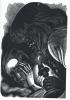
Fritz Eichenberg, "Bertha Mason Examining Jane," for Jane Eyre, Random House edition, 1943.
This image was created by Fritz Eichenberg, a famous German American illustrator and arts educator who was mainly known for his talented wood engraving. Eichenberg was known for his specialty in depicting religion, social justice, and nonviolence. He was particularly interested in illustrating novels, including the Brontë sisters. The image above is one of his many illustrations that depict intense spiritual and emotional conflict, fantasy, and social satire. Bertha Mason represented here as the scary woman hovering over a whimpering and terrified Jane is one of the many examples of a fictional madwoman within the Victorian era. Eichenberg creatively uses black and white to depict madness versus innocence. Bertha is shown mainly in all black whereas a frightened Jane is depicted mainly in the light. The use of light and dark is amazingly creative as both women are shown neither fully in the light nor fully in the dark. Since both women are neither dark nor light, this could be a representation of their shared confusion over the same beloved man, Rochester. Bertha is written to be crazy whereas, in this image, some parts of her face appear to be lit, which could imply her madness has not fully taken over her soul quite yet. For Jane, her soul is not fully dark yet, which may suggest she has not fully given herself to Rochester like Bertha once did.
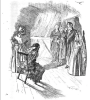
F. H. Townsend, "Bertha Mason, Bound to a Chair with a Rope," for Jane Eyre, Service & Paton edition, 1897.
Frederick Henry Townsend was a famous British illustrator and cartoonist who illustrated the second edition of Charlotte Brontë’s Jane Eyre back in 1897. We see in this image that Bertha Mason is surrounded by members of Thornfield, tied to a chair, seemingly miserable. However, this event never actually occurs within the novel. Interestingly to believe, this sounds like something that Charlotte should have incorporated into her novel to give more compassion to the character of Bertha Mason, a woman doomed from the beginning. Townsend obviously supports the view of Bertha as a madwoman, as an animal, violent, dangerous, and unpredictable. Even though Bertha is alive in this image and we know she eventually dies towards the end of the novel, her imagery is shown as dehumanizing. Her clothing is ragged and most likely hiding her ripped and tattered body, her posture is tortured, and her face is towards the floor; she’s embarrassed and she’s ashamed. Here Bertha is illustrated as crazy, tired, frightful, and maddening.
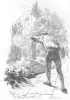
F. H. Townsend, "Bertha Mason Smashed on the Pavement after Throwing Herself off the Roof when Thornfield Hall is on Fire," for Jane Eyre, Servive & Paton edition, 1897.
Townsend created several images that give insight into Charlotte Brontë’s brilliant novel Jane Eyre.Townsend, who labeled Mason as a “maniac,” creates an image that shows how she left the world. The picture above shows Rochester standing over a dead Bertha Mason after she jumps off the roof of Thornfield Hall while the house is on fire. Committing suicide in the Victorian era was seen as an act of craziness, selfishness, and a purely mental state of mind. From the second that Bertha is introduced as a character in Charlotte’s novel, she is never given a proper chance to redeem her supposed "craziness’." The second she jumps off the roof, not only does it seem like she is giving up on herself, but it also seems like her illness has finally caught up with her reality. Bertha Mason is never given a chance to survive in this world with her label as a "madwoman." Unlike Townsend's depiction of when Bertha is alive, however, the artist draws her as beautiful in death. Despite the flames that surround her unconscious body, her hair lays on the ground as if untouched and natural while her dress is perfectly placed and unwrinkled. She is beautiful in her death but never when she is alive in illustrations by Townsend or Eichenberg.