
Vienna is significant to Jane Eyre because it's where Mr. Rochester offers to take Jane, along with numerous other places, for their honeymoon. He explains how he travelled across Europe ten years ago "half mad; with disgust, hate, and rage as my companions" but he will revisit it "healed and cleansed, with a very angel as my comforter" (Brontë 233). In the 19th century, Vienna, the capital of Austria, was one of the largest urban centres in Europe with a population of 1.7 million; in comparison, London had a population of 4.5 million, Paris a population of 2.7 million, and Berlin 1.9 million. It saw an influx of immigrants ranging from the Bohemia, Moravia, and Silesia. Because of that, only 46% of the population were actually born in Vienna, while the majority migrated. This information comes from a history blog about the world of the Habsburgs. Mr. Rochester can be technically considered as one of those immigrants since he left England to travel around Europe. He says, "For ten long years I roved about, living first in one capital, then another... Provided with plenty of money and the passport of an old name, I could choose my own society: no circles were closed to me. I sought my ideal of a woman amongst English ladies, French countesses, Italian signoras, and German grafinnen" (Brontë 278). He explains how he lived a life of vanity and frivolity, looking for love. He does eventually find something close to it with two mistresses: Giacinta the Italian and Clara the German. Rochester says he grew tired of Giacinta in three months. "Clara was honest and quiet; but heavy, mindless, and unimpressible: not one whit to my taste. I was glad to give her a sufficient sum to set her up in a good line of business, and so get decently rid of her" (Brontë 279). I interpret this line as a reflection of England and Germany's relationship in the 19th century, since the two countries had a longstanding relationship. They're close enough, but England still views herself as superior compared to Germany's bland tastes. This location illustrates class and social mobility because it gives an example of how easily Mr. Rochester was able to travel around Europe with just a name and a passport. He even says it himself. But if a woman wants a divorce, she gets burned at the stake. Mapping this location on COVE reveals how the novel's real geography grounds its atmosphere and how this place connects to Britain's wider colonial and economic history.

Bibliography
Research: The metropolis as melting pot I: Vienna – migration under the Emperor | Der Erste Weltkrieg
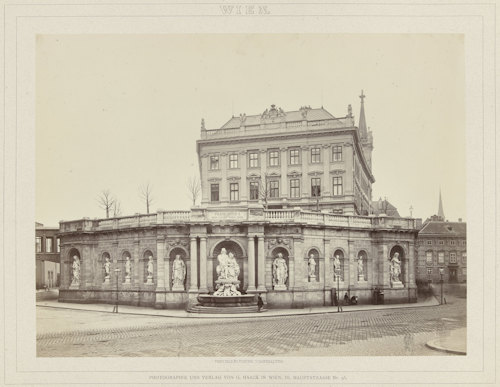
Photos: Historical photos of Vienna, Historic B&W photos of Vienna, Austro-Hungary (19th Century) | MONOVISIONS - Black & White Photography Magazine