
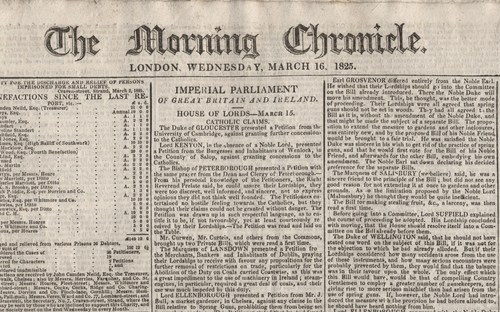
In 1829, after he learned shorthand, Dickens established himself as a reporter for the law courts, Parliament, and various other London newspapers, and in 1831, he joins the staff of the Mirror of Parliament. He would transcribe speeches by members of Parliament on topics such as factory conditions, penal reform, education reform, and Poor Law Commission. It is in 1834 that Dickens becomes a journalist for the Morning Chronicle, a job that now required him to frequently travel and attend political meetings. It is with this background that, I believe, laid the groundwork for what would be his political statements on the subjects of child labor and workhouses while writing Oliver Twist between 1837-1839. I think it’s also important to note that when the Poor Law Amendment Act (1834) was put in place, it ended relief given to the poor and forced those who needed assistance to enter workhouses, which is when the abhorrent conditions could more fully be seen, further giving Dickens fodder for Oliver’s background in the novel.
Work Cited:
Dickens, Charles. Oliver Twist, Barnes & Noble Books, 2004.
Image source:
“Morning Chronicle 1825.” Https://Www.arthur-Conan-Doyle.com, www.arthur-conan-doyle.com/index.php?title=File:Morning-chronicle-1825….
