
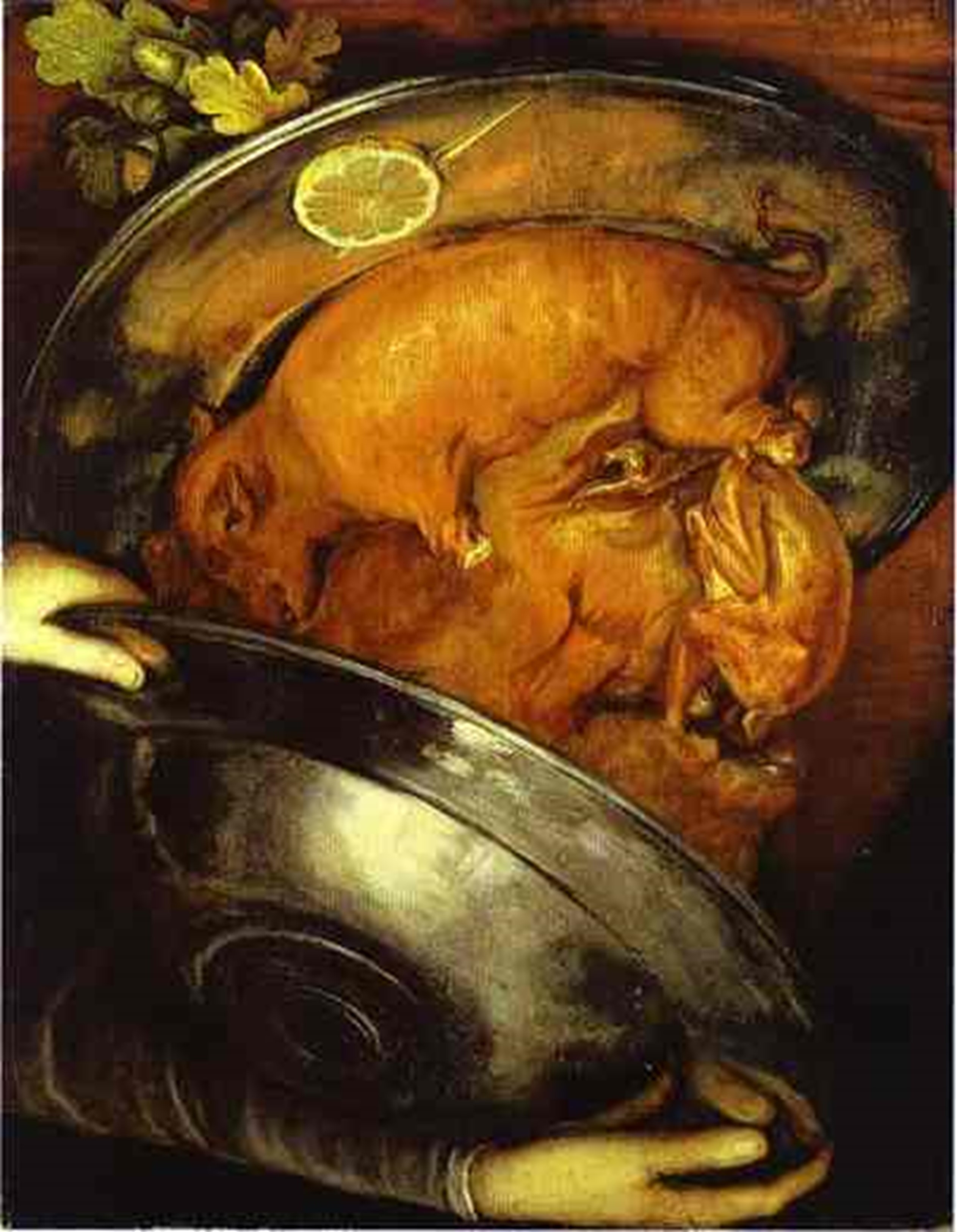
In 1936, the Museum of Modern Art in New York held an exhibition titled Fantastic Art, Dada, and Surrealism. Importantly, this exhibition hosted older works from the sixteenth- and seventeenth-century artists Arcimboldo and Joost de Momper. The style of these Renaissance-era European artists later influenced the art styles of the surrealists, especially in their representations of faces and figures transforming into non-human objects (Ades 40). Arcimboldo, for instance, created paintings of fruits, vegetables, and other objects arranged in such a way to closely resemble a human face. Joost de Momper similarly made landscapes that came together to form a face, which Dawn Ades refers to as “figure-landscapes,” (40). Importantly, the works of these artists are painted in a realistic, representational form similar to the later style of surrealism found in the works of Dali, Magritte, and many other surrealists. It is this dream-like impression of a human face within completely separate objects that resonated strongly with the surrealists. A particular consequence of Arcimboldo’s and de Momper’s styles is the dehumanization of their subjects. Their subjects are not quite human nor entirely non-human but exist in a strange limbo between. When combined with male surrealists’ tendency to use female subjects, the dehumanization of women within their work leads to a latent misogyny present throughout much of the movement.
Ades, Dawn. “Notes on Two Women Surrealist Painters: Eileen Agar and Ithell Colquhoun.” Oxford Art Journal, vol. 3, no. 1, 1980, pp. 36–42. JSTOR, http://www.jstor.org/stable/1360177. Accessed 19 Mar. 2023.
Arcimboldo, Giuseppe. The Cook. Nationalmuseum, Stockholm. 1570. https://www.wikiart.org/en/giuseppe-arcimboldo/the-cook. Accessed 30 Mar. 2023.