
Plate 1 depicts stars and galaxies, imaged by the European Space Agency using the Hubble Space Telescope, as we know them today. There are multiple perspectives on the story of how such stars and our lives came to be. Alan Lightman’s Mr g offers an interesting take on the story of creation. The novel is told from the perspective of Mr g, who is essentially God, but not the traditional all knowing, all controlling figure we imagined in the Bible. In the beginning of the novel, Mr g exists a formless void, along with his Aunt Penelope and Uncle Deva. There is no time, no matter, and no space, just stillness. One day, Mr g decides to create a universe. He does not seem to have a big plan in mind, he simply had been thinking for a long time and began, purely out of boredom. He goes through trial and error, deleting some universes along the way. He eventually settles on a universe governed by consistent natural laws of space, time, matter, and energy. After establishing the basic laws of physics, Mr g mostly steps back and watches the universe grow. He does not design every star or planet. Instead, he creates a set of rules and lets things evolve naturally. Stars are born, galaxies swirl, planets form, and eventually, conscious beings emerge. Mr g is surprised by how complex and unpredictable life becomes. He does not control every decision that living beings make, which leads to a lot of philosophical questions about free will and suffering. Such questions come mostly through Belhor, a character who appears early in the novel. Belhor challenges Mr g at every step, asking why a universe with pain and injustice is allowed to exist. He is not exactly a villain, but more of a critic and skeptic. He forces Mr g, along with readers, to think more deeply about what it really means to create something. Belhor is always accompanied by two silent figures, Baphomet Large and Baphomet Small, who rarely speak but always add to the sense of unease around Belhor. In the end, Mr g realizes that true creation means letting go. He cannot control everything, and he cannot prevent suffering without taking away the freedom that makes life meaningful. The novel finishes on a bittersweet note, as Mr g accepts that his universe will never be perfect but will always be beautiful because it is free to grow and change on its own. The setting of the novel shifts from the empty void to the dynamic universe, and Lightman’s style mirrors that change. His writing is clear, simple, and balances scientific ideas with deep philosophical and theological questions. Lightman makes the story feel surprisingly personal and relatable, even though it covers the creation of everything.
Pictured in plate 2, Alan Lightman is an American physicist and novelist known for exploring the intersection of science and the humanities. Born in Memphis, Tennessee, in 1948, Lightman earned his BA in physics from Princeton and a PhD from Caltech (MIT). He has held academic positions at Harvard and MIT, where he was the first person to receive a dual faculty appointment in science and the humanities (MIT). Many of his novels, including Eistein's Dreams (1992) and The Diagnosis (2000), reflect his fascination with philosophical and existential questions like the creation of the universe (MIT). Understanding Lightman's background helps readers understand Mr g on a deeper level. The novel blends scientific ideas with philosophical and theological questions in a way that feels very natural. Lightman writes about concepts like time, space, and quantum mechanics with authority, and he pairs those ideas with large questions on meaning, morality, and existence. This interdisciplinary background shapes the tone and style of Mr g. Lightman's prose is clear and often poetic, but never overwhelming or overly technical. He uses simple language to talk about complicated ideas, which makes the novel accessible, even when it deals with subjects like cosmology and consciousness. It also impacts the novel’s philosophical tone. Rather than offering one clear religious or scientific message, Lightman leaves a lot open to interpretation, allowing the reader to merge these two disciplines as they see fit.
Plate 3 is an image of Michelangelo’s The Creation of Adam (1512). It is a depiction of a very biblical frame of creation, emphasizing the story of Adam and Eve that we have become so familiar with. The story of creation found in Mr g has similarities and differences to this story. Like the Bible's account in Genesis, Lightman's novel opens with an empty void and the sudden decision to bring a universe into being. However, the way Mr g goes about creating the universe is different from the God we see in Genesis. In the Bible, God creates with purpose and authority, shaping the world we know over the course of seven days. In Mr g, the act of creation is more experimental. Mr g is thoughtful, but he is also figuring things out as he goes, which makes the process seem human and uncertain. Mr g also connects to the theme of free will seen in the Bible. In Genesis, human beings are given the freedom to make their own choices, even when it leads to mistakes like the fall in the Garden of Eden. Similarly, in Mr g, once conscious beings emerged, Mr g refuses to control their decisions. He believes that real existence means having freedom, even if that freedom leads to suffering, injustice, and pain. This idea ties closely to the biblical tension between God's power and human agency. There's also a clear parallel to the notion of evil in the Bible, especially in books like Job. Belhor's constant challenges to Mr g's decisions mirror the role of Satan in the book of Job by questioning why suffering is allowed to exist in a world created by a good and powerful being. Mr g's refusal to intervene mirrors the way God often allows suffering to happen without clear explanation. Mr g also relates to the exploration of the purpose of life and existential tone seen in Ecclesiastes. Human understanding being limited in its ability to understand divine creation is a theme that remains in Mr g.
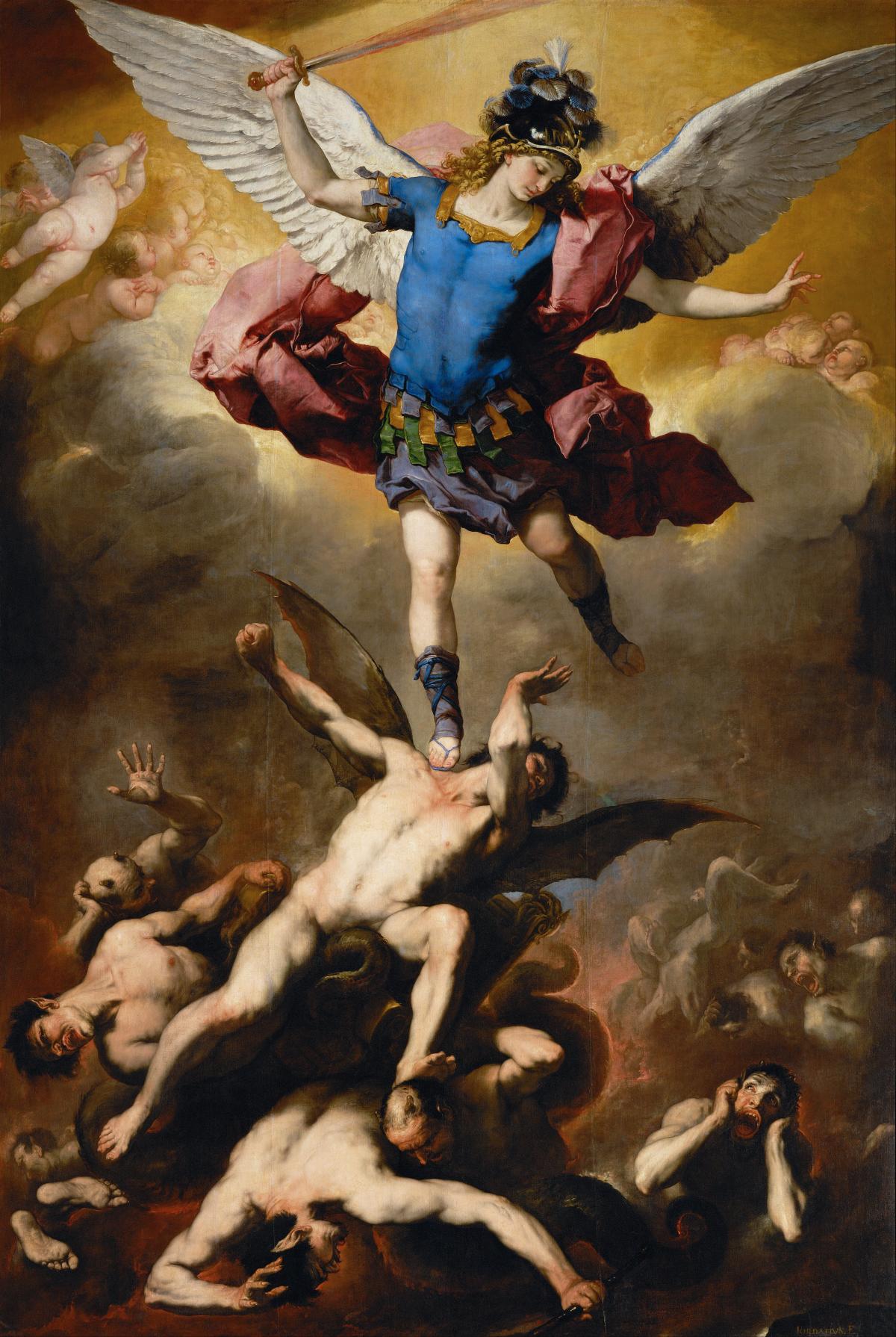
The fourth plate is an image of The Fall of the Rebel Angels by Luca Giordano (1666). For this purpose, it reflects the philosophical battle between Mr g and Belhor as Archangel Michael and Satan, respectively. The themes from this painting, an adaptation from Revelation 12:7-9, remain prevalent in Mr g’s feuds with Belhor. One such example is after Mr g and Belhor watch a starving girl steal food from her neighbors, when Mr g says how he “could have intervened. [He] could have prevented all of this from happening,” to which Belhor responds with “and would you also have intervened in the trillions upon trillions of other cases?” (144). Throughout Mr g, Belhor plays the exhausting role of devil’s advocate, constantly and consistently poking potential problems at Mr g. Lightman does draw more directly from the Bible in other scenarios, though.
The openings of each text are in sharp contrast. As we know, the Bible opens with, “in the beginning when God created the heavens and the earth…” (Gen. 1:1). This sets the stage of divine authority and flawless decisions. However, Mr g “had just woken up from a nap when [he] decided to create the universe,” (3) which demystifies creation and condenses it to a human-like task.
Another parallel is the use of “good” in each creation story. In Genesis 1, it is repeated that “God saw that it was good” after his creations, tying the word to divinity. But in Mr g, he “decided that these things were good also, although [he] was not sure at the moment exactly what they would be good for,” (47). Later, after the first day in the universe, Mr g states that “it was good (or at least satisfying),” (79). The use of the word good in Mr g is hesitant and declares something as acceptable rather than divine, but it is strategically used by Lightman to refer to the Bible.
Furthermore, Mr g is much more dynamic than the God we see in Genesis. Mr g says himself that he has “limited patience” (52) and later told by his aunt that he is “acting greedy” (89). Beyond all this, “although [he is] the creator, [he has] learned much from what [he has] created” (146). The dynamicity of Mr g helps the creator become more relatable, allowing the reader to leave some slack for the shortcomings and mistakes he has and will make. While not exactly consistent with what we saw in Genesis and the Old Testament, it is an interesting choice and perspective given by Lightman.
The biggest difference between the texts is the execution of creation. In Genesis, God has a very structured and refined method of systematic creation, finishing with the creation of humans. But in Mr g, multicellular organisms emerge randomly by “following the rules of chance and necessity…without any direction by” Mr g (99). In his idea of the creation of the universe, Lightman chooses to lean on scientific evidence, rewriting the biblical concept and suggesting that the two cannot coexist. Lightman provides a unique take on the creation story of the life humans understand. He challenges the biblical understanding in a respectful yet provocative way, leaving readers to decide for themselves the answers to existential questions.
Link to presentation: WQ.Bible in Lit Project Presentation.pptx
Works Cited
Coogan, Michael D., editor. The New Oxford Annotated Bible: New Revised Standard Version with the Apocrypha. 4th ed., Oxford UP, 2009.
Lightman, Alan. Mr g: A Novel About the Creation. Vintage Contemporaries, 2012.
"About Alan Lightman." MIT Comparative Media Studies/Writing, Massachussetts Institute of Technology, https://cmsw.mit.edu/alan-lightman/. Accessed 20 Apr. 2025.
Images (in descending order):
ESA/Hubble. Wikipedia, https://en.wikipedia.org/wiki/Star. Accessed 20 Apr. 2025.
Lionstar, Michael. Alan Lightman. 2022, Wikipedia, https://en.wikipedia.org/wiki/Alan_Lightman. Accessed 20 Apr. 2025.
Michelangelo. The Creation of Adam. 1512, Wikipedia, https://en.wikipedia.org/wiki/The_Creation_of_Adam. Accessed 20 Apr. 2025.
Giodano, Luca. The Fall of the Rebel Angels. 1666, Wikipedia, https://en.wikipedia.org/wiki/Michael_%28archangel%29. Accessed 20 Apr. 2025.