
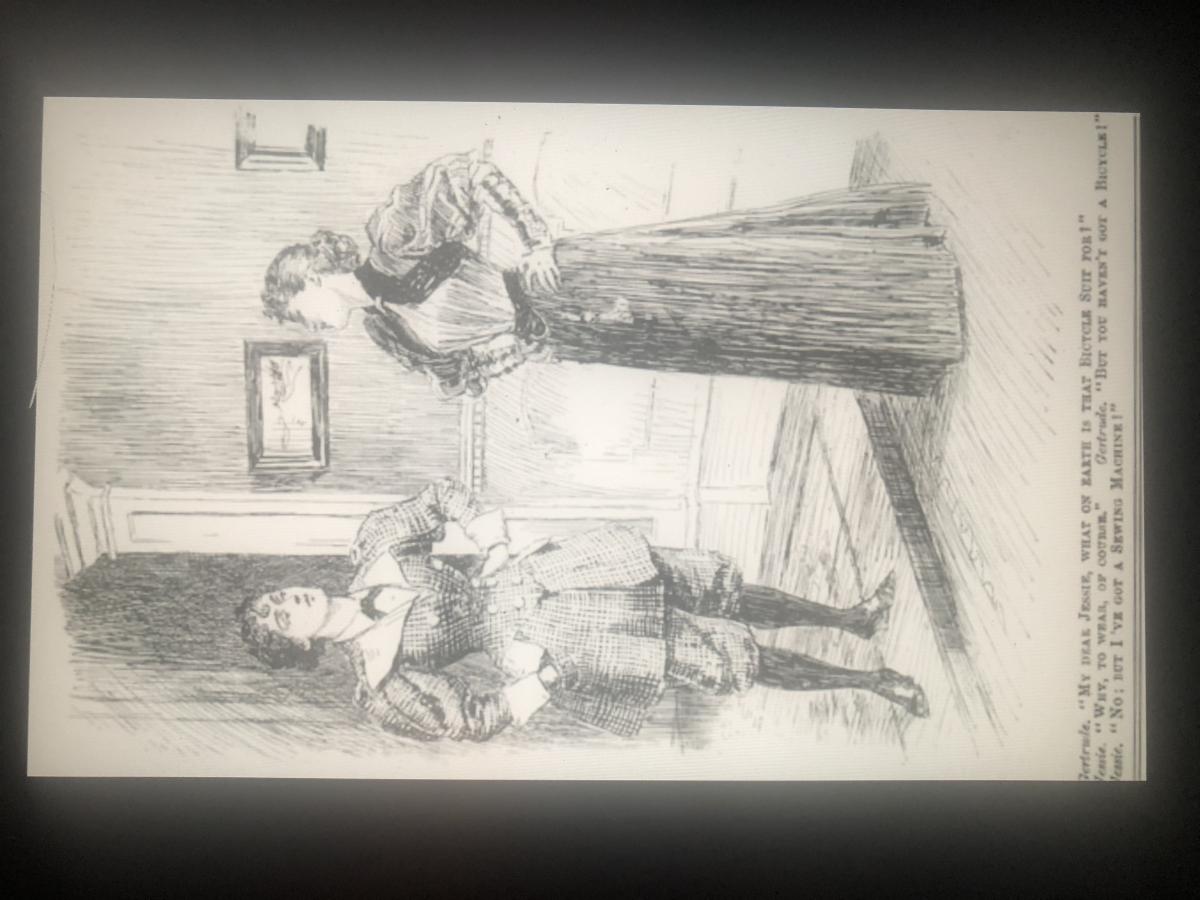
The New Woman: This hardly is a cartoon to me; it is reality. Society expects women to wear such ridiculous and inconvenient items, all to fit the mold of what men consider favorable. Women wear dresses with hoopskirts or other invasive objects to hold the shape of the dress. Corsets are also commonly worn to slim the waist. The smaller the waist, the more desirable a woman is to a man. While many women endure this excessive struggle daily, I only see the hoopskirts and corsets as rather restrictive. When I wear these things, it feels as though my body is in need of oiling, for I simply cannot move! The bicycle suit has none of these restrictions; it allows free movement of the body. I wear it when participating in physical activities such as cycling, which is a new concept for women. Physical activity is considered hazardous to my sex’s health, which is a preposterous idea. In addition, I wear a bicycle suit when I am not physically active, as I see it as common sense to wear what is most practical. However, this does not come without much questioning. Women of traditional styles look down upon me as if I am breaking the law. I am questioned, just like Jessie, as to why I am wearing such an outfit. This does not sway me from my stance, as being a New Woman is no walk in the park. It is a change in how one lives so that in time Jessie and I are the societal standards. I chose this cartoon because Jessie is me. Jessie is a New Woman.
Editorial Commentary: This cartoon pokes fun at the societal dress codes of the Victorian Era. According to Lynn Abrams in a journal article on Victorian women’s ideals, it was common for women to wear metal braces or other pieces of hard material under their dresses. These supports, such as a hoopskirt frame, were in place to give the dresses a desired shape. While successful in shaping the dresses, these supports were extremely uncomfortable. In addition, tiny waists were considered desirable, so women would wear corsets. A corset’s job is to restrict the waist into the desired skinny mold. These corsets were both uncomfortable and potentially dangerous, as they restricted breathing and caused organ displacement. By the late 19th century, women were looking for less harmful, more practical attire. Thus, enter the bicycle suit. Made without any of the restrictive materials, it provided superior comfort. These suits were popularized by the New Woman; these women were progressives who valued the comfort of their clothes over what society considered normal. In the cartoon, Gertrude questions Jessie’s choice of clothing, as Jessie does not have a bicycle. The cartoon exemplifies the shift in style that the New Women were bringing about. No longer were bicycle suits only for physical activity; they were beginning to be worn as everyday attire. Such as Jessie says she is sewing, this is an activity that does not require the mobility and comfort that bicycle suits afford. Instead, it is a choice to wear it. Making this choice to change one’s style of clothing for the sake of comfort is a characteristic of the New Woman. These progressive women looked for ways or practices that were not practical and sought change. Change is exactly what they achieved in the popularization of the bicycle suit.
“The Bicycle Suit.” Punch, Scanned by George P. Landow, 1895, p. 23.
Abrams, Lynn. "Ideals of womanhood in Victorian Britain." BBC History, 9 Aug. 2001.