
Display Explanation
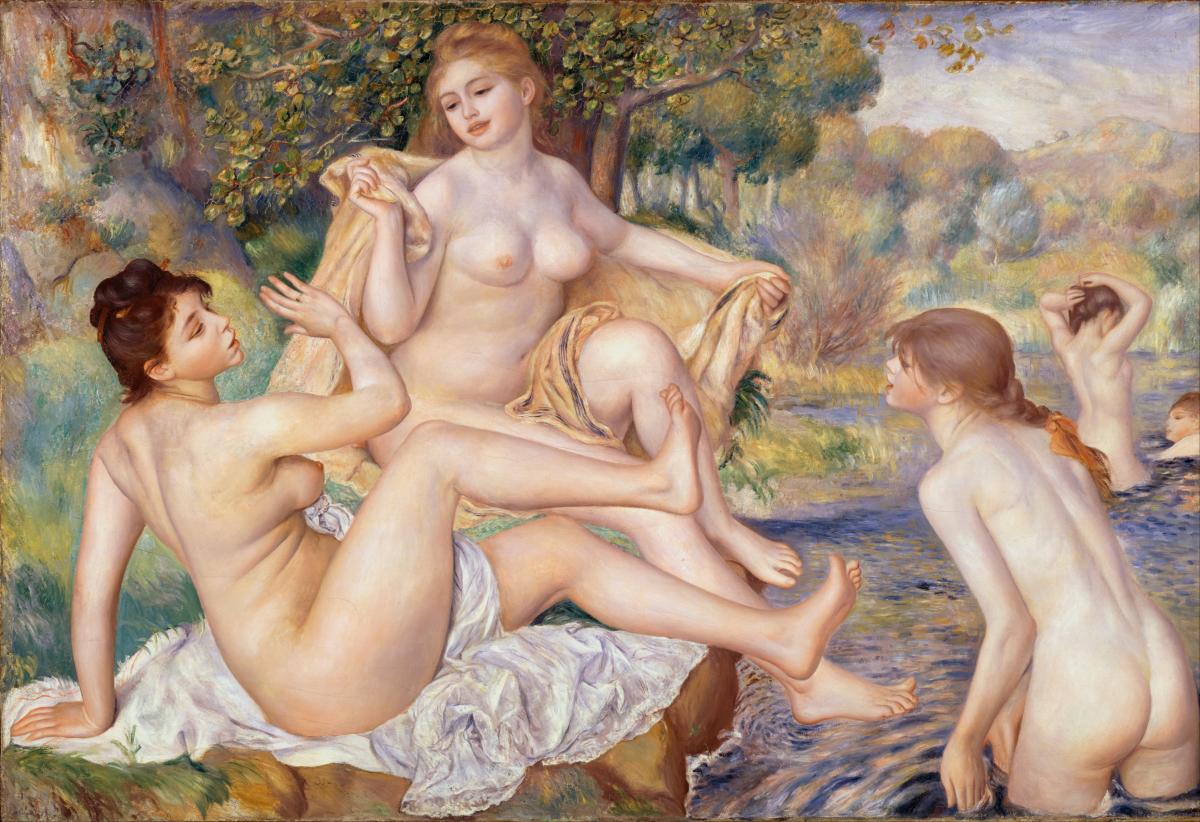
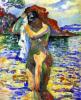
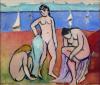
My three paintings will be presented in a manner with them all rotating clockwise would start with “The Large Bathers” by Pierre-Auguste Renoir, then it will go to “Woman Bather” by Henri Manguin, and the last one will be “Les Trois Baigneuses” which translates to “Three Bathers” by Henri Mattise. They will be in a museum, and they will be placed on a table with a rotator like a turntable but big enough to be able to have the paintings on it. They will be showing how different artists perceive people bathing with differentiating painting styles, even if all three of these artists are French. It will be spinning the paintings clockwise slowly, but constantly. There will be an option for the viewers to press a button to make it stop spinning, this will give them a chance to read. There will be a little section of writing about the artist that painted the image, mainly about their life and accomplishments that they earned throughout their painting career. It will also have sections of the installation note including what made it stand out and connecting it to the other paintings. This will have individuals when they come up to look at the trio of paintings. It may make them see a different painting first, this can make them portray the similarities and link the paintings in different ways. Although they all have the same main thought or idea the different order you see the paintings can spark new ideas about how they are connected or how they differ from each other. This could be in terms of colors surrounding the images, expressions on people's faces, or other factors. I would want the table and the back wall to be both neutral colors, like using Earth tones. I would look to use colors like brown, olive green, or even an off-white because all the paintings are in an outside setting; these colors will complement them nicely. I wanted to choose these images because they show how individuals would progressively bathe in public waters. It shows the women and how they go along bathing, with the first one the women are about to go in the water, then it is a woman in the water, it seems like she is washing herself. Then for the final picture, it is them out of the water drying off. The information about the paintings was difficult to find because they are all online; the websites did not give me any definitive sizes of each of them. I would present them in a way where they are all the same size on approximately a 24x36-inch canvas. I want them to be the same size because even though each image is very different in the way it can be portrayed they are all equal and I don’t look at one above the other. I wouldn’t want too many other things going on because then that can take away from the paintings themselves, the details and aspects around them are used to exemplify details that maybe the viewer may not see if they were looking at the paintings normally. The plan would have this set of paintings be away from other paintings in the museum because we would want the viewers to only focus on this trio, so they can view them with deeper thought and meaning.
Installation Note
These three paintings work well together in an installation because they all have the same main thought with women bathing in a public body of water, but many other connections can be made throughout them. One thing that sticks out to me that all these paintings have in common is their backgrounds because they are all bathing in body water which means they all take place outside. This can give more of an emphasis on its background with its colors and things going on. This is evident in all of the paintings because those are the first things that stuck out to me when viewing these paintings for the first time. The greenery and hills going on in “The Large Bathers”, while “Les Trois Baigneuses” has sailing boats and the water seemingly goes on forever to the horizon, then the “Woman Bather” has a mixture of colors that is hard to identify with the abstract painting style that Maguin uses. Another connection that I was able to make through these three paintings was that the women in them are all open to the viewer. This shows a sign of power and confidence, in which they are not hiding any parts of their body from the viewer. It shows they are not afraid to show off their body to the public, even though some of them have a towel trying to dry themself. They are drying their hair and other parts of their body. All of these artists that I’ve chosen paintings from are French and it seems like they only paint women in their paintings. This gave me the idea that naked women in a painting are more captivating and will attract more viewers to it compared to if there were men painted as well. It seems more like when there are naked women in a painting that it is empowering and real art, compared to a man where individuals may look at it as creepy and make the viewer uncomfortable. Also that they were all painted around the same time, which is the late 1800s and early 1900s. It shows a differing view and style from different artists with each one contradicting the others in many ways. The thought of clarity and how realistic they are come into play when I look at my installation, with the three paintings. This is evident in them because in “The Large Bathers” looks like a very realistic painting with many details for each of the individuals in it, including the background. Then for “Les Trois baigneuses'' looks more like an animated painting with the colors and the people in it, with it having fewer details like not being able to see the women's facial expressions. The painting “The Bather” is a drastic change compared to the other two with its painting style as a whole. Manguin chose to do more of an abstract style, in which everything blended into each other, and at first, the viewer may not see the image correctly, but they will then notice the correlation between it and the other paintings. This is another way to represent the connections between the paintings because as I stated earlier they will be rotating clockwise and the meaning and connections can differ between every individual with what painting they see first, or how they interpret them.
Citation List
Renoir, Pierre-Auguste. The Large Bathers. 1884-87. https://en.wikipedia.org/wiki/File:Pierre-Auguste_Renoir,_French_-_The_Large_Bathers_-_Google_Art_Project.jpgLinks to an external site.. Acessed 27 Feb 2023
Wikimedia Foundation. (2018, July 9). File:Henri Matisse, 1907, Les Trois Baigneuses (three bathers), oil on canvas, 60.3 x 73 cm, the Minneapolis Institute of arts.jpg. Wikipedia. Retrieved February 27, 2023, from https://en.wikipedia.org/wiki/Henri_Matisse#/media/File:Henri_Matisse,_…
,_oil_on_canvas,_60.3_x_73_cm,_The_Minneapolis_Institute_of_Arts.jpg)
Woman bather, 1906 by Henri Manguin: History, Analysis & Facts. Arthive. (n.d.). Retrieved February 27, 2023, from https://arthive.com/henrimanguin/works/544439~Woman_Bather