
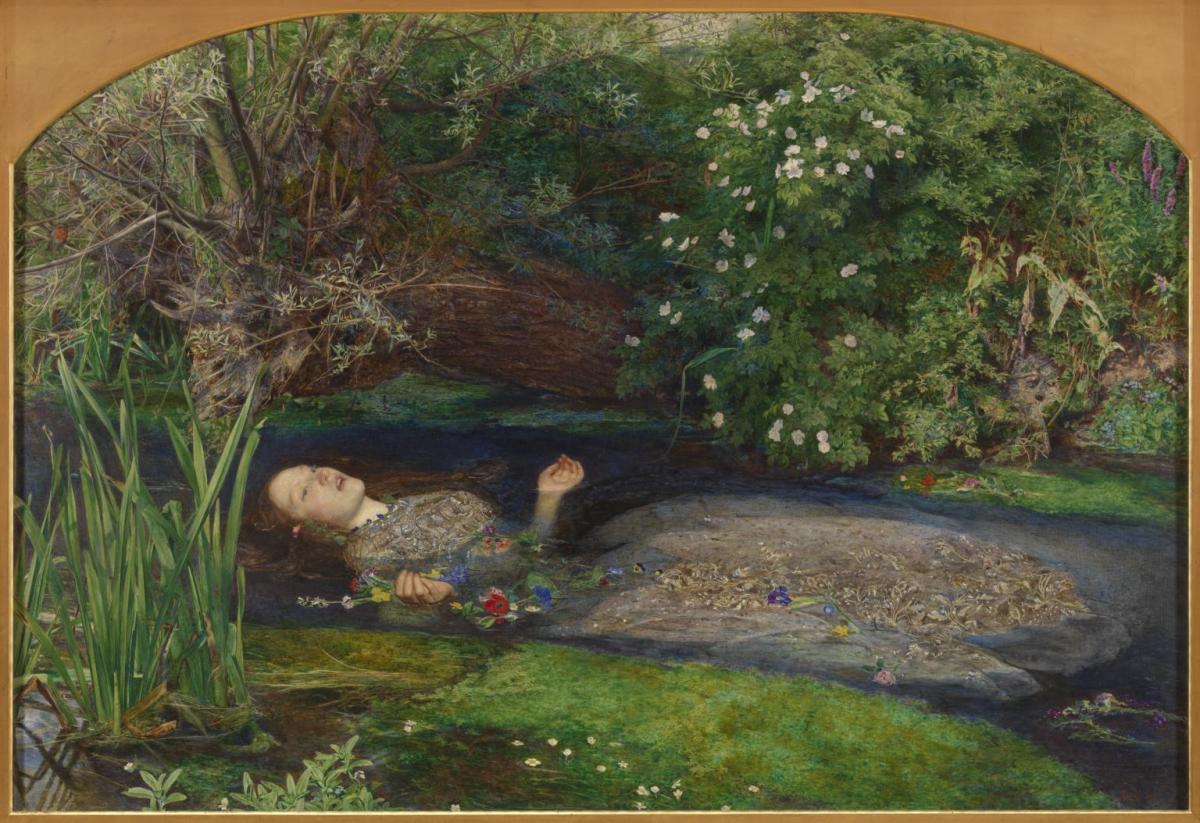
Ophelia, by John Everett Millais, represents the artistic movement of painting beautiful yet melancholy scenes of young, beautiful, and naïve girls (Painting Shakespeare 55). This was one of the artistic movements seen throughout Pre-Raphaelites’ paintings as these Pre-Raphaelite Brotherhood (PRB) artists idealized love and death that overcame young, beautiful females (Painting Shakespeare 55). Millais’ purpose in painting was to follow the source of his muse as closely as possible to bring meaning and to stay true to what the original author of this idea composed. Although Millais’ exceptional attention to detail and symbolism revealed a few of his personal inputs, Millais’ personal touches strengthened and maintained Shakespeare’s description of Ophelia.
Ophelia is based off Shakespeare’s tragedy Hamlet where Millais brings to life various sections in Hamlet. (Painting Shakespeare 56). The painting matched Gertrude’s lines identically from the background to the expression on Ophelia’s face. For example, Gertrude states that Ophelia “chanted snatches of old tunes... as one incapable of her own distress” (Hamlet, act 4, scene 7, lines 167-84). Millais’ attention to detail and the PRB’s attraction to a female’s romantic, naïve characteristics came into play with Ophelia’s mouth slightly opened to represent Gertrude’s assumption of her signing and disillusion to her dire situation. The Pre-Raphaelites believed in the Victorian society gender constructs that supported the inferiority and vulnerability of women to men. According to Victorian Fashion, Ophelia’s hair pulled back in what appeared to be a bonnet and her attire of multiple petticoats displayed her as an appropriate Victorian woman of the 1850s. Given the heavy weight of the petticoats, Ophelia is sinking slowly allowing Millais to emphasize an elegant appearance of Ophelia. Along with her ignorant facial expressions and ornate attire, the beautiful forest behind her and the array of flowers embracing her amplify the PRB’s idealization of innocent, appropriate Victorian women’s death.
The forest background depicted every use of imagery within Gertrude’s lines and incorporated other key descriptions of Ophelia within Hamlet. Artists within the PRB utilized symbolism frequently which illustrates Millais’ addition of a robin. Millais does not stray away from the original source as a robin appeared in a song Ophelia sang. The flowers that surround Ophelia represent various meanings prevalent within Shakespeare and Victorian society; however, Millais addition of daisies and forget-me-nots manipulate Ophelia’s original character by morphing her slightly into a Victorian society woman (Benton and Butcher 57). Disrupting the original source contradicts Millais’ promise to bring truthfulness to his art, but as daisies represent innocence and forget-me-nots offer a romantic feeling this strengthens the message of a beautiful, angelic woman peacefully approaching her death.
The dark contrasts of the navy blues and forest greens offer an eerie feeling as Ophelia is slowly being consumed within the dark shadows. Her beauty and sudden burial of flowers offer an unsettling feeling of hopelessness as she is physically and mentally captured by her heavy attire and mindset. Despite the intricacy of her dress and the flowers that surround her, her face and hands are what the eye is drawn to as they are the most pronounced given her pale skin. The PRB was known to utilize facial expressions to convey their messages regarding their art. Also, the stream is quite thin as it perfectly fits and shapes Ophelia’s body. Interestingly, the tall grass to the left of Ophelia’s face seems to be positioned to cover the extension of the stream so that Ophelia is the main focal point. Likewise, the individual hairs of the tall grass and the thin branches above frame Ophelia’s face lead the viewer’s eye to analyze her facial expression; her facial expression reveals the meaning behind her dangerous situation.
Millais’ ability in Ophelia to use horizontal scope narrows the focus for the viewer and helps them appreciate the realistic facial expression of Ophelia, the symbolism of the flowers and her attire, and the intricate detailing of all aspects. Although the multiple colors of the flowers that lay on top of her are greatly pigmented, the white flower buds on the bush just beside her immediately attract the eye as well. White signifies innocence and virginity which relates to the delicacy Victoria woman were forced to embody. This bush with the white flower buds slightly sticks out, edging closer to Ophelia and offering a narrower space for the eye to look.
In Ophelia, Millais realistic depiction of Ophelia, according to Hamlet, combined with his use of the forest background, dark contrasts, and horizontal scope to reflect his unique interpretation of Shakespeare’s original work. Millais’ membership within the PRB is shown in his realism, natural themes, and intricate detail. At the same time, Ophelia reveals Victorian gender constructs with Millais’ presentation of an aloof, innocent, and appropriate Victorian woman.
Benton, Michael and Sally Butcher. “Painting Shakespeare.” The Journal of Aesthetic Education, vol. 32, no. 3, 1998, pp. 53-66, http://ezproxy.depaul.edu/login?url=https://www.jstor.org/stable/3333305. Accessed 23 Oct. 2020.
Dwyer, John. “Garden plants and wildflowers in Hamlet.” Australian Garden History Society Inc, vol. 24, no. 2, 2012, pp. 5-8, 34, http://ezproxy.depaul.edu/login?url=https://www.jstor.org/stable/249188…. Accessed 23 Oct. 2020.
Millais, John Everett. Ophelia. 1851-2. Tate Britain, London. https://www.tate.org.uk/art/artworks/millais-ophelia-n01506. Accessed 25 Oct. 2020.
Moritz, Reiner. “John Everett Millais – Ophelia.” Alexander Street, produced by ArtHaus Musik, 2012. https://video-alexanderstreet-com.ezproxy.depaul.edu/watch/john-everett…
Shrimpton, Jane. Victorian Fashion. London, Shire Publications, 2016.