
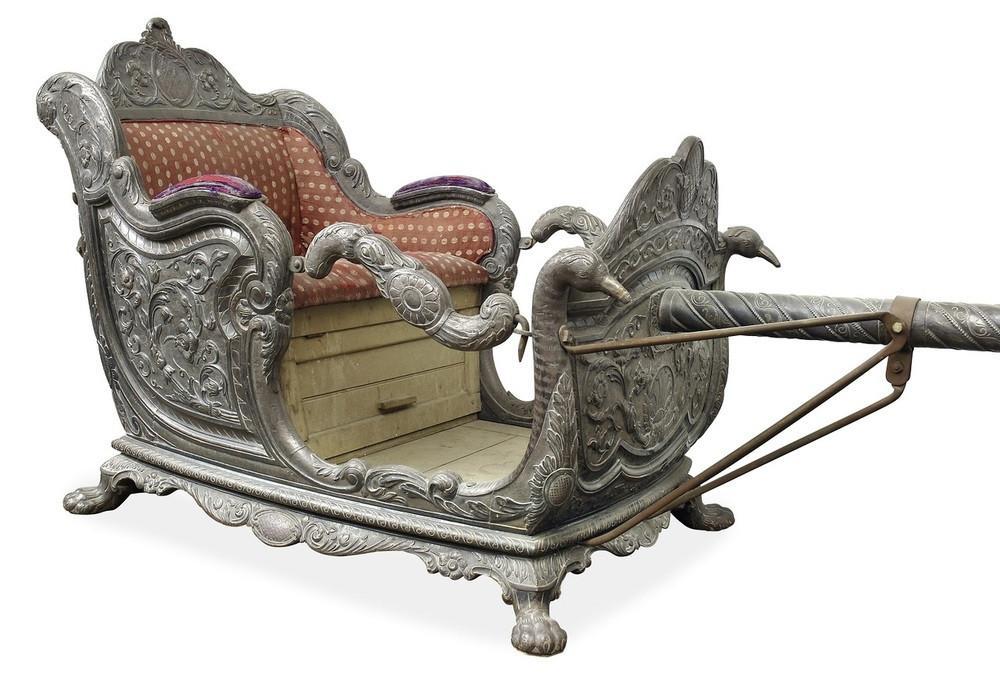
A Palanquin is a covered wheel-less carriage (litter) carried on two horizontal poles by men. The tradition of wheel-less carriages for travelling short and long distances is very old in Indian subcontinent; and its use was often restricted to royals, nobles, and the wealthy. The people who carried these palanquins were variously known as Kahār, Gond, or Bhoi in North and central Indian. These are hereditary servants of the three highest divisions of castes--the Brahman, Kshatriya, and Vaisya, from whom they receive compensation on a fixed scale. Because their service is of a domestic nature, they have a good deal amount of interaction with their patrons and are often on fairly intimate terms with them. After all, the men of no other caste gain entrance to interior, and centainly not the women's apartments, of their employers' homes. Kahār men can even tease and joke with higher caste women for whom they work.
Knowledge of palanquin enriches our understanding of Sen's autobiography. First, it connotes social and economic inequality--the ability of the higher castes to exploit the labor of lower ones on a hereditary basis is one of the instances of class distinction, and of social immobility (the role of palanquin bearer is hereditary; its compensation is fixed). More importantly, the culture of palanquin bearers makes Sen's wedding scene ironic. Indeed, Sen seemed privileged to be able to enjoy the service of lower caste men. However, she was even more constrained by social conventions. As an upper-class women, she was instructed to be modest--teasing with men (especially those from the lower castes) could be criticized as being inappropriate or even flirtatious, whereas palanquin bearers could joke with upper-class women. Despite her family wealth, Sen became economically dependent on her husband's family; later, she retained little personal property as a widowed child bride after her parents' death. Ironically, despite their low status, palanquin bearers were able to make their own living on a stable basis. All these contrasts point to a more deep-rooted type of inequality: the inequality between men and women. And such inequality is even more remarkable than social inequality. Because she was a woman, Sen's caste imposed strict restrictions on her freedom; but it could not save her from being economically dependent. So which one is more preferable: to be a (male) palanquin bearer of a lower caste, or an upper-class woman as Sen? This becomes a serious question.
Sources:
Opler, Morris E. and Shaligram Shukla. "Palanquin Symbolism: The Special Vocabulary of the Palanquin-Bearing Castes of North Central India". The Journal of American Folklore, vol. 81, no. 321, 1968, pp. 216-234. https://www.jstor.org/stable/537542. Accessed 21 Feb. 2021.
https://grahamgeddesantiques.com.au/products/an-early-19th-century-indi…. Accessed 21 Feb. 2021.
https://avtans.com/2020/06/13/the-secret-language-of-palanquin-bearers/. Accessed 21 Feb. 2021.