
Character Commentary:
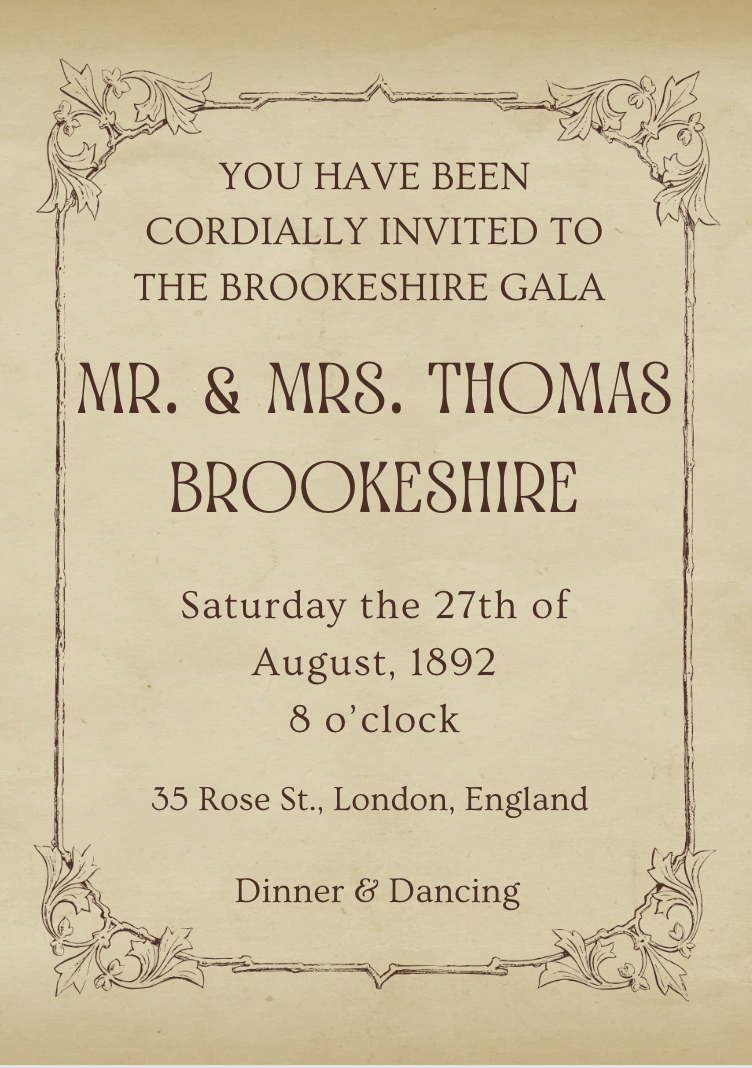
It was around 1 o’clock in the afternoon when the paper boy dropped the invitation on the front doorstep. Once I saw it, I could not have been more ecstatic because this was the first gala of the new season. It had been months since an intriguing party had been hosted, and everyone in town was growing restless. Finally, though, the best part of the year has commenced. I will have to wait to inform my husband of our upcoming outing since he is busy working at this time. It will be so exciting to see the other wives I have not seen in so long because of the lull in between seasons. All of our husbands have been preoccupied with providing for their families, so we have not had any dinner parties recently. I am sure there is a scandal around town that I have not heard of yet, and I am growing anxious just thinking about it. It will be nice to go to the gala with my husband, Septimus, as well. I pray that we will not have to leave the event early due to his business. I understand that he has sacrificed so much for us; however, it would be pleasurable to be able to stay at the party to experience the dancing after dinner. Although I do love to dance, it is not something Septimus enjoys so we rarely stay for it to start. Even if he declares we will not partake in the dancing, I still wish to observe others. However, I do hope to become fortunate enough that Septimus will grant me one dance. I suppose I will find out tonight if my husband will allow us to go to the Brookeshire’s gala.
Editorial Commentary:
In her journal entry, Caroline Pratt details that she received an invitation to a party in 1892, and she goes on to explain how her husband dictates what they usually do at parties. Most women in the Victorian era were under the control of their husbands, or even fathers. Robert Allan Houston explains in “British Society in the Eighteenth Century” how “any improvements in women’s social position occurred within a framework of firm male domination” (Allan 450). Pratt expresses that she can only attend the Brookshire’s gala if her husband allows them to (Pratt). Women during this time most likely did not have many political, social, or economical rights, so they were required to rely on their husband to provide for the family. Due to this reliance, it was possible for women to feel as though their husbands should be able to make the family decisions. Men holding power in relationships and family was also normalized in society and could not be resisted. Pratt even “hopes to become fortunate enough that Septimus will grant [her] one dance” (Pratt). Her journal entry indicates the severity to which men could determine all aspects of his wife’s life; not only her social calendar but her actual decisions. The marital dynamic between men and women in the Victorian era can be summarized by Felicia Appell’s article, “Victorian Ideals: The Influence of Society’s Ideals on Victorian Relationships,” which states that women could not “gain knowledge outside of the home because it was a man’s world” (Appell). Caroline could not attend the gala without her husband because society ruled it unacceptable for a wife to do something without the consent or supervision of her husband or another male. The marital relationship conveyed in Caroline Pratt’s journal showcases the authoritative characteristic of men over women.
Works Cited
Appell, Felicia. “Victorian Ideals: The Influence of Society’s Ideals on Victorian Relationships.” Victorian Ideals, www.mckendree.edu/academics/scholars/issue18/appell.htm. Accessed 3 Oct. 2023.
Houston, Robert Allan. “British Society in the Eighteenth Century.” Journal of British Studies, vol. 25, no. 4, Oct. 1986, pp. 436-466.