
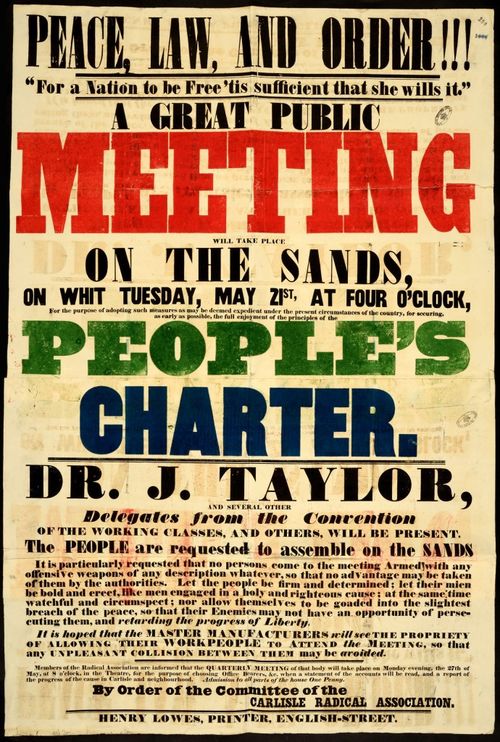
After the Reform Act of 1832, the men of England’s working-class wanted more. A group known as the London Working Men’s Association introduced the People’s Charter in 1838, which illustrated to the London government the demands they wanted met (“The People's Charter, 1838”). Their orders consisted of the following: “one man, one vote; equal electoral districts; payment of members of parliament; elections by secret ballot; removal of property qualifications for MPs; and parliaments elected every year” (“History : British History Timeline”). The charter was rejected by Parliament. Many worried about violence in the city, “Support for Chartism peaked at times of economic depression and hunger. There was rioting in Stockport, due to unemployment and near-starvation, and Manchester, where workers protested against wage cuts, wanting ‘a fair day's pay for a fair day's labour’” (The National Archives Learning Curve: Power, Politics and Protest: The Chartists”). During the period of Oliver Twist, many were faced with the similar bleak reality that Oliver himself experienced. So, like Oliver, they let it be known that they wanted more. The People’s Charter served as a way for the men of the working class to begin and try and gain rights for themselves without having to own property. Unfortunately, women and others like Nancy and Rose would not be able to have rights like those of men for at least a hundred years. Despite their circumstances, some may have clawed their way out of poverty. If the charter had succeeded, the government could have been more balanced and helpful to the poor. However, the charter’s supporters gradually died off until 1848, when its ideas began to be absorbed by other reformers.
Works Cited:
“History : British History Timeline.” BBC, BBC, 2014, www.bbc.co.uk/history/british/timeline/victorianbritain_timeline_noflas…. Accessed 13 February 2021.
“The National Archives Learning Curve: Power, Politics and Protest: The Chartists.” The National Archives, www.nationalarchives.gov.uk/education/politics/g7/. Accessed 13 February 2021.
“The People's Charter, 1838.” The People's Charter, 1838 , Social History Portal, 1 Jan. 1970, socialhistoryportal.org/museum/6804. Accessed 13 February 2021.
Image Citation:
Lock, Alexander, and Margaret Makepeace. “The People's Charter.” Untold Lives Blog, British Library, May 2015, blogs.bl.uk/untoldlives/2015/05/the-peoples-charter.html.