
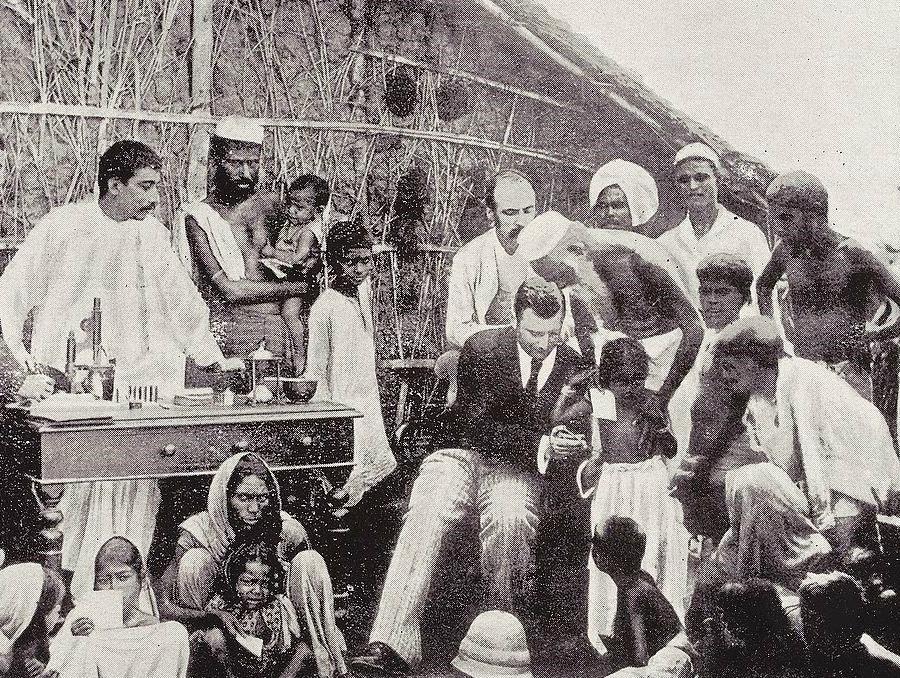
When the British East India Company began to settle in India, the face of Indian medicine began to change. Western medicine claimed superiority over traditional Indian medicine, even denouncing Indian medical practitioners as “quacks.” Traditional medical practitioners were known as vaidyas and hakims. Vaidyas and hakims were among some of the highest respected in Indian society, but their status soon lowered when Western Medicine was introduced with the British East Company. In the hospital, these Western doctors were also known as “civil surgeons” as many were employed by the British East India Company to also serve in the Company’s military. Since many of the Indian natives refused to be seen by Western doctors, the British East India Company began recruiting native Indians and Indian soldiers to attend Medical schools where Western medicine was taught. These recruits were called “native doctors” and were assistants to the civil surgeons. Later, in the 1860s and onward, a new group of paramedical staff known as “licentiates'' began to appear in hospitals. Licentiates attended medical schools specific to their training where admissions were less rigorous and courses were much shorter than those of the traditional medical schools. They were given positions in the lower rungs of hospital administration, but were more easily accessible to Indian civilians who wish to be educated in medicine.
Haimabati Sen began in the hospital as one of these “licentiates” after graduating from the Campbell Medical School in 1894, getting her degree in Vernacular Licentiate in Medicine and Surgery. As demonstrated in her texts, licentiates were not paid very much money nor given very respected positions in the hospital. Sen herself was indeed sexually harassed by one of her hospital higher-ups, a Bengali surgical assistant (pg 199). There was also corruption in the hospitals that Sen experienced and detailed in her narrative. There was one particular experience where a civil surgeon drafted a faulty death certificate for a young girl and both the civil surgeon, the surgeon’s assistant, and Sen, the licentiate, were offered a sum of rupees for it. Sen only received 500 Rs to the civil surgeon’s 5000 Rs, but she still tried to refuse it (pg 193). As a mere licentiate, however, she had no grounds to be able to stop the corruption from occurring in the first place.
Sources:
Saini, Anu. “Physicians of Colonial India (1757-1900).” Journal of Family Medicine and Primary Care 5, no. 3 (2016): 528. https://doi.org/10.4103/2249-4863.197257.