
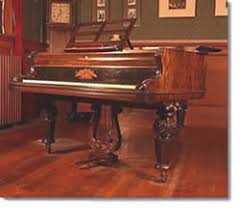
According to Middle March the piano marks a key significance. it was purchased on the 22nd of November 1869 for the50th birthday of the novelist George Elliot in which the Broadwood piano was delivered to a grieving household. the piano was purchased then and represents a deep significance. Not surprisingly, no flurry of references to the new piano fills Eliot’s correspondence at this date. However, the piano has an implied presence as a source of solace a decade later when, on the first anniversary of Lewes’s own death, a line in Eliot’s diary reads Darwin. Schubert’ (Journals, 180). ‘Darwin’ may denote a visitor, or his books; Schubert she must have been playing at the piano. Eliot’s journal further records that she had ‘Touched the piano for the first time’ after Lewes’ death on 27th May (Journals, 175). The piano is, however, representative not just of the personal importance for George Eliot of Romantic music but of its significance for numerous areas of Victorian culture in Britain. the Purchase of the piano was possibly because of Elliot’s success as a novelist. Surprisingly, this was not the first piano she had owed. the first purchase was back in 1861, and was marked as an important early milestone in her successful career. The arrival of Eliot’s first Broadwood was celebrated, on 5th October 1861, with a "Beethoven night" which was the first of many musical evenings in which music of the Romantic period predominated. It seems that Eliot owned numerous Beethoven scores and when she acquired her first Broadwood, she had been playing Beethoven duets ‘with increasing appetite every evening.