

Phyllis Lorimer's commentary:
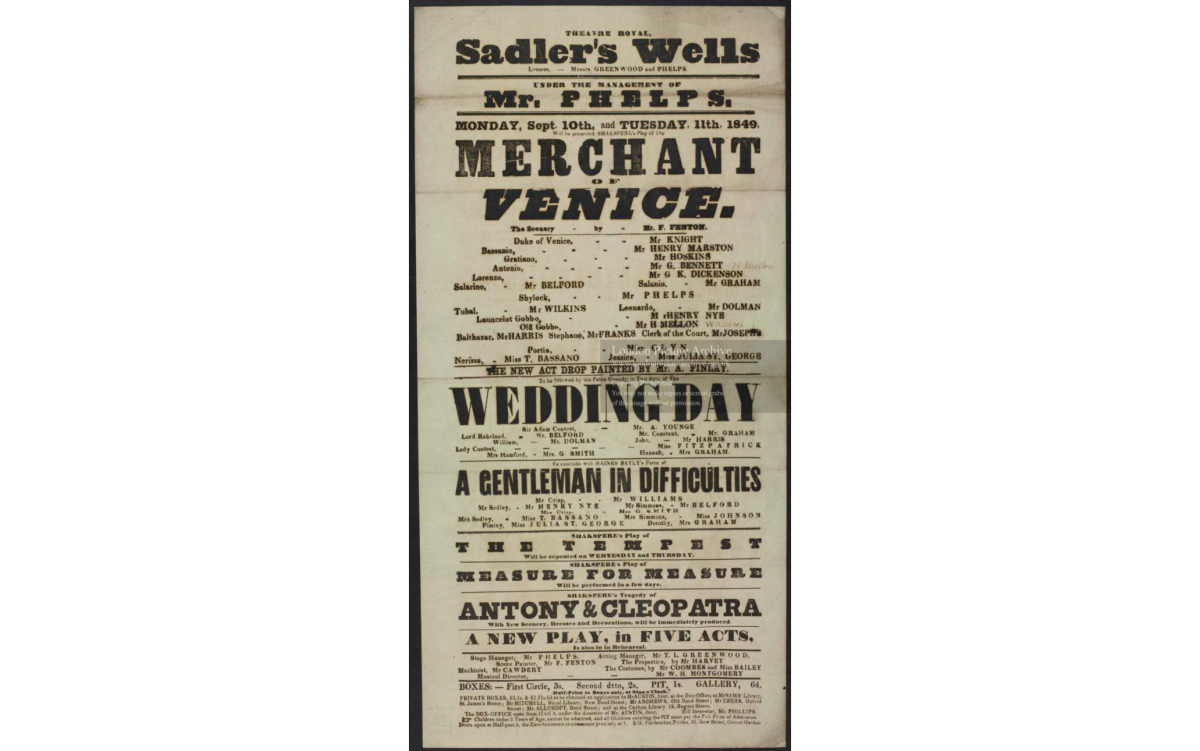
While strolling through the streets with my sisters to collect supplies for our photography shop, an encounter with a young boy working at the Theatre Royal brightened my day. He handed me a small advertisement poster announcing a new play, "The Merchant of Venice." Although I confess I do not know much about the playwright William Shakespeare or his work, the mention of his name intrigued me, and I couldn't help but think of asking Sidney Darrell to join me for this theatrical experience on our next date. However, I am uncertain if Sidney will have the time for a date anytime soon, as he often mentions his demanding work schedule. During my last visit to his studio to sit for a portrait, amidst my fascination with his artistic talents and captivating face, I distinctly recall him discussing various art forms and artists who inspire him. Among those names, I believe he mentioned William Shakespeare. Since my father's passing, I have barely had the opportunity to attend a play, given my commitment to assisting my sisters in running our family photography shop. The prospect of delving into Shakespeare's works excites me, offering an opportunity to broaden my artistic horizons. I hope to learn more about the art that Sidney is passionate about so that we can engage in meaningful discussions during our next meeting. Sidney's artistic and creative nature has always served as a wellspring of inspiration, not only for our family's photography business but also for my personal growth.
Editorial commentary:
During the Victorian era, the time period where “The Romance of a Shop” written by Amy Levy is based, women's rights were very limited regarding their social and sexual freedom. Women had no right to sue, own property or vote. Most women were owned by their husbands or fathers and socially restricted and controlled by men in their lives. Though women were allowed to work outside of their homes most of the time, less than one third of all women during the 19th century were employed (Cossar 17) while most men worked. Women were expected to live up to the image of a perfect wife and mother and always be modest which forced them not to express their desires. Particularly, upper class women were likely to have relatively more social freedom and sexual restrictions than lower class women because of their social status and the reputation. In Shakespeare’s works, especially his famous plays and literature, he tends to choose lower class women as his female characters. It is easy to conclude that the reason behind this is because lower class women were likely to be more socially harmless than women in upper class (Lee 19). He portrays women in various ways but oftentimes women in power are illustrated as women with weird and questionable morals and their endings are usually deaths (Lee 34). However, some argue that Shakespeare contributed to women’s independence and freedom from men during the 19th century and others argue that Shakespeare was just one of the famous male figures who disrespected women like any others.
Sources:
Cossar, Elena. “The Role of Women in Victorian England.” The Role Of Women In Victorian England I Oxford Open Learning, Oxford open learning, www.ool.co.uk/blog/the-role-of-women-in-victorian-england/#:~:text=So%2…. Accessed 11 Oct. 2023.
Jamieson, Lee. “Why the Women of Shakespeare’s Play Are Especially Unique.” ThoughtCo, ThoughtCo, 28 Mar. 2020, www.thoughtco.com/introducing-shakespeares-women-2984938#:~:text=Shakes…’s%20Presentation%20of%20Women,-Women%20in%20Shakespeare’s&text=High%2Dborn%20women%20are%20presented,the%20men%20in%20their%20lives.
“Playbill for the Merchant of Venice.” London Picture Archive, www.londonpicturearchive.org.uk/view-item?i=322679&WINID=1699234030310. Accessed 5 Nov. 2023.