
1914
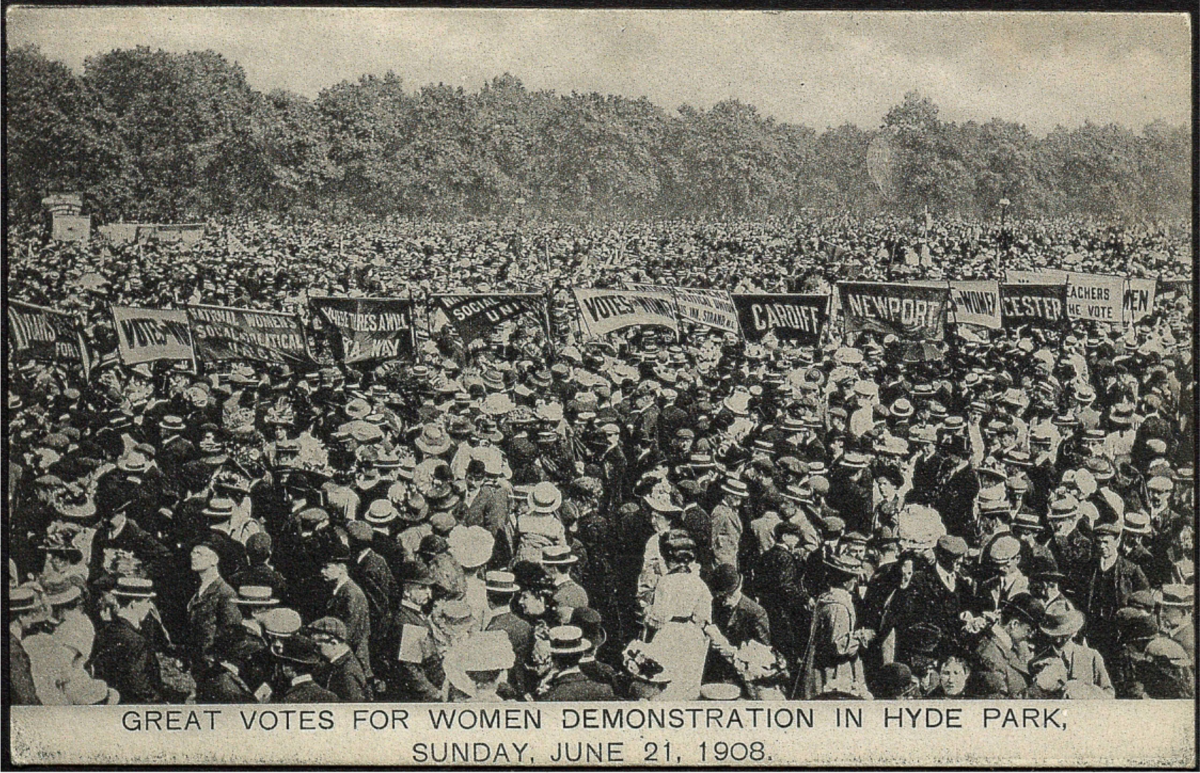
I recently came across this WSPU postcard in one of the local post offices near my home. I was there to simply send a letter to one of my dear cousins, when I noticed this card on the rack next to me. It depicts the demonstration for women’s voting in Hyde Park back in June of 1908. I was so surprised to see this and decided I must purchase it! I was at that exact demonstration all those years ago! I think if you look hard enough, you might be able to recognize me amongst the crowd. I remember it so vividly, because there was so much excitement throughout the park, and just being there was sort of breathtaking. The purpose for my attendance was to stand beside other women and protest for women’s voting rights in England. There were numerous large signs being held not only by women, but by some men too! I was pleasantly surprised by the sheer number of men who turned up at the gathering. It was very relieving to see that we were no longer fighting alone for this important change. Now, I feel as if we are getting closer to our goal every day, especially with the rising number of supporters throughout England. This was six years ago, and since then, there have been so many more demonstrations throughout London. Now, they are much bigger than this one was! At this moment, I feel that the right to vote for women cannot be but a few years away! We have accomplished so much for ourselves despite being told as children that we must depend on men throughout our lives. I think we are finally starting to show that women are just as strong, if not stronger than the men.
The women’s suffrage movement in England unfortunately did not end until 1928, when the Representation of the People Act was passed. With that being said, this woman had to hold out for a bit longer until she earned the right to vote. She was so incredibly hopeful that change was just around the corner, so hopefully she kept up with her fighting for fourteen more years in order to help make that change. During the Victorian era, women were mostly dependent on men. For their entire lives, they were trained to become wives, instead of doctors or writers. Young women were expected to participate in the season for marriage and come out with an engagement. In fact, “the majority of women did not have the option not to marry: it was simply a necessity for survival” (Victorian Women: The Gender of Oppression). Once they were married, they were simply an extension of their husbands. Once a Victorian woman married, “her rights, her property, and even her identity almost ceased to exist” (Victorian Women: The Gender of Oppression). They were expected to bare children and live the life of a mother. Their only job was to be a good mother and wife. Due to this, they did not have their own sources of income, and they really were dependent on their husbands to provide for them. Women earning the right to vote shows that instead of being inferior to their male counterparts, they were closer to equals instead. This woman notes that she is strong and independent, and she does not need to rely on a man. She mentions that this goes against how she was raised, and that is likely the reality. She was raised to think that she needs a man in order to be successful, but she is starting to realize that is not really the case.
"Historical Analysis: Women as 'the Sex' during the Victorian Era." Victorian Women: A Gender of Oppression, webpage.pace.edu/nreagin/tempmotherhood/fall2003/3/hispage.html.
Wilson, E Hartley. c.1913-1914. W.S.P.U. Postcards. Gender: Identity and Social Change[Postcard]. At: Place: Bryn Mawr College. Available through: Adam Matthew, Marlborough, Gender: Identity and Social Change, http://www.genderidentityandsocialchange.amdigital.co.uk/Documents/Deta… [Accessed April 07, 2021].