


Men’s sexuality is a major theme in almost every adaptation of Jekyll and Hyde. In many ways, Stevenson’s original text can be seen as an allegory for male homosexuality. However due to traditional views around sex, marriage and gender rules, it is depicted as something shameful, but too powerful to be restrained or repressed. This leads to some problematic depictions of male sexuality as primal, aggressive, and something that can’t be controlled, especially in the presence of women. There are racial implications to the primality of sexuality in these depictions. Jessica Metzler discusses this in Lusty Ape-men and Imperiled White Womanhood: Reading Race in a 1930s Poe Film Adaptation stating that, “The commonly held belief that primates sexually desired human women, a myth that frequently found its way into nineteenth-century natural history texts, became the basis for various representations of black sexuality as primal, insatiable, and indiscriminate,” (32). In many adaptations Dr, Jekyll, the “more white” side of the character, still expresses the same primal sexuality as Mr. Hyde, the racially stereotyped side of the character, the only difference being he cannot act on his sexual desire due to the restraints of society. Mr. Hyde is not held to those same restraints as he is already a social outcast due to the race and class implications of the character. Therefore, I will be focusing on male sexuality as whole and not entirely race based as Hyde is Jekyll and the character serves as an outlet for Jekyll (the white upper class man)’s desires. Even in Stevenson’s homosexual reading of this dynamic as argued by Elaine Showalter in Dr. Jekyll’s Closet, “‘Man is not truly one, but truly two,’ [Jekyll] observes, and his need to pursue illicit sexual pleasure and yet to live up to the exacting moral standards of his bleak professional community have committed him to ‘a profound duplicity of life,’ accompanied by ‘an almost morbid sense of shame,’” (5). This is the same idea of the upper class white man leading a double life to pursue sexual desire through a persona that society views as lesser. These stories argue that the strict social standards surrounding sexuality for men lead to a sense of shame when one inevitably can not live up to those standards, however, in doing so they also depict any form of deviancy from traditional ideas of sexuality as perverse, creating a problematic narrative that a man may either live up to impossible standards or he can’t fight the primal nature of his sexuality and can’t control his aggressive sexual actions.
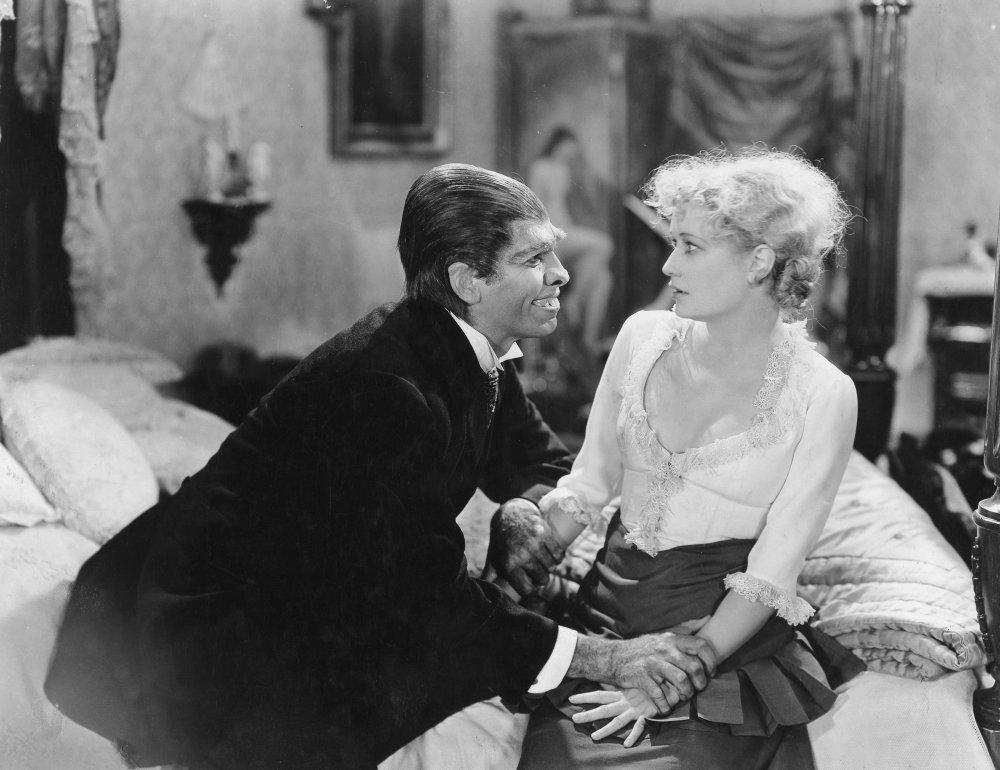
Dr. Jekyll and Mr. Hyde. Directed by Rouben Mamoulian, Paramount Pictures, 1931,(48:43) |
Lewis, Jerry, and Jerry Lewis. The Nutty Professor. Paramount, 1963. ( |
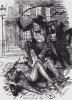
Sullivan, Edmund Joseph. Mr. Hyde assassinates Sir Danvers Carew. 1927. Strange Case of Dr. Jekyll and Mr. Hyde, by Robert Louis Stevenson, 1886, p. 21. |
Dr. Jekyll and Sister Hyde (1971) Martine Beswick, Gerald Sim. |
In Mamoulian’s Dr. Jekyll and Mr. Hyde, the theme of male sexuality as primal is the most obvious. This image serves as an accurate example of the way the film depicts Jekyll’s sexuality. It is inherently sexual as they are sitting on a bed, and Hyde is blatantly shown as ape-like both in physical appearance, but also in the aggressive forcible nature in which he is grabbing Ivy, pulling her towards him. He is smiling, eager, and feels entitled to Ivy ignoring her obvious fear and repulsion to him. This desire however does not solely belong to Hyde, as Jekyll has expressed his own sexual desire for both Ivy and Muriel. However he could not pursue Muriel as they were not yet married and she is an upper-class woman and he could not pursue Ivy as although she was a lower class prostitute and it would be more acceptable for him to pursue sexually outside of marriage, he was engaged and did not want to be viewed as unfaithful. The eagerness of Hyde in this image both on his face and the way he is leaning in towards Ivy is the eagerness of Jekyll who is finally getting what he wants by giving into his sexual desires without having to worry about the way society will view him for it. |
I chose this image because in many ways it parallels the image I used from the Mamoulian film. Buddy is hovering over Stella leaning in towards her indicating a similar sense of entitlement and eagerness for Stella. While not as blatantly repulsed as Ivy, Stella appears surprised with her mouth hanging open and unpleased with her brow furrowed. Once again their body language indicates the power dynamic of the interaction. Buddy is demanding a kiss from Stella, not asking her if she wants to, but telling her to, and in many ways Buddy expresses his sexuality in similar ways to ape-man Jekyll of the Mamoulian film. He is impatient and impulsive as in the scene in the car he insists they skip talking and just start kissing, he is demanding and overpowering telling Stella what to do and even telling her what she likes. Also similarly to Jekyll in the Mamoulian film, these desires do not belong solely to Buddy as in one scene of the film, Professor Kelp blatantly fantasizes about Stella in increasingly more provocative outfits. In this film Kelp doesn’t have to be a literal ape for his sexuality to be depicted in such a primal manner, and in fact Buddy’s appearance in this film speaks to different social demands at the time. Society did not as heavily frown on sex outside of marriage so Kelp did not need to hide behind an appearance of someone socially looked down upon to enact his desires, but rather made himself appear more desirable, to enact them. |
While this Illustration by Edmund Sullivan is the only image not sexual in nature, I think the primal way in which Hyde is depicted coupled with the homosexual subtext of Stevenson’s text makes this image quite interesting. One of the ways homosexuality is expressed in Stevenson’s text is through the imagery of the backdoor that Hyde is seen going in and coming out of and the secrets that lay behind the door. That makes this image particularly interesting because you can see that very door in the background, framed by the bodies of Sir Danvers Carew and Mr. Hyde, suggesting similar implications about Jekyll's sexuality as the text. Furthermore, we once again see the depiction of Hyde as ape-like particularly in the angles his arms and legs are bent and his long curled fingers. What’s interesting about this is that although stereotypes of gay men, especially in the 1800s, are that they are more feminine men or have feminine qualities, this image still depicts Hyde in the same aggressive, ape-like, dominating way, standing over the other figure in the photo that Jeykll in the Mamoulian image and Buddy in the Lewis image are similarly presented. This suggests that despite these stereotypes, even a gay representation of Hyde is still shown to be primal and agressive. Once again, while this scene is not sexual in nature, rather depicting a violent scene, many of the other images that are sexual are also violent suggesting a connection between sex and violance, and this is further supported in the parrells between the forms of the characters in the previous scenes and this illustration. |
This image from Dr. Jekyll and Sister Hyde contrasts the ways in which a woman’s sexuality is depicted compared to the men’s sexualities in the previous photos. In this image, despite the fact that Hyde is in a position of power as she is just about to kill an unsuspecting Dr. Robertson, unlike the other images I chose, she is not physically dominating over Robertson. In fact they are exactly level. Hyde’s arm is framing their faces, highlighting how perfectly matched they are nose to nose. Even when in a position of power, the woman is not shown towering over the man, as being on the same level as one is menacing enough according to gender stereotypes. This image in many ways reminds me of the Myth of Lilith who was said to be the first wife of Adam, but was banished from the garden of Eden because she refused to submit to Adam. Not that she tried to fight for dominance herself, but refused to be lesser. Rather than depicting her sexuality as eager, demanding, and forcible as the male Hydes have mostly been, she is quite the opposite. She is calculating, purposeful, and cold playing into the stereotype of the female seductress using her sexuality as a weapon against the unsuspecting man. |
Metzler, Jessica. “Lusty Ape-Men and Imperiled White Womanhood: Reading Race in a 1930s Poe Film Adaptation.” Adapting Poe, 2012, pp. 31–43., https://doi.org/10.1057/9781137041982_3.
Showalter, Elaine. “Dr Jekyll's Closet (Extract).” The Horror Reader, 2002, pp. 190–197., https://doi.org/10.4324/9780203138618-15.
Featured in Exhibit
Copyright
©
Vetted?
No