
Ralston, John McL. The Little Lame Prince. Nineteenth-Century Disability: Cultures & Contexts, https://www.nineteenthcenturydisability.org/items/show/14.
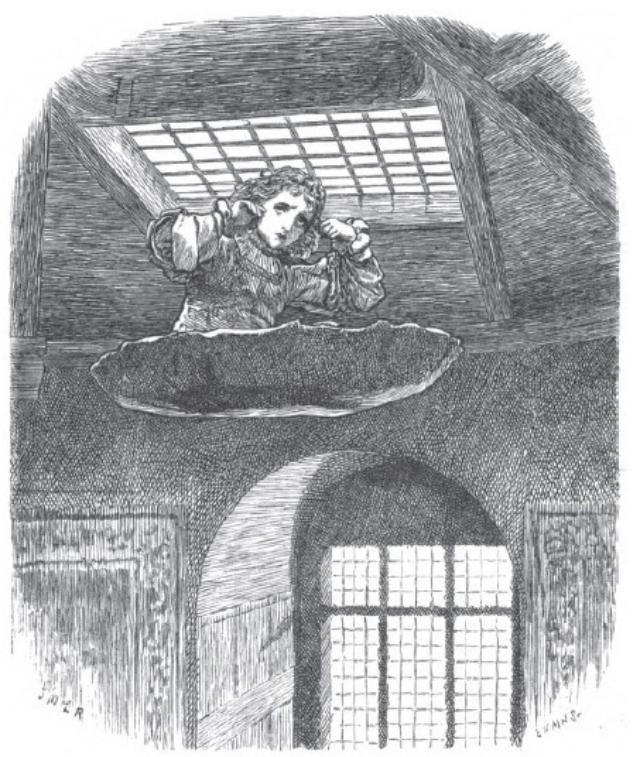
Illustrator, John McL. Ralston displays Prince Dolor as he first tests his traveling cloak within his tower. In The Little Lame Prince, Diana Maria Mulock uses play and toys to showcase Prince Dolor’s maturation from boy to man. What is particularly interesting about his maturation, is the way in which his physical disability impacts him. Dolor is effectively a prisoner of the domestic space being shut up in Hopeless Tower, due to the stigma of his disability. He is excluded from a masculine world of physical adventure and play; his own play is instead solitary and stagnant through toys and books. Eventually Prince Dolor leaves the inner domestic domain through the vehicle of his traveling cloak, as depicted in the above illustration. Once he can move beyond the domestic sphere of the woman, he begins to impose masculine gender roles onto himself, specifically through his toys and play. With “disdain”, he exclaims “Toys, indeed! When I’m a big boy” (Craik, Chapter IV), attempting to fulfill manhood by rejecting the objects of childhood. Despite his estrangement from masculinity, he reminds himself of his gender, as seen when he leaves the tower on his cloak and is faced with the cold wind, “I am a boy, and boys ought not to mind anything” (Chapter IV). Philipose states on page 136 that Prince Dolor’s movement into the outer metropolis further pushes him into masculinity. He strives to adopt masculine virtues yet cannot fully erase the femininity that his domesticated disability has imposed upon him, “big boys do not always play. Nor men neither – they work” (Chapter VII). Prince Dolor’s masculinity is consistently drawn back to play, as the further he moves from play the closer he becomes to achieving the qualities of a man.
Works Cited
Craik, Dinah Maria Mulock. The Little Lame Prince and His Travelling Cloak. 1875.
Philipose, L. (1996). The Politics of the Hearth in Victorian Children’s Fantasy: Dinah Mulock Craik’s The Little Lame Prince. Children’s Literature Association Quarterly, 21(3), 133–139. https://doi-org.ledproxy2.uwindsor.ca/10.1353/chq.0.1268