
When Queen Victoria ascended to the throne in 1837 she was only eighteen years old (Cavendish 1). Having grown up without a father, Victoria was a willful, independent girl. Many people thought that an older, more mature husband would help tame her, but this was not to be.
Victoria married her cousin Prince Albert of Saxe-Coburg and Gotha, who was from Germany (Reynolds 19). The match had been made by her German uncle, King Leopold, who was her mother’s brother (Cavendish 1, Reynolds 19). The Duke and Duchess of Kent similarly desired the match (Strachey 83). Ever since they were children both Victoria and Albert knew that they were to someday be married (Cavendish 1). When Albert was only three years old his nurse told him that, “‘the little English May flower would be his wife’” and since then he never even considered otherwise (Strachey 83). Other possible suitors had been presented to Victoria, but she was set on having Albert (Reynolds 20).
Though they had known of each other before, it was not until Victoria’s seventeenth birthday celebration, where Albert and his brother were in attendance, that they actually met. Victoria was immediately taken with him and later wrote in her journal that he was beautiful (Cavendish 2, Reynolds 20).
Albert was rather quiet and more subdued and did not enjoy the lively parties that Victoria did, but in her eyes his physical attractiveness helped make up for the fact that he fell asleep at parties (Reynolds 20). After this first meeting Victoria and Albert kept in correspondence for the next few years. Once Victoria was crowned queen, and had gotten used to her independence, she was no longer eager to get married, and stated that she wouldn’t marry Albert until at least two or three years later (Reynolds 20). Despite this, Albert was once again brought to court, and upon seeing him Victoria was again immediately enchanted by him. A proposal from Victoria, as was befitting considering her higher station, was given not long after, and Albert immediately accepted. In the time afterwards, before Albert had to go back to Germany, the two spent every possible moment together (Cavendish 3-4, Reynolds 21, Strachey 89). However, Albert, unlike Victoria, was not so much in love, though he did like her very much, and was more interested in the marriage for its potential to raise his station than for Victoria herself (Strachey 88).
Albert was not a particularly popular choice with the public. Many saw him as a penniless foreigner who was only going to hurt taxpayers. He was also three months younger than her, and therefore not the older, wiser man they had hoped would be able to help Victoria (Cavendish 1, Reynolds 20). He seemed awkward and stiff and had a very un-English air to him, which further made the high-born men and women around him dubious of the marriage (Strachey 94).
Despite these objections to Albert, on February 10, 1840 he and Victoria were wed in the Chapel Royal at St. James’ Palace (Cavendish 6, Reynolds 21). She wore a white dress of heavy silk satin, trimmed with Honiton lace. She had a white lace veil and wore a diamond necklace and earrings. She also wore a sapphire brooch that had been given to her by Albert (Cavendish 6). Their honeymoon was three days long and took place at Windsor Castle (Cavendish 7). Alfred had wanted a longer honeymoon but was reminded of his wife’s political duties and obligations (Reynolds 21)

historyhouse.co.uk/articles/queen_victoria_assasination.html
In the beginning, Victoria, who had become accustom to her independence, was determined to assert her dominance over Albert, and she made it clear that politics were to be her business and not his (Strachey 92). But it was only two years later that these roles were flipped. Albert was involved with politics, and Victoria didn’t do anything without his approval first (Reynolds 21). This complete turn of events was due in part to Albert’s determination to be the head of the household, something he could never be in public as his station was due solely to marriage to Victoria, and she was the sovereign. The other influence in Victoria’s submission was the gender roles of the time. She subscribed to the idea that the wife was supposed to be obedient and subservient to their husbands. Victoria actually expressed regret that her age and station made it so that she was technically superior to Albert (Reynolds 22). Her submission had not been immediate though, there had been many fights between them, the echoes of which could be heard throughout the palace corridors. After these fights Victoria would feel guilty and blame herself for them. And, sometimes, Albert would threaten to withhold affection or even withdraw completely from the relationship if Victoria was not doing as he wished (Reynolds 22).
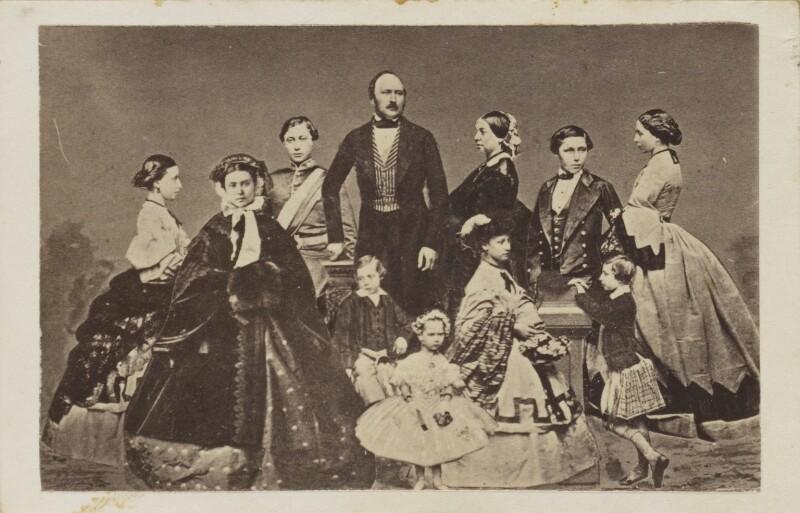
Victoria and Alfred were unusually fertile for the time. They ended up having nine children, named Victoria Adelaide, Albert Edward, Alice, Alfred, Helena, Louise, Arthur, Leopold, and Beatrice, and Victoria never suffered a miscarriage or stillbirth (Reynolds 24). Victoria was not fond of her children, as she disliked small babies, calling them “frog-like,” and found them generally bothersome. Even more importantly was the fact that they drew Albert’s attention away from Victoria, which she was very displeased about. Albert took the primary role in dictating how the children were educated and brought up (Reynolds 25).
Albert was completely faithful to Victoria, and never showed interest in other women, unlike many of the royals who had come before them. To the public theirs really seemed like the perfect family. Victoria became a symbol of middle-class virtue, and anything she did was sure to be imitated by them (Reynolds 25).
Domestic Life of the Royal Family (Queen Victoria; Victoria, Empress of Germany and Queen of Prussia; Prince Albert of Saxe-Coburg-Gotha; Princess Louise Caroline Alberta, Duchess of Argyll; Princess Helena Augusta Victoria of Schleswig-Holstein; Prince Alfred, Duke of Edinburgh and Saxe-Coburg and Gotha; Princess Alice, Grand Duchess of Hesse; King Edward VII) by Unknown Artist, 1848 or After. 2014.
Albert’s death in 1861 at 42 years old deeply affected Victoria. While he was sick, she stayed by his bedside at almost all times (Cavendish 7). When he finally died, Victoria and three of their children, Alice, Albert Edward, and Helena, were present (“Death of Prince Albert”). Victoria had become so accustomed to leaning on Albert and having him make all the decisions and act as a patriarch that when he died, she was at a loss for what to do. It similarly left the country in a precarious position, as Albert had been heavily involved with matters of the State. Victoria never fully recovered from Albert’s death, and the second half of her life without him was noticeably subdued (Strachey 176).
Works Cited
Cavendish, Richard. “Queen Victoria’s wedding. (Months Past / February 10th 1840).” History Today, vol. 65, no. 2, History Today Ltd, Feb. 2015, p. 8–.
“DEATH OF PRINCE ALBERT.” New York Times (1857-1922), New York Times Company, 25 Apr. 1880, p. 4–.
Reynolds, K. D., and H. C. G. Matthew. Queen Victoria, Oxford University Press, 1995. ProQuest Ebook Central, https://ebookcentral.proquest.com/lib/depaul/detail.action?docID=430521.
Strachey, Lytton. Queen Victoria : A Life, I. B. Tauris & Company, Limited, 2012. ProQuest Ebook Central, https://ebookcentral.proquest.com/lib/depaul/detail.action?docID=945539.