
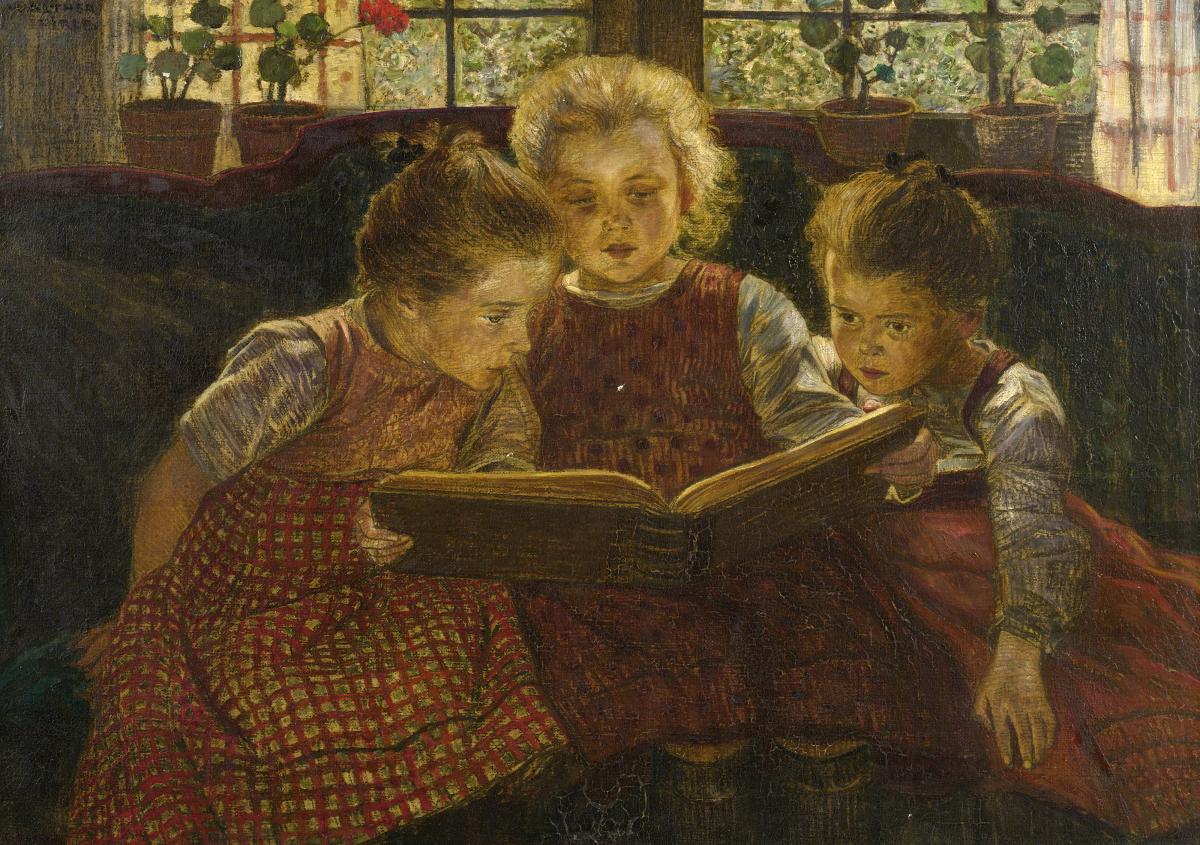
This painting depicts three young girls enraptured by a storybook. This image is included in the gallery as it confirms that stories and books were a growing fascination during the period. Meant for children, these texts were used as both a method of entertainment and of education. Many texts were didactic, including narrators who would speak directly to their readers, offering advice for young children to absorb as they learned moral lessons through the adventures of the storybook characters. By proxy, a child could understand the life of a fairy tale prince, an orphan or anything in between and gain a wider understanding of the world through these texts and their lessons. Beyond education, storybooks and reading were good ways for children to amuse themselves in the period; many authors claimed their stories "grew from private conversations with children they knew" (Iché), suggesting these texts were engineered with the specific intention of satisfying childhood fancy and whimsy while simultaneously acting as teaching tools that engaged rather than bored young readers. The reader-addressing narration "[gives] the impression that authors or narrators and readers are in the same room" (Iché), mimicking the event of an adult sharing a story with a child in both the intimate, friendly address and the educational content that the story may hold. In The Little Lame Prince, Prince Dolor is attached to his books – they are how he begins to understand the world outside of the confines of his tower and, besides his few toys, these texts function as his main form of entertainment. While all children can benefit from the imaginative effect of books, Dolor feels an enhanced version of this effect as the extreme limitations of his physical circumstances force him to rely on books for virtually all outside information. While he cannot overcome his physical isolation and his physical impairment through books, the imaginative play and learning that he does through reading help mitigate the effects of living in the tower; books thus present an accessible version of play that can be done through the mind when the body cannot physically play.
Reference:
Iché, Virginie.“(Dis)Empowering Child Readers in the Golden Age of Children’s Literature.” Cahiers victoriens et édouardiens, vol. 92, 2020, https://journals.openedition.org/cve/7992.
Firle, Walter. The Fairy Tale. Soethbys, 2012, https://www.sothebys.com/en/auctions/ecatalogue/2012/old-master-19th-cen.... Accessed 10 April 2025.