
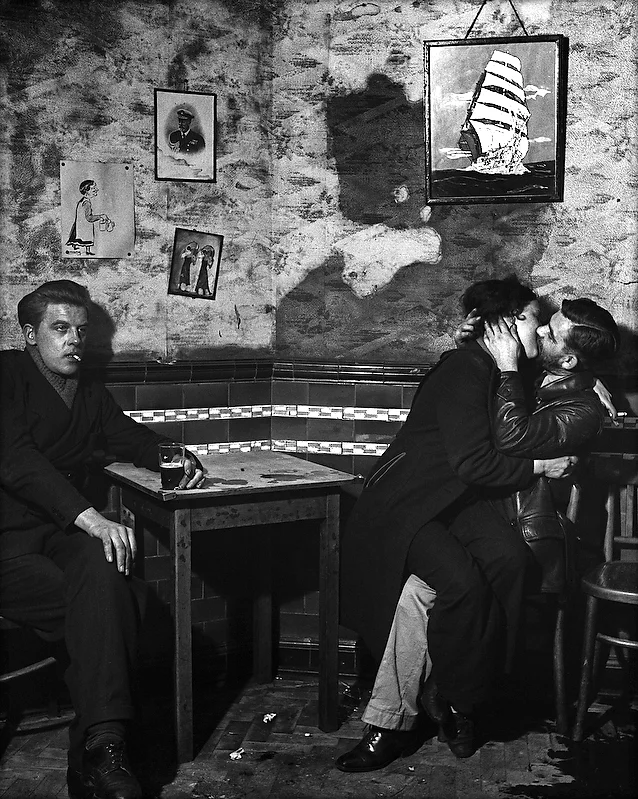
Docent Project of At Charlie Brown's Pub, Limehouse, 1945 By Bill Brandt.
Timeline
Table of Events
| Date | Event | Created by |
|---|---|---|
| 1893 | Charlie Brown comes into possession of The Railway TavernWhile The Railway Tavern would be built in the 1840s, the pub becomes popularized when Charlie Brown becomes the owner. While the name of the tavern would remain, The Railway Tavern, many coined the nickname Charlie Brown’s Pub. The name would eventually be changed by 1972 to Charlie Brown’s, but at the time of the photo, Bill Brandt names the location Charlie Brown’s Pub. Brandt was a person who investigated the local histories and people of each area that he encountered in London, so it’s very likely that he knew the history of the tavern before his arrival. News about the tavern spread everywhere since Charlie Brown’s lovable attitude and the environment of the pub welcomed many to travel and see it. There were quite a few trinkets that had made their way into the bar that Brown would boldly post all over and gave it a unique feel (Mystery of the Charlie Brown Roundabout). In the end, the real Charlie Brown’s pub would be demolished in 1989 due to an encroaching project by the railway in London. Many of the possessions in the pub are unable to be traced, so Brandt’s photograph is one of the few images that remain of the historic pub. |
Aidan Pellegrino |
| 1929 | Bill Brandt works for Man Ray in ParisBill Brandt was born in Germany and spent a good bit of time in Vienna, but he would finally come to popularity with his move to Paris. While Brandt was in Paris, he joined the studio of “American artist and photographer Man Ray in 1929” (“Bill Brandt”). Man Ray was a very respectable artist in his own right. He specialized in Dadaism and Surrealism and mostly worked in the medium of painting, rather than photography. However, I think it’s likely that Brandt would have learned a great deal under his tutelage. It’s fair to assume that Ray influenced Brandt’s up-close captures of human faces. Both photographers are capable of capturing human emotion that is easily conveyed through the medium and it’s easy to see why they both were so popular in this realm. While Ray would opt for more illusory and extraordinary pictures, Brandt would search for more realism in his photography. Additionally, Brandt adapted the background of photographs to help contextualize the life of the person he is photographing. In At Charlie Brown's Pub, Limehouse, 1945, it’s very easy to see how Brandt’s work takes in the surrounding life of his subject in photographs. It makes it easier to piece together who the person is and possibly even what they are thinking. |
Aidan Pellegrino |
| 1933 | Bill Brandt's Exodus to LondonBill Brandt's life took him from Germany to Vienna and even Paris. However, Brandt's photography comes into its own when he moves to London. The majority of Brandt’s photographs are captured in or around the London area. Brandt even remarked “he adopted Brtain as his home and it became the subject of his greatest photographs” (“Bill Brandt Biography”). Brandt’s work started to reflect the day-to-day life of many people in Britain. While he would maintain some pictures of high-profile people, most of his work in London was on “commoners,” people of the middle and lower class. At Charlie Brown's Pub, Limehouse, 1945 does a great job at exhibiting the subjects that Brandt often looked for in his pictures. Both men appear to be fully clothed but aren’t wearing anything fancy or colorful. Even though the picture is in black and white, it’s obvious that the men are wearing muted-colored clothes which shows a bit of their middle-class standing. Charlie Brown’s Pub was well known for being a melting pot. As it was a tourist attraction, many people of varying classes and backgrounds made the pub a hot spot to meet others from different cultures. Brandt likely chose the location of the photograph because of its internationally recognized blend of culture. |
Aidan Pellegrino |
| 1939 | Brandt's Incredible Blackout PhotographyDuring WWII, German planes would frequently bomb London to discourage the people and wreak havoc on the infrastructure of Britain. Churchill and Parliament, in an effort to minimize death and conserve energy for the war, placed a curfew on the country to turn off all lights and go into a blackout. This would make it harder for German planes to have a target or even know what they were hitting. Bill Brant’s photography of the city during the blackouts would come to be some of his most iconic work. While the pictures aren’t edited by Brandt, it’s hard to rationalize how the images could be real. There’s an eerie and mysterious tone to each that is completely void of life at all. Compared to Brandt’s early work in London trying to capture daily life, the blackout photos appear to be devoid of any life at all. There’s a solemn sadness to each photograph that words are unable to describe. Brandt’s photography took a different turn and he wished to capture the spirit of the British people during the war. Even with large estates next to those that are small and not as well developed, they appear the same in the darkness of the blackouts. Brandt’s photography sees a disillusioned population that wasn’t thrilled to join a war but was thrust into it by force. |
Aidan Pellegrino |
| 1945 | Brandt's Post-WWII PhotographyBrandt goes back to his signature “photographing of life” once the war is over in London. However, the psychology of London has definitely taken a shift since the beginning of the war when comradery surged through the people. What’s left after the war is hardened people who were forced into a war that they didn’t want. The constant bombing by the Germans has left the city of London in shambles. Thousands of refugees flood into Britain during the war which creates a large amount of cultural blending. Pubs were a historically good place for people to gather with one another and relieve themselves after reconstructing the war. The reconstruction efforts in London were arduous and mostly left to people of middle and lower-class laborers. Judging by the clothing of those in the picture, it’s fair to assume that they would be working at the docks near Charlie Brown’s pub. The man on the left’s stare is longing and almost searching for release in a difficult time in London’s history. However, there was some excitement from the end of the war like the man on the right who found himself a “lady friend.” Brandt does a fantastic job at capturing the blend of emotions in a pub where the emotions of people are worn right on their faces. I wanted to tell you about these five events of At Charlie Brown’s Pub, 1945 to help you understand the environment of the pub, the artistic process of Bill Brandt, and to get a better idea of the effect of WWII on the people of London. Brandt has always been fantastic at capturing moments, but his images do take intricate staging. Everything in his photographs serves a purpose as he seems to manipulate each frame in the way that he wants. The pub itself represents a safe haven for people after the war to just release as it had always done for people before. The specific photographs and pictures on the wall have no cohesive origin, but they show the spirit of Charlie Brown’s amalgamation of culture. Brandt’s skill in photography is incredible, but he never takes away from the humanistic element. While subsequent photographers, like Man Ray, attempted to take eye-catching or odd photographs of surrealistic scenes, Brandt stayed grounded in reality and wanted to capture the essence of day-to-day life. To this day, his pictures serve as a time capsule to the past the time was simple before the war, time was uncertain and scary during the war, and time was hard but full of relief. Both of the men in the picture represent the horrors of the war, but there were happier times ahead. Brandt is a magician with a camera and has been able to create art that evokes emotion in the viewer. Whether he wants to scare the audience or leave them in awe, Brandt’s special ability has allowed him to remain relevant throughout history.
“Bill Brandt Biography.” Victoria and Albert Museum, Victoria and Albert Museum, 27 Apr. 2004, https://web.archive.org/web/20100519133457/http://www.vam.ac.uk/collect…. Britannica, The Editors of Encyclopaedia. “Bill Brandt.” Encyclopædia Britannica, Encyclopædia Britannica, Inc., https://www.britannica.com/biography/Bill-Brandt. “Mystery of the Charlie Brown Roundabout.” Go Britannia! Travel Guide: London's East End - Mystery of the Charlie Brown Roundabout, https://web.archive.org/web/20131029192101/http://www.britannia.com/tra….
Pictures Cited (IN ORDER): "The One & Only Charle Brown." Isle of Dogs LIfe, n.d., https://isleofdogslife.wordpress.com/2013/03/13/charlie-brown-the-king-of-limehouse/. Accessed 2 April 2023. Ray, Man. "Self-Portrait." Getty Museum, 1931, https://www.getty.edu/art/collection/object/104E4H. Accessed 3 April 2023. Brandt, Bill. "Street Scene, London, 1936." National Gallery of Art, 1936, https://www.nga.gov/collection/art-object-page.93394.html. Accessed 3 April 2023. Brandt, Bill. "St. Paul's Cathedral in the Moonlight." The Metropolitan Museum of Art, 1939, Bill Brandt | St. Paul's Cathedral in the MoonlightThe Metropolitan Museum of Arthttps://www.metmuseum.org. Accessed 3 April 2023. Brandt, Bill. "At Charlie Brown's pub, Limehouse, 1945." Bill Brandt Archive, 1945, https://www.billbrandt.com/bill-brandt-archive-print-shop/sp10-at-charley-browns-pub-limehouse-1945. Accessed 28 March 2023. |
Aidan Pellegrino |