
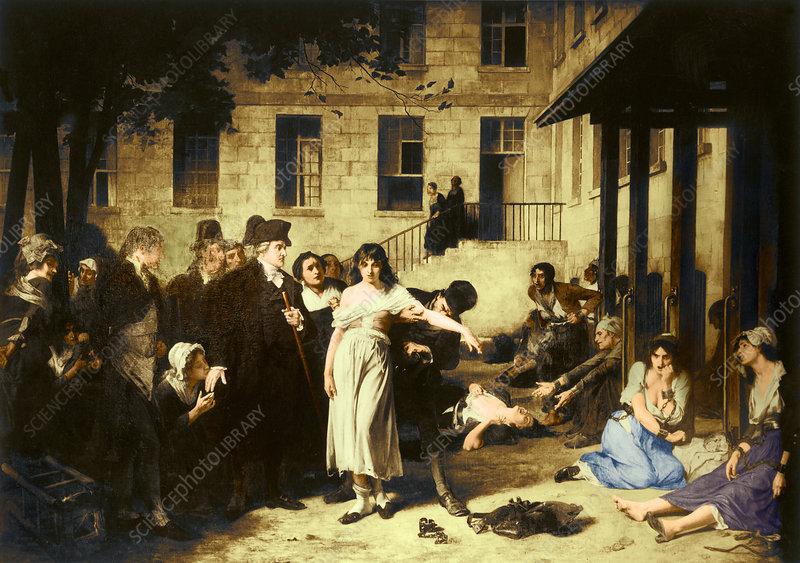
This painting is called Pinel, médecin en chef de La Salpêtrière, délivrant des aliénés de leurs chaînes. It depicts Philippe Pinel (1745-1826) releasing female inmates of the Salpêtrière asylum from their chains in 1795. Pinel was a reformer who advocated for more humane treatment of the insane. Showalter’s main aim in “The Female Malady” was to depict the unfair treatment of women in the nineteenth century and to show that patriarchal standards of how a woman should act resulted in a large percentage of women being locked away for being “insane.” The left side of this painting shows the men responsible for deciding if a woman was sane or not. A woman can be seen crouching down to kiss the prominent man’s hand, illustrating that when women were obedient and praised the men in charge, they were not punished for being “crazy.” The women on the left, however, are shown clawing at their chains and screaming in agony. The main woman in the center, however, is shown as not yet being chained, but she is still at the mercy of the men, and although Pinel, the man behind her, may have heroic intentions, she is still being controlled by him. This shows that men had full control over these women's futures, deciding for them whether they would spend their lives locked away because of their differences or if they got to remain unchained. The women that had been locked away for longer are also all stooped down, low to the ground, representing their literal inability to stand up for themselves without facing repurcussions. They are all lower than the men because they were seen as inferior. This relates to how in "Jane Eyre," Bertha is locked away after exhibiting differences and behaviors that Rochester deemed "crazy," and after years of living like an animal in solitude, becomes more and more of an animalistic creature until her self-destruction. In contrast, Jane's older self keeps her opinions and feelings to herself and is therefore seen as more ladylike and sane.
Tony Robert-Fleury (French, 1837-1911), Pinel, médecin en chef de La Salpêtrière, délivrant des aliénés de leurs chaînes(1876, oil on canvas, 11.6 ft. x 16.5 ft., Pitié-Salpêtrière Hospital, Paris; reproduced Wikimedia)