
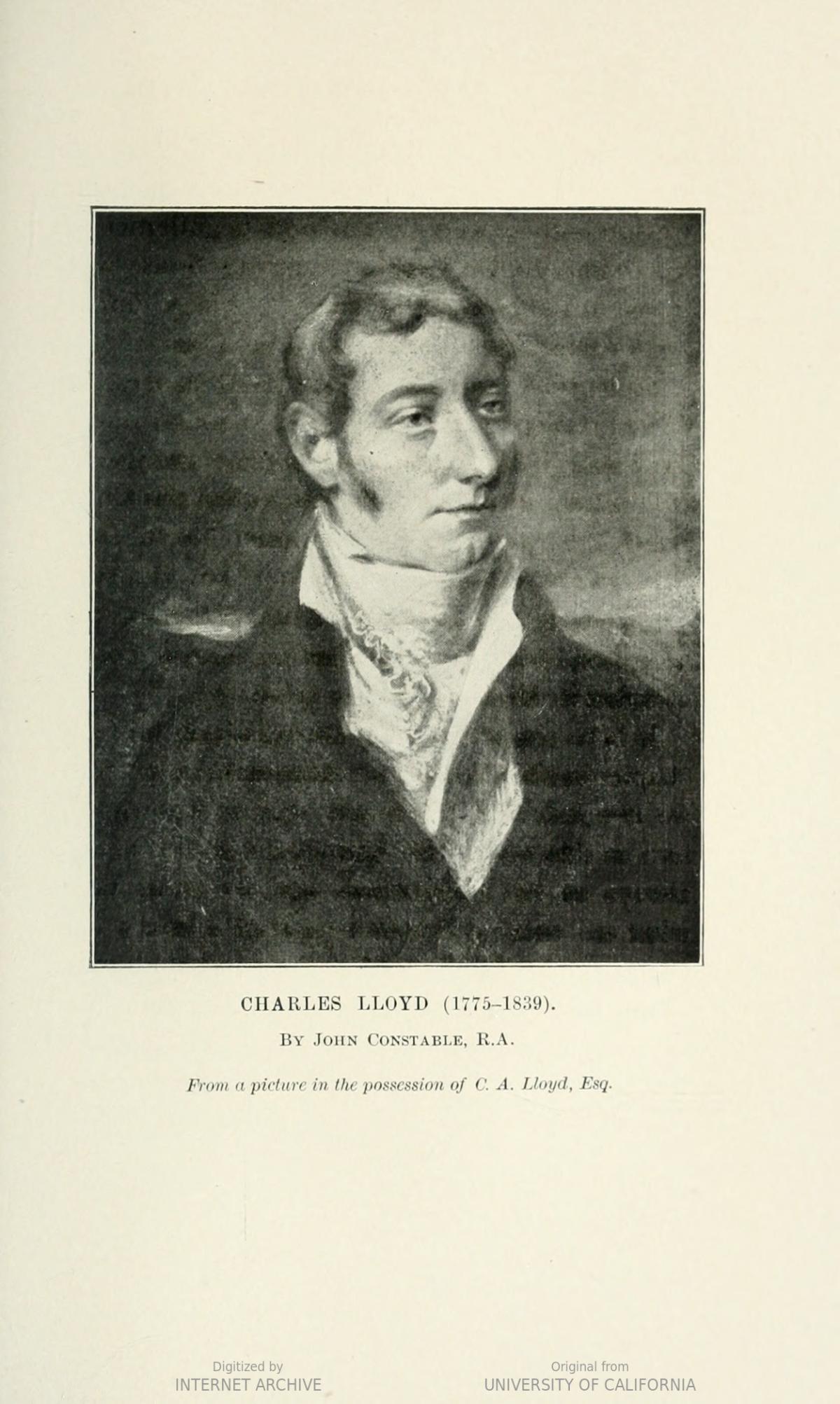
This is a portrait called Charles Lloyd, named after the English poet from the Romantic period. Although he was quite mentally unstable and spent years of his life in and out of insane asylums, poets of the period still considered him a poetic genius, according to Burwick in Poetic Madness and the Romantic Imagination. According to the Dictionary of National Biography, Lloyd became productive as a poet when he “entered on a period of relative health” which he “attributed . . . to the healing effect of a performance by W. C. Macready in a stage adaptation of [Walter] Scott’s Rob Roy, which moved him in a way that recalls the emotional release described by John Stuart Mill in his account of recovery from depression [in Mill’s Autobiography]." He was close friends with many of the most famous and revered poets of the time, including Charles Lamb and Samuel Coleridge, who remained friends with him as he suffered from hallucinations and other mental "infirmities," as Burwick refers to them. Some of his friends even allowed him sanctuary when he would escape the asylums he was staying in. This is a great example of how differently men afflicted with insanity were treated when compared to the way women were treated, as Showalter describes in her work. This unfair contrast in treatment can also be seen in some of the Brontë's characters. In Jane Eyre, Bertha is locked away just as younger Jane is after they are thought to be "mad" or "hysterical." Jane was treated with great disrespect and Bertha was not even to be seen by people, and yet men like Lloyd were met with friendship and even praise for their "genius" following their fits of madness?
Garnett, Richard, and Geoffrey Carnall. “Lloyd, Charles (1775–1839), poet.” Oxford Dictionary of National Biography. September 23, 2004. Oxford University Press. Date of access 28 Jul. 2024, <https://www.oxforddnb.com/view/10.1093/ref:odnb/9780198614128.001.0001/…;.