
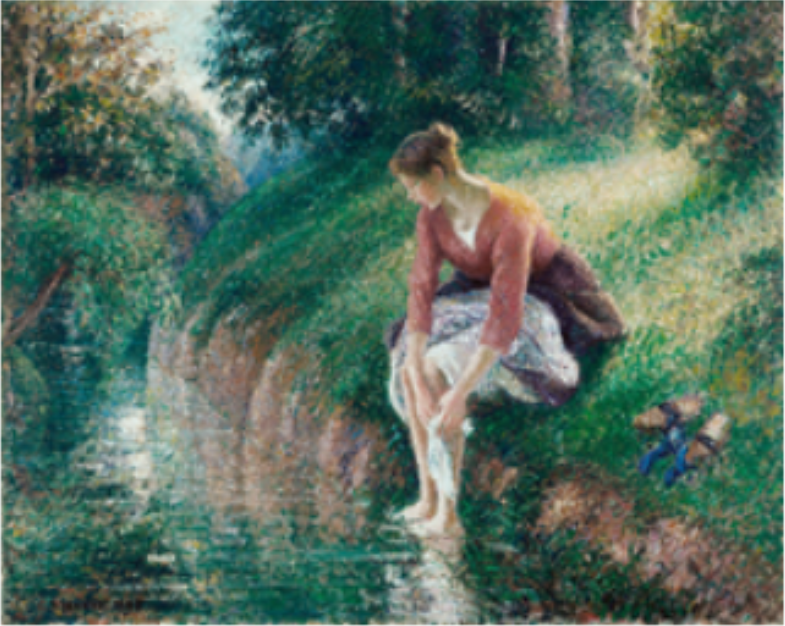
Mary’s Commentary: This is a painting we had to replicate in the Academy. It was my favorite artwork for more reasons than one. It seems simple, but the intricacy of the oil painting and the color variance stuck out to me as beautiful and elegant. All hues work well together and the realisticness of the skin tones and grass tones make this a difficult task to paint but also well worth it in the end. We painted this on our second week in the Academy. I sat down next to two older gentlemen who, like me, were aspiring to become artists. They were both married and I would often listen in on the conversations they had with each other. The gentleman who sat to my right was named Mr. Charles and the man to the left was Mr. Toby. Mr. Charles was married to a younger woman named Bethany. He married her because Her parents offered him a large sum of money and property rights to one of their estates so that their daughter can be married into a good family. I was saddened every time I heard this. The poor thing couldn't have known any better or even believed her parents would sell her away like that. Every time I see this painting I think of the conversations Mr. Toby and Mr. Charles would have about this situation and how much I wanted to speak up about it but decided to keep my mouth shut and continue painting the woman bathing her feet. I included this because it not only reminds me of an earlier chapter of my life as an aspiring artist but also of the mentality of men these days that I so despise.
Editors Commentary: This is a very interesting piece of artwork to include as a commonplace book item. The painting itself is a clear and dictionary example of Impressionism. According to an article by Margret Samu, “this 19th-century art form involved small brushstrokes and realistic depictions of light”. Another unique thing about Impressionism was that it tried to grasp a lot of motion and movement in the painting itself. Pissaro was a major contributor to Impressionism and Post Impressionism so many more of his works could have been used as samples in the Art Academy Mary studied in. The woman bathing her feet and the artist showing her bare legs was still a questionable thing at the time. This painting was made in 1895 and while there was a lot of progressive thought about what women chose to wear and how much skin they were allowed to show, many people at the time would consider showing women's skin above the ankle to be immodest at the very least. Mary including this shows that she may have been more progressive thinking than other women at the time. They may have believed this to be too risque and not include it in their homes commonplace book, but since Mary was okay with including this we can come to the conclusion that she was accepting of the New Ideals that came around at the time. Her commentary also lets us grasp the idea that she was more progressive than women at her time.
Citation: Camille Pissarro, French; 1830-1903. Woman Bathing Her Feet (Le Bain-de-pied). 1895. Artstor, library-artstor-org.proxy-remote.galib.uga.edu/asset/AMICO_CHICAGO_1031151380
Samu, Margaret. “Impressionism: Art and Modernity.” In Heilbrunn Timeline of Art History. New York: The Metropolitan Museum of Art, 2000–. http://www.metmuseum.org/toah/hd/imml/hd_imml.htm (October 2004)