
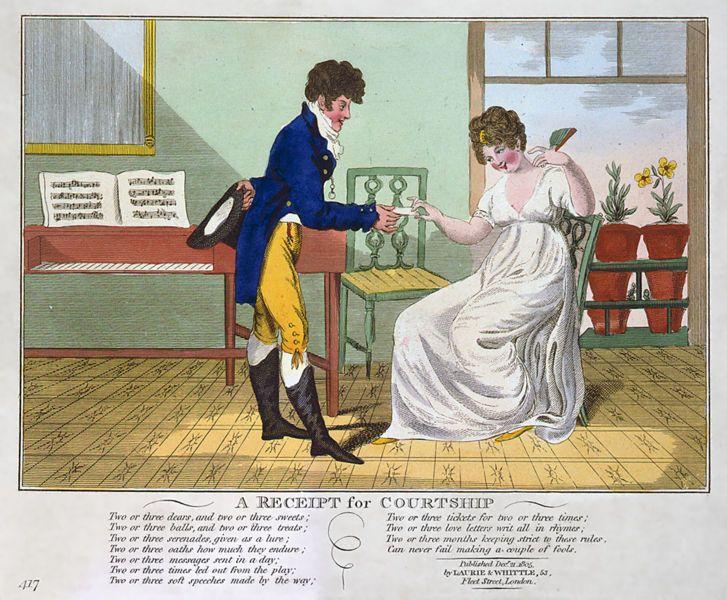
The above caricature titled “A Receipt for Courtship” works to mildly satirize the courtship customs or romance rituals of early 1800’s England. Yet despite this satire, the Regency era is when courtship truly “became the road leading to matrimony” (Samantha). Although it was less formal and common in the previous century, courtship was now beginning to show itself as a necessary set of rules that both men and women had to follow in order to safeguard themselves from improperly interacting with and finding marriage with the opposite sex – Courtship was not merely a romantic pursuit; it was a public performance governed by an intricate set of rules: “Since many young people now enjoyed a degree of choice over their marriage partner, they needed advice on how to judge character, how to behave in public towards the opposite sex, how to attract the opposite sex, even the proper way to make or refuse an offer of marriage” (Samantha 1). These permitted activities were often supervised and involved chaperones, the sending of letters to one another, small gifts, and public gatherings, all of which served to prevent the loss of any reputation from ‘improper conduct.’ These outings typically included balls, tea parties, and social calls, each governed by strict codes of conduct.
Despite the fact that arranged or forced marriages were becoming less common, marriage was still widely seen as a political union between two families or a way of financial security. Furthermore, men still enjoyed larger freedoms in their actions than women, with legal rights to inheritances, freedoms for work, and they were often allowed to be courting several women at a time. Yet both sexes had to be cautious and properly follow courtship etiquette lest they end up marrying someone due to breaking any code. For women, etiquette dictated a careful balance of modesty and charm. They were expected to be engaging yet reserved, allowing a suitor to approach them without appearing overly forward. A woman’s demeanor—her ability to flirt subtly while maintaining decorum—was paramount. A well-timed blush or a coy smile could convey interest without breaking societal norms. This can be seen used within Jane Austen’s work as well. In Mansfield Park, Fanny Price uses this modesty to show her deep uninterest in Henry Crawford: “ She is very aware of his intentions, [and] therefore tries to be as modest as possible and appears to be uninterested in his future plans…If the lady did not return her feelings towards the suitor, she had to act as decently as possible” (Martynková 30).
Men, too, had specific expectations to meet. They were tasked with demonstrating their suitability as husbands through their manners, conversation, and behavior. Courting a woman required patience and respect; any sign of undue haste or overt familiarity could be seen as presumptuous or inappropriate. The rules of engagement during courtship were layered with nuances. For instance, it was customary for a suitor to request an introduction through mutual acquaintances, allowing for a sanctioned meeting. For example, if a men met and began to court a lady at a ball, perhaps through dancing, in no way was he permitted (or the woman) to call out to her if seen in public – a mutual friend had to introduce him to her a second time first. Once a rapport was established, a gentleman might request a dance or a conversation, but he had to remain aware of his surroundings, as the presence of others served to regulate their interaction. Should a lady express disinterest, a gentleman was expected to withdraw gracefully, maintaining the lady’s honor and his own dignity. All in all, the nuances of courtship created a strict and complex societal web that men and women had to navigate, turning love into more of a business as they looked for a proper spouse.
Works Cited
“A Receipt for Courtship” Engraving, colour, 1805. No. 417. British Cartoon Collection, Library of Congress.
Holloway. “The Real Rules of Courtship: Dating in the Regency Era.” PBS, Public Broadcasting Service, 16 Jan. 2024, www.pbs.org/wgbh/masterpiece/specialfeatures/the-real-rules-of-courtshi….
Martynková, Hana. The Rules of Regency Society in Jane Austen’s Novels, theses.cz/id/ie1k6e/BP_Martynkova_2020.pdf. Accessed 16 Oct. 2024.