
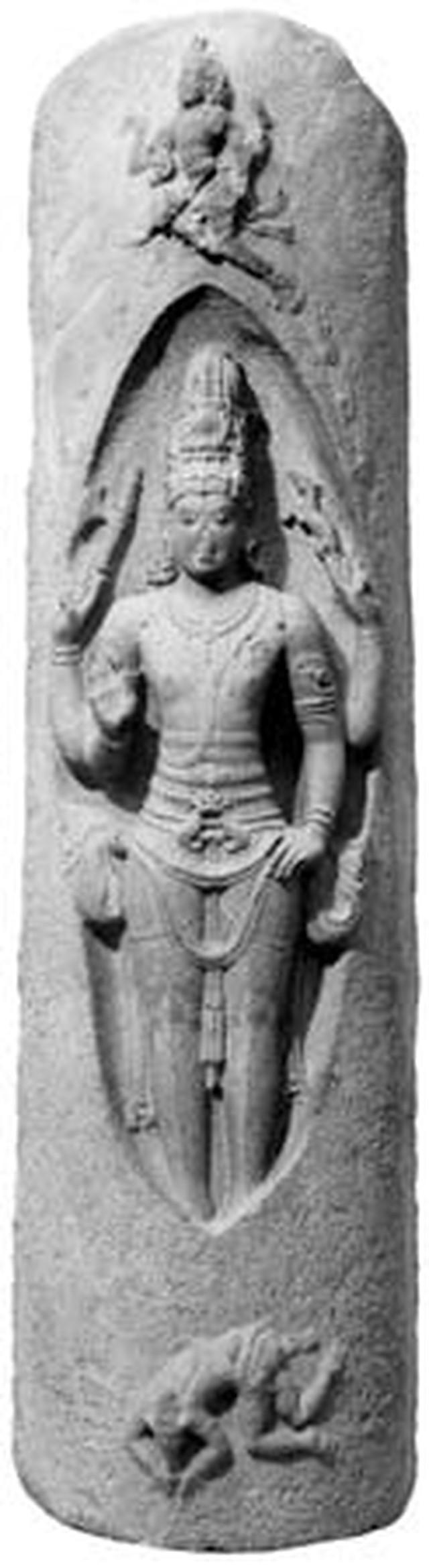
Shiva lingam is a cylindrical shaped votary object that symolizes the Hindu god, Shiva. In the Indian Sanskrit epic Mahabharata, “lingam” takes on the meaning of pillar in a myth about Shiva. In this myth, the creator, Brahma, asks Shiva to create creatures. Shiva, however, goes into a body of water and is described as a pillar as he motionlessly stands under the water. Shiva then comes out and tears out his lingam and throws it on the ground where it stands up erect. As it appears in this myth, “lingam” denotes pillar-like characteristics of Shiva. However, Shiva’s pillar-like characteristics are ambiguous in this myth. On the one hand, Shiva’s pillar-like characteristics may represent his immobile and desexualized form, while on the other hand, they may represent a procreative phallic-like symbol. As such, there is not a consensus on the meaning behind the symbol or the word, and some even refuse to worship the symbol due to its possible sexual connotations. Despite the disagreement, Shiva lingam was widely worshipped and known across castes as a symbol meant to revere Shiva. These figures were often displayed in the center of temples with sacred images of deities surrounding them.
In Because I am a Woman, Haimabati Sen’s family evidently reveres the symbol, as Sen is chastised for using a Shiva lingam to prop her mattress up and for eating the Shiva lingams when she was starving. Shiva lingams are made of clay, so Sen was likely eating the offerings (such as milk, fruits, leaves, and sun-dried rice) that people left while worshipping the figures. This episode in Sen’s autobiography, shows the importance she places on study and education. She claims that she does not care how people think of her for her actions regarding the Shiva lingam as her “ambition was to study and do some important work” (73).
Sources:
“Lingam -- Britannica Academic.” Accessed February 23, 2021. https://academic-eb-com.proxy.uchicago.edu/levels/collegiate/article/lingam/48386.
Doniger, Wendy. “God’s Body, or, The Lingam Made Flesh: Conflicts over the Representation of the Sexual Body of the Hindu God Shiva.” Social Research 78, no. 2 (Summer 2011): 485–508.
Sen, Haimabati. Because I am a Woman. Edited by Geraldine Forbes and Tapan Raychauduri. New Delhi, 2011.