
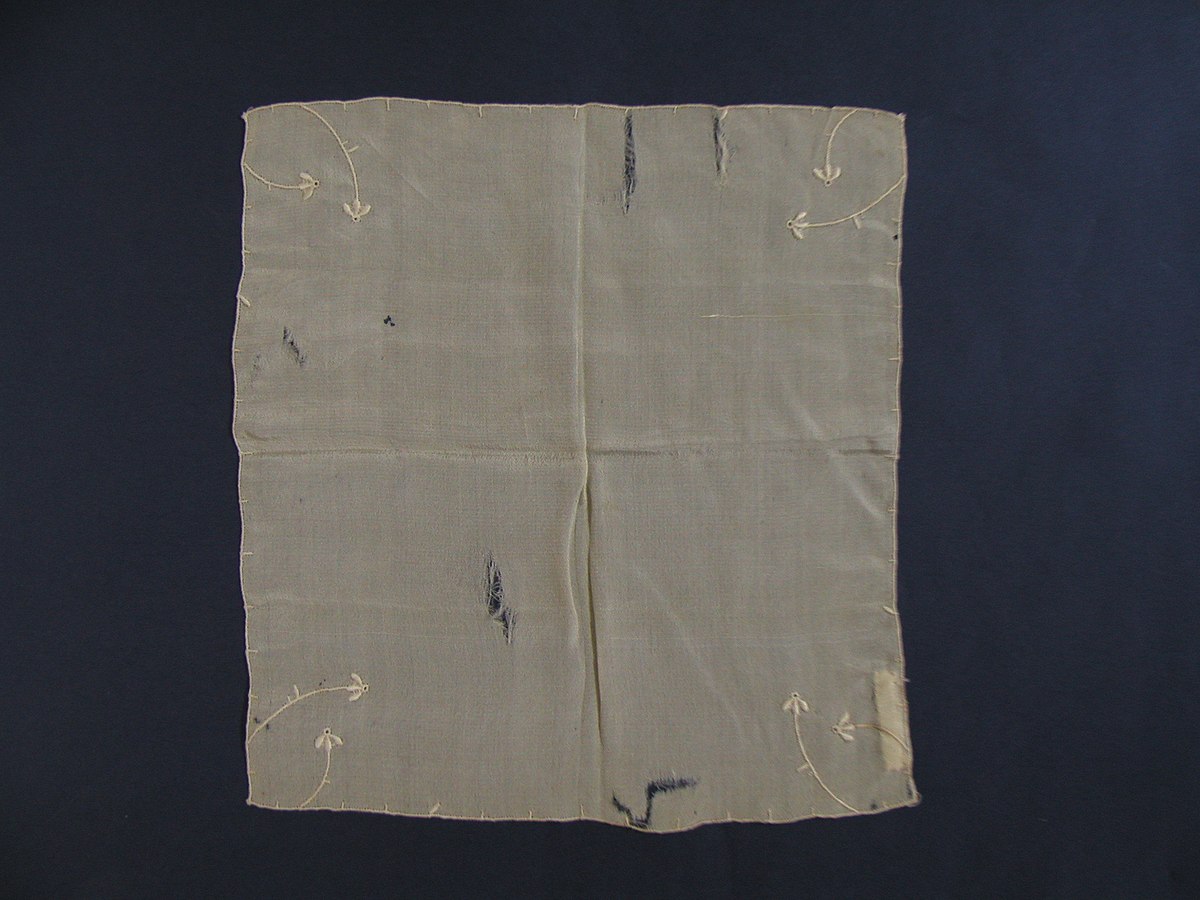
Handkerchiefs have a long history as a social symbol and a (usually romantic) communication device. Silk handkerchiefs were the favored type of the Victorian elite, and they were considered an “important fashion accessory for well-to-do persons of both sexes” (Jordan 3). Their purpose was not practical, but symbolic: as an “article of luxury,” their appearance in a person’s attire suggested wealth and power (Jordan 3). The high demand for silk handkerchiefs among the affluent members of English society meant they were especially valuable to criminals like Fagin. Fortunately for thieves, they were also easy to steal: men usually carried them in their pockets, so a skilled pickpocket would be able to snatch one with ease. After stealing the handkerchiefs, criminals would pull out the embroidery, which was usually the owner’s initials or a family sigil, so that the article would not be identifiable (Jordan 3). In chapter nine of Oliver Twist, we witness an exchange between Fagin, Oliver, the Artful Dodger, and Charley Bates after the two young thieves return from the streets with four stolen handkerchiefs. Fagin tells Charley that he “[hasn’t] marked them well…so the marks will be picked out with a needle, and we’ll teach Oliver how to do it” (Dickens 92).
After this task is done, the handkerchiefs are advertised and repurchased, often by the same people they were stolen from. The clothing trade, an unlicensed market for mostly stolen articles, was very popular among the working-class at the time; in fact, it was the main way working-class people obtained clothing (Toplis). Articles such as these silk handkerchiefs sold quickly through the clothing trade, which diminished the chances of the stolen article being discovered and the thief prosecuted. There is no question now why Fagin’s gang focused mostly on stealing pocket handkerchiefs: the market for the item was lucrative, and the chance of being caught with the stolen handkerchief was low thanks to the clothing trade (Toplis).
Handkerchiefs play another important role in the story of Oliver Twist. By this time, handkerchiefs had also become popular among the lower class, though for more functional reasons; they were used to wipe perspiration from a sweaty workingman’s brow or dab food off of the corner of one’s mouth. We see the boy thieves wearing handkerchiefs around their necks, and “at least half of the twenty-four [illustrations] in the book contain or suggest the presence of a handkerchief” (Jordan 2). However, these handkerchiefs were made of cotton, not silk—cheap cotton imported from America. Slave labor across the sea allowed this “luxury” to be brought to England’s lower class (Jordan 4). The type of handkerchief (silk, cotton) and its function (fashion accessory, sweat towel) in the novel reveal a character’s station in society. With a bit of research, the presence of cotton handkerchiefs also shows how slavery is always at least in the background of Victorian novels; though there are no slaves in Oliver Twist, the boys benefit from their cotton-picking through their ability to own handkerchiefs.
Works Cited
Dickens, Charles. Oliver Twist. New York, Barnes & Noble Classics, 2003.
“Handkerchief.” Wikimedia Commons, 10095, 7 May 1972, commons.wikimedia.org/wiki/File:Handkerchief_(AM_10095).jpg. Accessed 10 Feb. 2021.
Jordan, John O. “The Purloined Handkerchief.” Dickens Studies Annual, vol. 18, 1989, www-jstor-org.liblink.uncw.edu/stable/44371627?seq=2#metadata_info_tab_contents. Accessed 4 Feb 2021.
Toplis, Alison. “The Illicit Trade in Clothing, Worcestershire and Herefordshire,1800-1850.” Journal of Historical Research in Marketing, vol. 2, no. 3, 2010, search-proquest-com.liblink.uncw.edu/docview/740190370?pq-origsite=summon. Accessed 4 Feb 2021.