
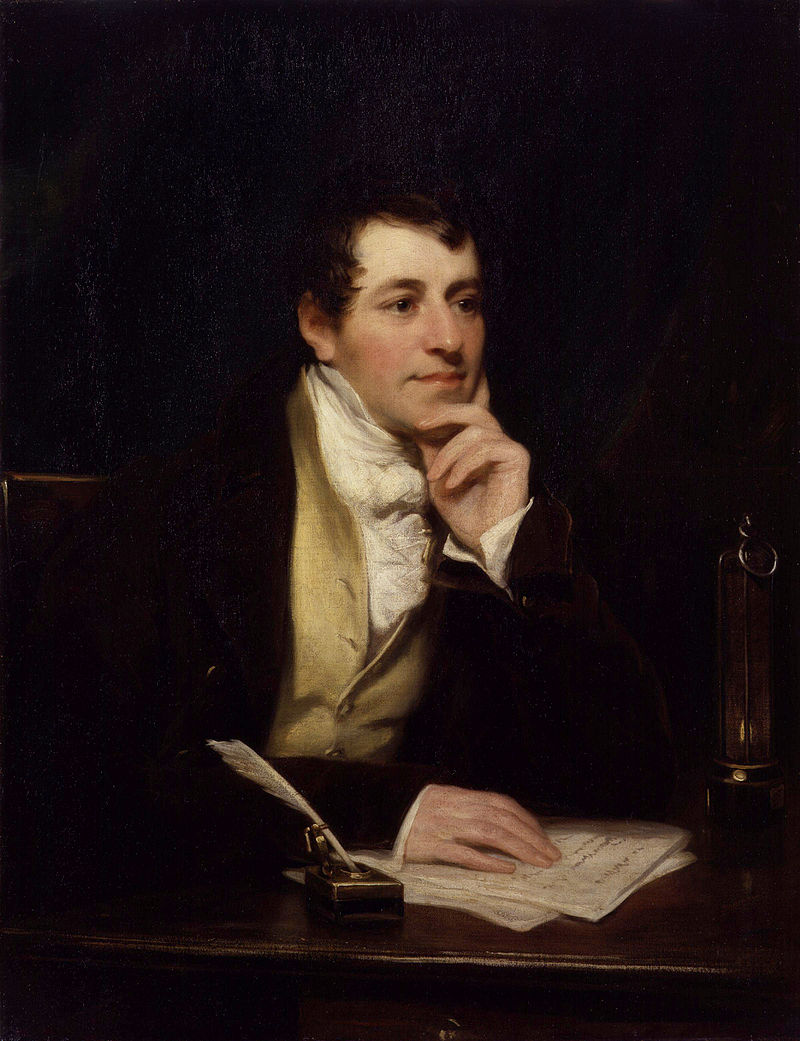
Chemist and Inventor, Sir Humphry Davy was born in Cornwall, England in 1778. While he has many claims in his field, he is best known for originating the isolation of the elements potassium, sodium, calcium, strontium, barium, magnesium and boron, as well as discovering the elemental nature of chlorine and iodine. He also is credited with inventing the scientific practice of electrochemistry (the branch of physical chemistry that studies the relationship between electricity as a measurable and quantitative phenomenon, and identifiable chemical changes).
As a youth he practiced chemistry and wrote a rather large collection of poetry, most of which remained unpublished (which he continued writing even into his later years in life). In the scientific field he thrived at an early age, gaining popularity among his peers and some note as a genius.
He was among the first in his field to have experimented with nitrous oxide and remarked about its potential in the field of anesthetics, noting its numbing or knock out effects. Anesthetics weren’t yet used as a standard in surgical or dentistry settings (it would be decades after his death when the practice would be more readily integrated into surgical settings). His findings and experiments with nitrous oxide made him laugh upon inhalation, so he coined the term “laughing gas,” a phrase that is commonly still in use in modern times. Davy became addicted to the gas, and put himself at great risk with the various experimentation he practiced during his residency at the Pneumatic Institution in Bristol.
Works Cited
Wikipedia contributors. "Humphry Davy." Wikipedia, The Free Encyclopedia. Wikipedia, The Free Encyclopedia, 26 Nov. 2020. Web. 27 Nov. 2020.
Wikipedia contributors. "Electrochemistry." Wikipedia, The Free Encyclopedia. Wikipedia, The Free Encyclopedia, 22 Nov. 2020. Web. 27 Nov. 2020.