
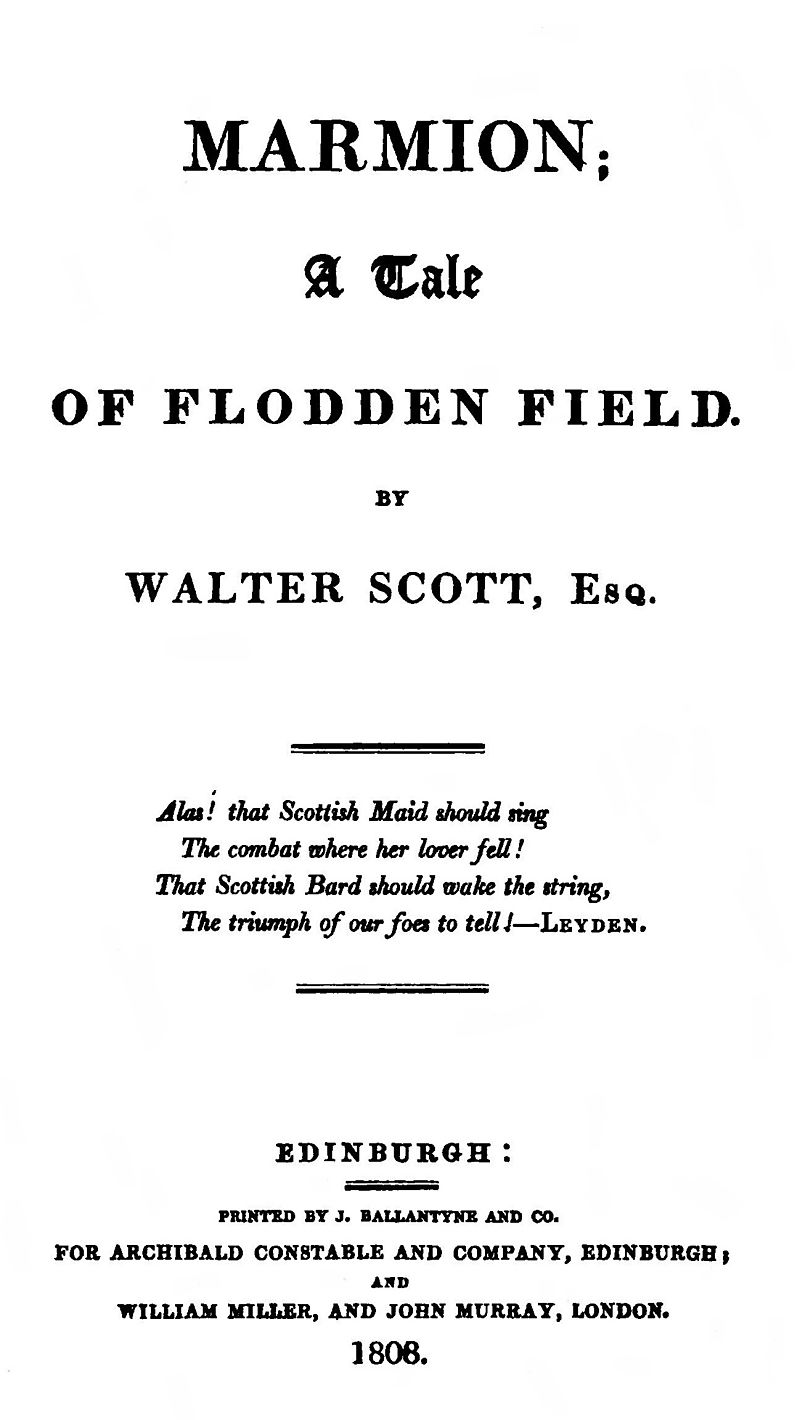
The works of Sir Walter Scott are commonly referenced in Jane Eyre, as we often see Brontë quoting, for example, from his work The Lay of the Last Minstrel as a descriptor for the scenes at hand. In chapter 32 however, another work of poetry by Scott is mentioned in passing, Marmion, as the text St. John brings for Jane's reading pleasure. Upon receiving the gift, Jane briefly details her outlook on the current state of literature in her society — mainly relaying that a deep appreciation for poetry and literature (and by extension, learning) is somewhat out of fashion but in the long run their presence and relevancy cannot be quelled (Brontë 331). With Jane's mentality in mind, I explore the history of Marmion to further elucidate Jane's academic status as well as analyze an early reference to St. John's later treatment of Jane's character.
The idea of Marmion first arose in 1806, as Scott reflected on the battle of Flodden Field which took place in 1513. The battle took place near the border of England and Scotland and was the largest to take place between the two countries (Johnson). Despite the great loss inflicted on the Scottish, Scott, having been born in Edinburgh himself, found the event to be a suitable subject for poetry and poetic discussion of Scotland's honor, especially as instability, resulting from the current events of the Napoleonic wars (1803-1815), rose across the country ("Marmion"; Hepburn). The poem, which is written in iambic tetrameter and consists of six cantos, details a fictional story of Lord Marmion and (the real) James IV where both are depicted as morally corrupt resulting in the detrimental outcome of the battle of Flodden (Hewitt). While the story was originally published in Edinburgh in February 1808, it was first published in England a month later. While the publication was a great success, it had several critical reviews that detail the story as convoluted and controversial — particularly for its showcasing of a villainous protagonist ("Marmion").
Marmion's placement in Jane Eyre (as are other references to Scott's work), is primarily an indicator of Brontë's favor of Scott's work as a poet. In the scene on page 331 however, we might also recognize Brontë's reference to Marmion as a suggestion of St. John's judge of Jane's character and intellectual ability. At this point in time Marmion had been released to the public for several years and had acquired its reputation as one of Scott's more challenging and esteemed poems. Later in this week's reading section, we see St. John test Jane with other academic work so he many eventually covet Jane only for her intellectual fervor. With the latter in mind, this moment of St. John bringing Jane Marmion as reading material depicts an early instance of his evolution into obsession with Jane's intellectual character.
Works Cited
Hepburn, Carla. "Walter Scott the 'might minstrel' and Marmion." Edinburgh University Press. 3 July 2018. https://euppublishingblog.com/2018/07/03/walter-scott-the-mighty-minstrel-and-marmion/. Accessed 23 January 2022.
Hewitt, David. "Scott, Sir Walter." Oxford Dictionary of National Biography. 24 May 2008. https://doi.org/10.1093/ref:odnb/24928. Accessed 23 January 2022.
Johnson, Ben. "The Battle of Flodden." Historic UK. https://www.historic- uk.com/HistoryUK/HistoryofScotland/The-Battle-of-Flodden/. Accessed 23 January 2022.