
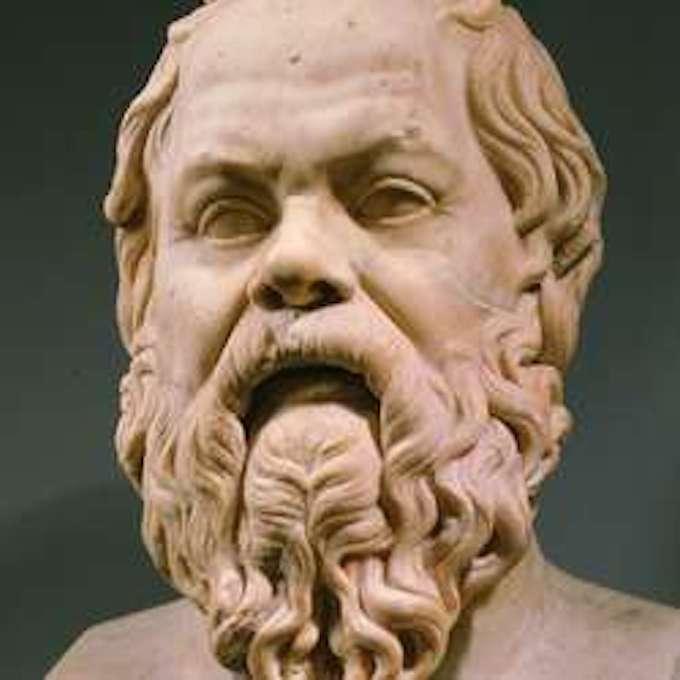
The Socratic Method is a way of teaching in which the instructor asks their students a series of questions as a way of distilling a logical argument by discovering its least precise points or its fallacies. The weaknesses of argument are thereby discovered by the students themselves through the contradictions of their responses. The method was practiced by Greek philosopher Socrates (470-399 BC) and was, arguably, his greatest contribution to philosophy. Socrates himself suffered for his contribution. It was partially his teaching that led to his indictment of corruption of the young, a crime that, along with impiety, warranted his execution. Ironically, it was these supposedly corrupted youth who espoused the virtues of his teaching. Socrates did not write about the Socratic method. It was his students, namely Plato, whose work J.S. Mill read, who recounted the pedagogical approach.
The Socratic method was heavily adopted by James Mill in his education of his son, John Stuart Mill. In his work Autobiography, J.S. Mill said that “the Socratic method … is unsurpassed as a discipline for correcting the errors, and clearing up the confusions incident to the intellectus sibi permissus…” Intellectus sibi permissus may be defined as “the intellect left to itself.” It was the mind unchecked by the external force of questioning that Mill believed that the Socratic method combated. He also referred to the Socratic method as “elenchus,” meaning an “extrac[tion] [of] truth through cross-examination,” or in Latin, literally, a pearl worn as an earring. The word evokes the searching nature of the Socratic method. By using it, Mill expressed that through the Socratic method, the exact center of an argument, its logical pearl, is rooted out.
Sources
Penguin Edition of Autobiography by J.S. Mill: Own summary as well as quotes drawn from the text and footnotes of pages 38 and 39
https://www.law.uchicago.edu/socratic-method
https://www.oxfordreference.com/view/10.1093/oi/authority.20110803100515856
https://www.britannica.com/biography/Socrates
https://www.history.com/topics/ancient-history/socrates
https://www.utilitarianism.com/millauto/seven.html