
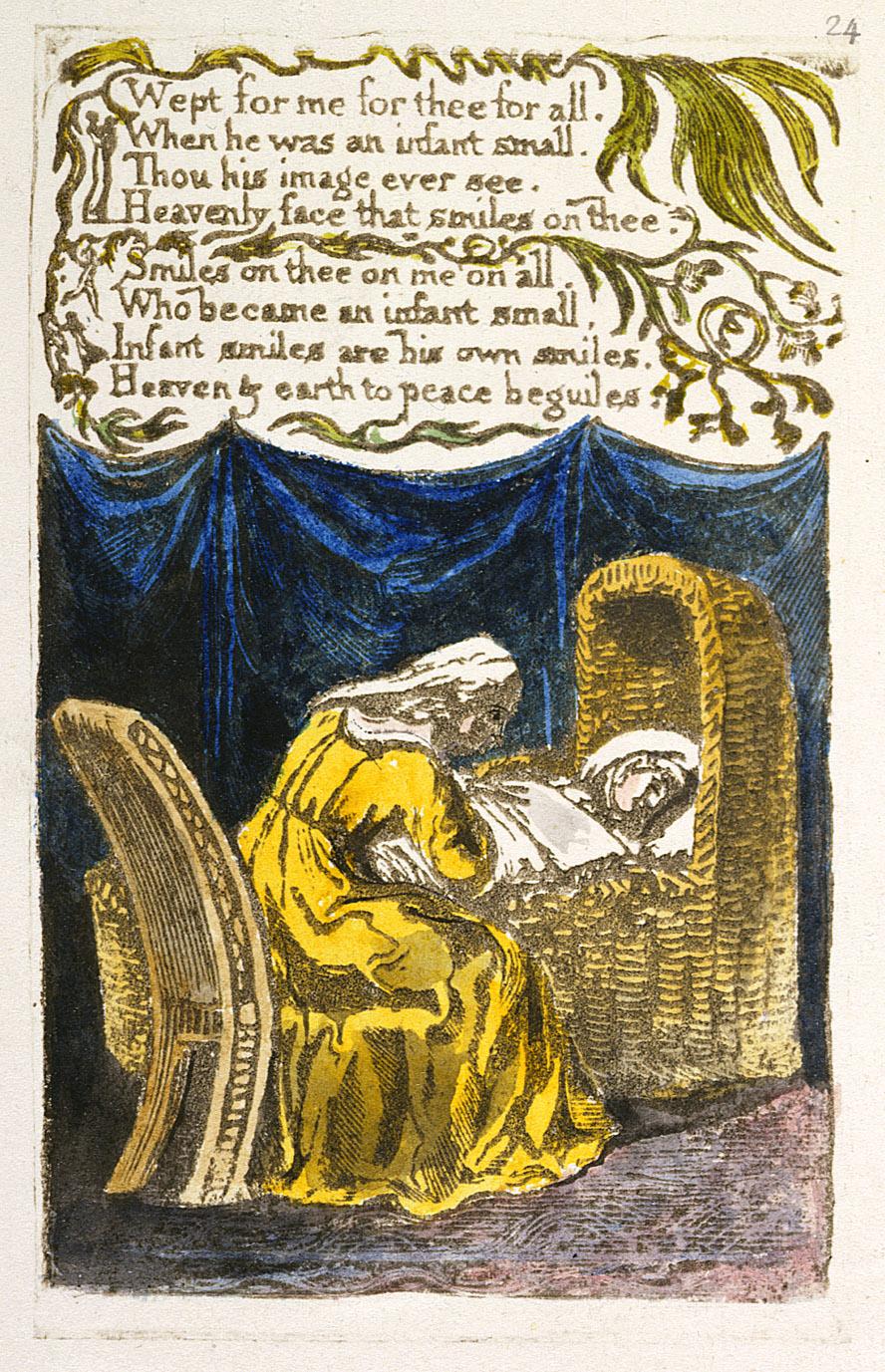
This is an image from William Blake’s Songs of Innocence and of Experience. The work was originally published in 1789. The publishing was done solely by Blake himself through a process he invented in 1788, illuminated printing. Illuminated printings was a lengthy process that printed both the text and image on the same copper plate, a very revolutionary concept for the time. After Blake had settled on his final drafts on both image and poem, the text and image were written out in reverse in stop-out varnish. Stop out varnish is an acid-resistant varnish that was applied to a copper plate. The plates were then etched in two stages because of the delicate nature of the letters and images. In the middle of etching, Blake would stop at least once to wash and dry the plates and then apply the varnish. When the etching was finished, the inks would be mixed from dry pigments and then put on the plates with a leather dauber. After the printing process was over the prints would be colored by hand. Only a small number of works Blake published with illuminated printing, like Songs of Innocence, were created and were then sold privately to friends and collectors.
Curators of the British Library. “William Blake's Songs of Innocence and Experience.” The British Library, The British Library, 6 Feb. 2014, www.bl.uk/collection-items/william-blakes-songs-of-innocence-and-experi….
The Editors of Encyclopedia of Britannica. “Songs of Innocence and of Experience.” Encyclopædia Britannica, Encyclopædia Britannica, Inc., 11 Oct. 2011, www.britannica.com/topic/Songs-of-Innocence.
Phillips, Michael. “‘Printing in the Infernal Method’: William Blake's Method of ‘Illum...” Interfaces. Image Texte Language, Université De Paris, Université De Bourgogne, College of the Holy Cross, 1 July 2018, journals.openedition.org/interfaces/489.