
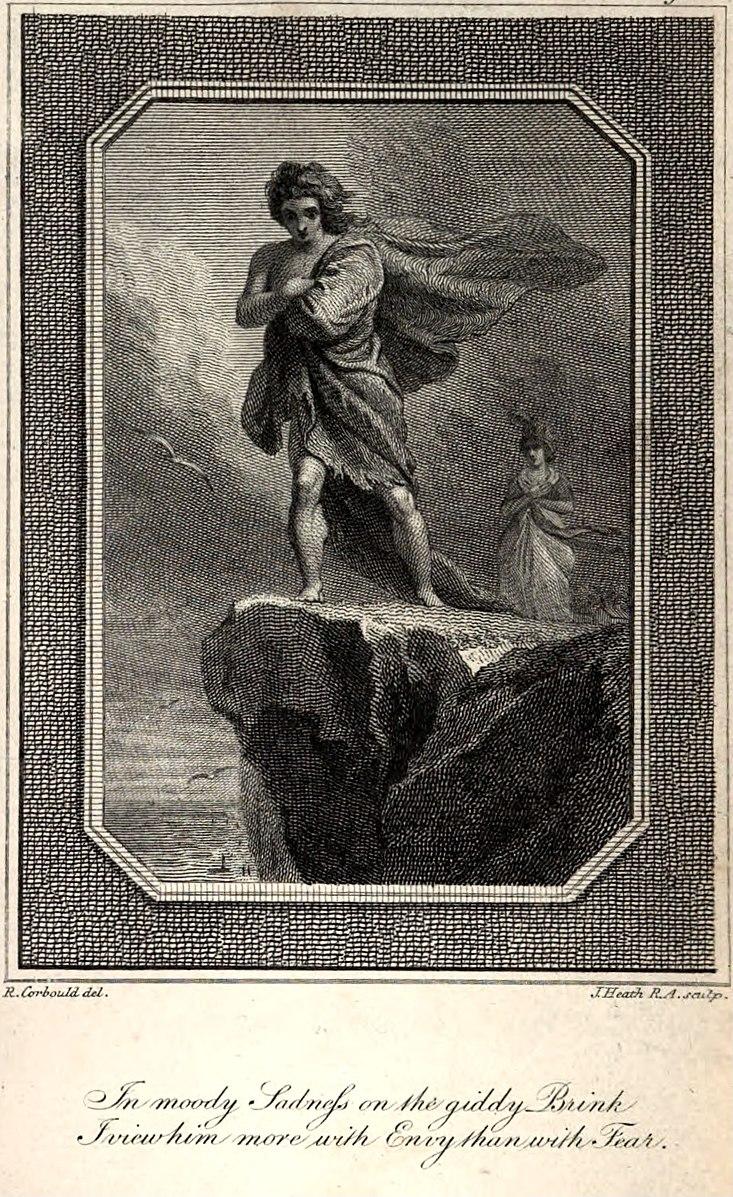
Charlotte Smith was born in 1749, and at the age of 15 was married off to Benjamin Smith. Benjamin Smith was a wealthy but irresponsible man who was, “imprisoned for debt and then ran off to France to avoid his creditors, insisting that Charlotte follow him with their nine children” (Poetry Archive). Charlotte Smith ended up leaving her husband and taking her nine children with her. In her lifetime, she produced 63 volumes, which included her Elegiac Sonnets which were written in 1783 to feed her family. The Elegiac Sonnets containing elements of the gothic included the sonnet ‘On Being Cautioned against Walking on a Headland Overlooking the Sea, Because It Was Frequented by a Lunatic,‘ which produces the image of a lady seeing a lunatic on the edge of the cliff.
In the first stanza, like the apparitions that the children hear about in stories from Anna Laetitia Larkin Barbauld's “On the Pleasure Derived from Objects of Terror”, the lunatic acts as the apparition to the speaker. The first stanza is the speaker trying to figure out if the man on the cliff is real. The speaker first mentions the man saying, "Is there a solitary wretch who hies To the tall cliff, with starting pace or slow, It is also in the first stanza where the speaker portrays the wretch, as it describes it as one who “And, measuring, views with wild and hollow eyes, Its distance from the waves that chide below.” It is here that we can get a sense of the wretch and what he is like. The wild and hollow eyes actions create a sense of an object of fear which Barbauld describes as, "all the most terrible disasters attending human life" (Barbauld). The way the wretch is acting, fills that idea of the object of fear, as the wretch is measuring the distance to the waves below. A sure demise if the wretch were to jump and the way the wretch is described as one with "wild and hallow eyes", creates that sense of fear in the speaker's eyes.
The second stanza further develops the wretch, and it becomes more apparent the speaker's curiosity about him. Barbauld in “On the Pleasure Derived from Objects of Terror,” speaks of curiosity saying, “The pain of suspense, and the irresistible desire of satisfying curiosity, when once raised, for our eagerness to go quite through an adventure, though we suffer actual pain during the whole course of it” (Barbauld), and there are two moments of curiosity in the second stanza. The first instance of curiosity is the mention of the wretch’s bed. “Who, as the sea-born gale with frequent sighs, Chills his cold bed upon the mountain turf” (Interesting Literature). This is the speaker’s curiosity about the wretch, and whether or not he wanders the cliff all day and stays away from the place he is supposed to be in. The second curiosity is about the wretch’s state of mind. The speaker writes, “With hoarse, half-uttered lamentation, lies Murmuring responses to the dashing surf?” (Interesting Literature). The question mark gives the whole stanza the questioning of the state of the wretch, and here the speaker mentions the wretch talking to the waves, and the speaker becomes aware of the state of the wretches mind, in which acknowledging the title, the wretch is the lunatic. Curiosity is an important part of the gothic genre, as it is the curiosity that draws the viewer into something that is frightening, and we see the curiosity that lies within the speaker about the lunatic on the edge of the cliff.
The third stanza and the last two lines are where we come to understand that the speaker does not fear the lunatic, but envies its freedom. In Barbauld's “On the Pleasure Derived from Objects of Terror,” she mentions, “The painful sensation immediately arising from a scene of misery, is so much softened and alleviated by the reflex sense of self-approbation on attending virtuous sympathy, that we find, on the whole, a very exquisite and refined pleasure remaining, which makes us desirous of again being witnesses to such scenes, instead of flying from them with disgust and horror" (Barbauld). We see this play out at the end of the sonnet, as the speaker's curiosity does come from the so-called misery of the lunatic. The speaker says, “I see him more with envy than with fear; He has no nice felicities that shrink From giant horrors; wildly wandering here, He seems (uncursed with reason) not to know "The depth or the duration of his woe” (Interesting Literature). The speaker envies the freedom that the lunatic in her eyes has because of his condition. His condition allows it to wander uncursed because he does not know how it affects him. It is his condition that allows him to stand at the edge of the cliff and speak to the waves, wander through life where he so pleases, and not be afraid. Barbauld’s quote talks about virtuous sympathy that comes from scenes of misery and how there is a refined pleasure in it. The speaker is feeling that virtuous sympathy and finds pleasure in the wretch, as the speaker envies the lunatic and the freedom he holds. ‘On Being Cautioned against Walking on a Headland Overlooking the Sea, Because It Was Frequented by a Lunatic,‘ is a sonnet that produces a strong image of the gothic genre, as it produces an example of exploring the curiosity that lies within something terrifying. It is within this sonnet that the speaker finds pleasure in the circumstance of the lunatic, which produces pleasure within the text.
Text Source:
Barbauld, Anna. "On the Pleasure Derived from Objects of Terror." 1773.
“'Sonnet on Being Cautioned against Walking on a Headland': A Poem by Charlotte Smith.” Interesting Literature, 26 Jan. 2019.
“Charlotte Smith.” Poetry Archive, 26 Jan. 2020.
Image Source:
https://commons.wikimedia.org/wiki/File:On_Being_Cautioned_Against_Walk…
